
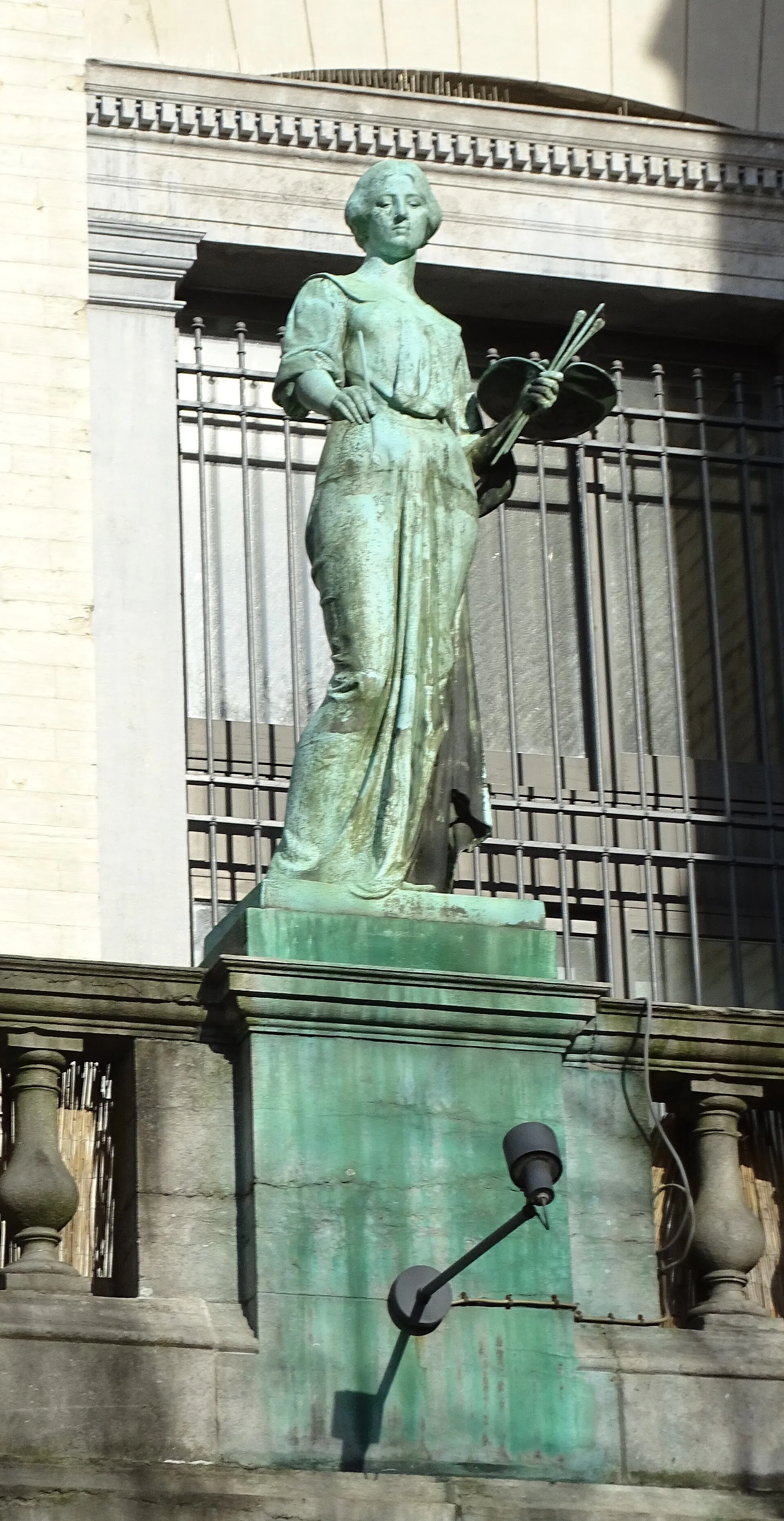
Collection Highlights
The Death of Marat (Jacques-Louis David, 1793)
The Oldmasters Museum's most politically charged canvas, painted by Jacques-Louis David in the weeks after the revolutionary Jean-Paul Marat was stabbed in his bath. David stripped away all narrative clutter to present Marat as a secular martyr, and the picture has stayed in Brussels since the painter's exile here after the fall of Napoleon. It is widely regarded as one of the founding images of political art.
The Fall of the Rebel Angels (Pieter Bruegel the Elder, 1562)
A signed and dated Bruegel that swarms with hybrid creatures cast out of heaven by the Archangel Michael, painted with a Boschian appetite for grotesque invention. The dense, almost hallucinatory composition is a cornerstone of the museum's unrivalled Bruegel holdings, which rival Vienna's.
The Census at Bethlehem (Pieter Bruegel the Elder, 1566)
Bruegel relocates the biblical nativity to a snowbound Flemish village, where Mary and Joseph vanish into a crowd of peasants going about ordinary winter chores. As with his Fall of Icarus, the sacred event unfolds almost unnoticed amid everyday life, a hallmark of Bruegel's quietly subversive storytelling.
The Justice of Emperor Otto III (Dieric Bouts, c. 1470s)
Two towering panels depicting a trial by ordeal, left unfinished at the painter's death and among the greatest surviving works of the Flemish Primitives. Bouts's cool precision, elongated figures, and early command of perspective make these a highlight of the museum's medieval galleries.
The Martyrdom of St Livinus (Peter Paul Rubens, c. 1633)
Baroque violence at full theatrical pitch, its muscular figures wrenched along a dramatic diagonal and lit like a stage. It typifies the museum's Rubens gallery, where oil sketches and finished altarpieces show how the master's Antwerp workshop turned out large-scale drama at speed.
Portrait of Antoine, Grand Batard de Bourgogne (Rogier van der Weyden)
A crisp, dignified portrait of a Burgundian nobleman wearing the collar of the Order of the Golden Fleece, showing the psychological restraint that made van der Weyden the most influential portraitist of the 15th-century Low Countries. It anchors the Flemish Primitives rooms alongside Memling and Petrus Christus.
Scandalized Masks (James Ensor, 1883)
Two masked figures confront each other in a bare, lamplit room in one of Ensor's earliest and most unsettling masterpieces. It marks the moment the Ostend painter turned toward the carnival masks and skeletons that would make him a forerunner of Expressionism, and Brussels holds one of the world's richest Ensor collections.
Trains and Sleepwalkers (Paul Delvaux)
Delvaux's dreamlike tableaux pair somnambulant nudes with classical architecture and the Belgian railway stations of his childhood, producing scenes that feel simultaneously erotic and coldly still. His canvases in the modern galleries extend the Belgian surrealist thread that runs from Ensor through Magritte.
Collections Highlights
The complex is best understood as six museums under one roof, each a distinct destination:
- Oldmasters Museum — the largest wing, descending from Rubens and Jordaens through the Bruegel room (a rare concentration of works by Pieter Bruegel the Elder) to the luminous Flemish Primitives galleries of Rogier van der Weyden, Hans Memling, Dieric Bouts, and Petrus Christus. Long attributed to Bruegel, "Landscape with the Fall of Icarus" — the best-known version of the composition — hangs here, its drowning figure barely visible while a plowman works on, unmoved.
- Fin-de-Siecle Museum — opened in 2013, it reconstructs the Brussels of 1868-1914, when the city was a European laboratory for Symbolism, Art Nouveau, and avant-garde music and literature. James Ensor anchors the wing; note that his most notorious canvas, "Christ's Entry into Brussels in 1889," is not here but at the Getty in Los Angeles, so the museum instead shows earlier Ensor masterworks such as "Scandalized Masks" (1883).
- Modern Museum — Bastin's underground galleries trace Belgian art after 1900, from Rik Wouters' Fauvist color to Paul Delvaux's and Rene Magritte's surrealism.
- Magritte Museum — five reverse-chronological floors of the world's largest Magritte collection, best treated as its own two-hour visit.
- Wiertz and Meunier Museums — two free satellite house-museums, a short walk away, preserving Antoine Wiertz's theatrical canvases and Constantin Meunier's dignified bronzes of miners and dockers.
Guided Tours
Specialist guides at the Royal Museums navigate the complex's six interconnected institutions, crafting itineraries that match visitor interests — from a concentrated Bruegel-and-Rubens Oldmasters tour to a comprehensive survey connecting Flemish Primitives through Symbolism to Surrealism. Art historians decode Bruegel's hidden social commentary (why is Icarus drowning unnoticed while peasants plow?), explain how Rubens' workshop system produced hundreds of paintings, unpack the political charge of David's "The Death of Marat," and trace the philosophical evolution from Ensor's masked grotesques to Magritte's painted paradoxes.
A guide is most valuable for sequencing: the complex is genuinely disorienting, with the Modern wing descending underground and the Magritte and Fin-de-Siecle wings branching off the central hall. Combining the Royal Museums with Grand Place and Manneken Pis creates a full-day circuit through Brussels' cultural and architectural highlights, descending from the Coudenberg hilltop museums to the medieval city center below. For a modern counterpoint, guides often pair the visit with the Atomium on the northern plateau.
Royal Museums of Fine Arts of Belgium timeline
-
Founded under Napoleonic decree
A consular decree established a fine-arts museum in Brussels, seeding the collection that would grow into today's six-museum complex.
-
Oldmasters palace inaugurated
The monumental neoclassical building on Rue de la Regence, designed by architect Alphonse Balat, opened to display the Flemish and old-master holdings.
-
Modern wing descends underground
Roger Bastin's extension buried eight naturally lit gallery floors beneath Place Royale to house 19th- and 20th-century art.
-
Magritte Museum opens
Over 200 works by Rene Magritte were gathered into a dedicated museum inside the complex, the largest such collection in the world.
-
Fin-de-Siecle Museum opens
A new wing reframed the 1868-1914 explosion of Symbolism, Art Nouveau, and early modernism around James Ensor and his contemporaries.
When to Visit
Tuesday-Friday: 10 AM - 5 PM. Saturday-Sunday: 11 AM - 6 PM. Closed: Mondays and some public holidays (Jan 1, May 1, Nov 1, Dec 25). Best: Tuesday-Thursday mornings (10-11 AM) or late afternoons (3-5 PM) when school groups and tour buses are absent. The Fin-de-Siecle and Modern wings close their doors slightly before the headline time, so start deep and work back toward the entrance. Duration: Minimum 3 hours for highlights; a full day for a comprehensive visit across all six museums.
Admission and Costs
Combined ticket (all museums): €15 adults, €13 seniors, free under 18. Magritte Museum only: €10 adults. First Wednesday afternoon: Free entry 13:00-17:00 (extremely crowded). The Wiertz and Meunier house-museums are permanently free. Guided museum tour: €60-90 for a 2-hour specialist tour (on top of entry). Audio guide: €4 (worthwhile for the Magritte Museum). Holders of the Brussels Card enter without an additional ticket, which pays off if you are also visiting the Atomium or other city museums.
The Case for a Guide
Left to navigate alone, most visitors treat the Royal Museums as a checklist — find the Bruegels, glance at a Magritte, leave exhausted after two hours of wrong turns. A specialist guide changes the visit in three concrete ways:
- They impose a route. With 20,000 works across six museums and eight underground floors, an unguided visit is mostly navigation. A guide plots the shortest path between the pieces that matter to you.
- They supply the context that turns pictures into stories — why David painted his assassinated friend as a martyr, how Bruegel smuggled social criticism into peasant scenes, and why fin-de-siecle Brussels became a crucible for Art Nouveau and Symbolism.
- They connect the collection to the city outside. The best guides fold the museums into a wider Brussels day, linking the Magritte Museum's surrealism to the medieval Grand Place a few minutes downhill.
Expect €60-90 for a two-hour specialist tour on top of admission — worthwhile for first-time visitors or anyone with a specific interest in the Flemish masters.
Tips for Visitors
- Prioritize ruthlessly. With limited time, focus on the Oldmasters (Bruegel, Rubens, and David's "The Death of Marat") and the Magritte Museum. The Fin-de-Siecle deserves a full afternoon if Art Nouveau interests you.
- Avoid the free-afternoon crush. The first Wednesday free entry (13:00-17:00) attracts massive crowds; paying €15 buys a far quieter experience another day.
- Pace the Magritte. 200+ Magrittes across five floors can overwhelm — break it into two visits or focus on floors 3-4 (his mature work).
- Mind the underground galleries. The Modern wing descends eight floors underground — architecturally impressive but easy to lose your bearings in. Bastin's daylight wells light it from above, so it never feels windowless, but the deep, spiraling descent can still disorient; pause at each level to re-orient.
- Chain nearby sights. The museums sit at the base of the Coudenberg hill: walk up to Place Royale, see the Palais Royal exterior, and continue down to Grand Place (10 minutes downhill) and Manneken Pis.
- Skip the museum cafe. It is adequate but uninspired; the nearby Sablon district (5-minute walk) has superior brasseries.
- Photography. Allowed without flash in the permanent collections; temporary exhibitions may prohibit photos.
Frequently Asked Questions
When is Belgium's Royal Museums of Fine Arts open and least crowded?
Tuesday-Friday: 10 AM - 5 PM. Saturday-Sunday: 11 AM - 6 PM. Closed: Mondays and some public holidays (Jan 1, May 1, Nov 1, Dec 25). Best: Tuesday-Thursday mornings (10-11 AM) or late afternoons (3-5 PM) when school groups and tour buses are absent.
What does admission to Royal Museums of Fine Arts of Belgium cost?
Combined ticket (all museums): €15 adults, €13 seniors, free under 18. Magritte Museum only: €10 adults. First Wednesday afternoon: Free entry 13:00-17:00 (extremely crowded). Guided museum tour: €60-90 for 2-hour specialist tour (on top of entry).
How should visitors split time across the six Royal Museums?
Prioritize: If time is limited, focus on Oldmasters (Bruegel, Rubens) and Magritte Museum. The Fin-de-Siecle deserves a full afternoon if Art Nouveau interests you. Free afternoon crowds: The first Wednesday free entry attracts massive crowds.
Which paintings are the must-sees at the Royal Museums of Fine Arts?
Five works anchor most visits: Jacques-Louis David's The Death of Marat (1793), Pieter Bruegel the Elder's The Fall of the Rebel Angels (1562) and The Census at Bethlehem (1566), Dieric Bouts's twin Justice of Emperor Otto III panels, and Rubens' The Martyrdom of St Livinus. Reserve extra time for the world's largest Magritte collection in the linked Magritte Museum.
Is the Magritte Museum included in the Royal Museums ticket?
Yes. The €15 combined ticket covers all six museums in the complex, including the Magritte Museum. If you only want to see Magritte, a standalone €10 ticket is cheaper, but the combined ticket is better value once you add the Oldmasters or Fin-de-Siecle wings.
How do you get to the Royal Museums of Fine Arts in Brussels?
The museums sit on Rue de la Regence at Place Royale, a 10-minute uphill walk from Grand Place. The nearest metro stops are Gare Centrale/Centraal Station and Parc/Park on lines 1 and 5; trams 92 and 93 stop at Place Royale directly outside. From Bruxelles-Central rail station it is a five-minute walk uphill through the Coudenberg district.