
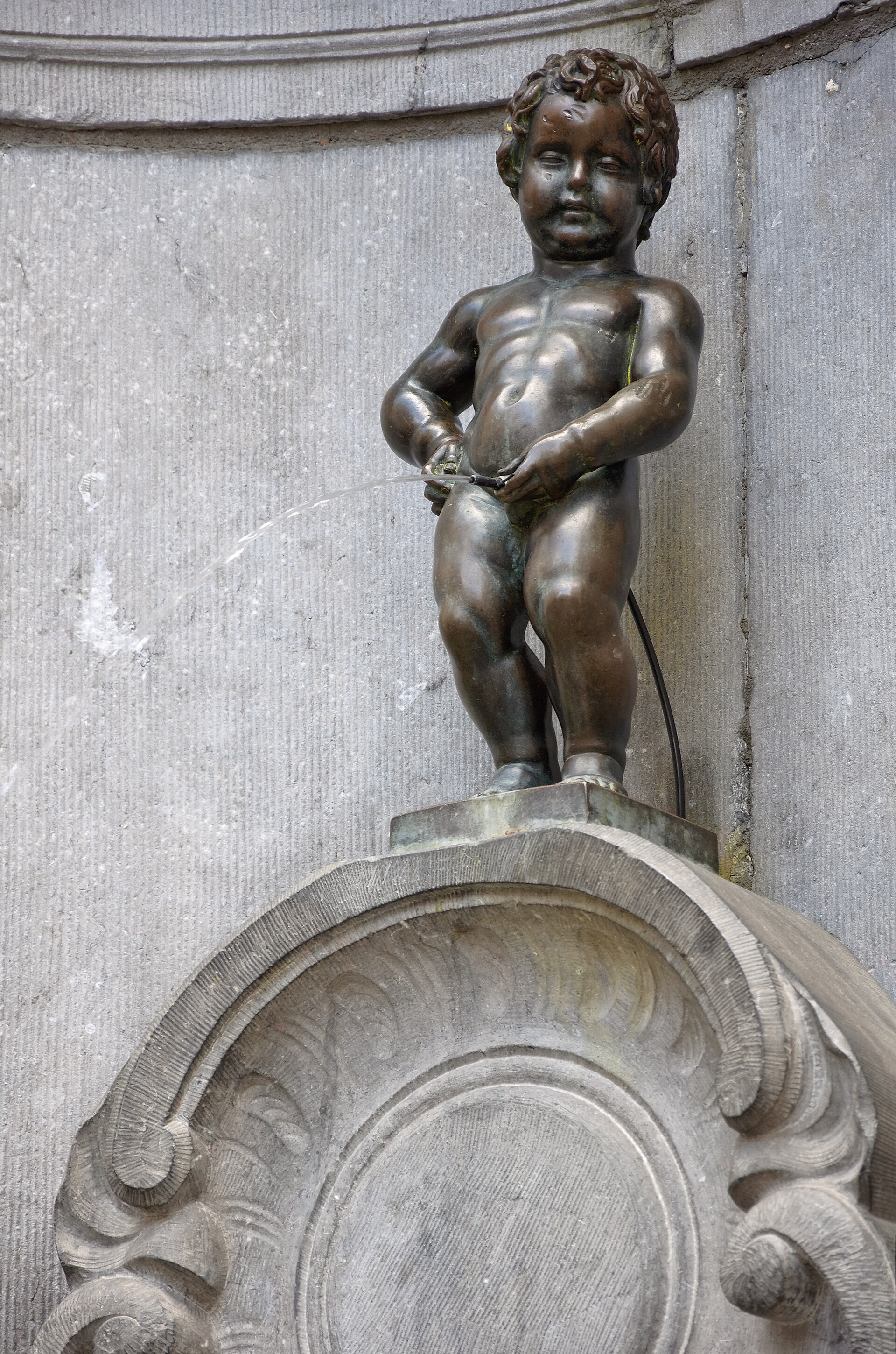

Overview
Manneken Pis (literally "Little Man Pee" in Brussels dialect) is Brussels' most irreverent symbol — a bronze fountain statue of a naked boy urinating into a basin, standing just 61 centimeters tall at a street corner three minutes' walk from Grand Place. The current statue dates to 1619 (carved by Jerome Duquesnoy the Elder), though the fountain itself existed earlier. What makes Manneken Pis distinctly Belgian is the gap between his fame and his scale: international visitors arrive expecting a grand monument and find a tiny figure almost lost amid selfie-stick-wielding tourists. Yet Brussels embraces this absurdity wholeheartedly, dressing the statue in elaborate costumes for special occasions — over 1,000 outfits donated by visiting dignitaries, corporations, and cultural groups, ranging from Elvis jumpsuits to samurai armor to a Mozart costume gifted by Austria. The statue's origin stories are appropriately legendary and contradictory: one tale claims a medieval duke's son urinated on enemy troops, securing victory; another says a boy's urine extinguished a fuse that would have destroyed the city; a third simply suggests a practical fountain serving a busy intersection. The statue has been stolen multiple times (the 1817 theft required recasting from molds), and visiting heads of state traditionally donate costumes that the city rotates through. You can view the full wardrobe collection at the Brussels City Museum on Grand Place. A guide explaining Brussels' tradition of self-deprecating humor and the statue's role in Belgian identity transforms a potentially disappointing tourist trap into a genuinely amusing insight into local character.
Architecture
Costume days: When dressed, Manneken Pis wears surprisingly elaborate outfits — a detailed Mozart period costume, full samurai armor, or Elvis's white jumpsuit. Check the schedule; costumed days offer better photo opportunities and local crowds. Costume Museum: The Brussels City Museum on Grand Place displays hundreds of Manneken Pis outfits including gifts from visiting dignitaries. Reveals the absurd earnestness with which Brussels treats its urinating boy. Photo strategies: The narrow street makes wide-angle shots impossible at close range. Step back 10-15 meters for context including the ornate niche housing the fountain, or embrace close-ups of just the statue. Chocolate shop circuit: The lanes around Manneken Pis contain some of Brussels' best chocolatiers — Planete Chocolat, Mary, and others. Siblings: Brussels has Jeanneke Pis (girl version, installed 1985 as feminist commentary) and Zinneke Pis (dog version, 1998). Collecting all three is a local scavenger hunt challenge.
Historical Significance
The original Manneken Pis fountain predates the current 1619 bronze statue, with documentary references to a stone version appearing as early as the 14th century — making this one of Brussels' oldest surviving public monuments. The statue's repeated thefts constitute a catalogue of European political turbulence: French soldiers carried it off during the 1745 War of Austrian Succession, English troops took it in 1745, and the 1817 theft by a former convict prompted the city to commission the current replacement cast from molds of the original. Louis XV of France, embarrassed by his soldiers' theft, returned the statue dressed in a brocade suit — inaugurating the costume tradition that has since accumulated over 1,000 outfits. The statue embodies Brussels' zwanze (local dialect for irreverent humor): a city that chose a urinating toddler as its civic symbol, dresses him in diplomatic gifts from heads of state, and celebrates the absurdity with genuine civic pride. This self-deprecating wit distinguishes Belgian identity from the grandeur of neighboring France and the orderliness of the Netherlands.
When to Visit
Access: Always accessible — it's a street fountain. Costume changes: Check the City of Brussels website for schedule — typically 100+ dressing days per year for holidays, commemorations, and visiting delegations. Best: Early morning (7-8 AM) or late evening (after 9 PM) to avoid crowds; or during costume days to see him dressed. Avoid: Midday in summer when the narrow surrounding streets clog with tour groups. Duration: 2-5 minutes to photograph (honestly); combine with Grand Place and chocolate shop circuit.
Admission and Costs
Viewing: Free — it's a public fountain. Costume museum (Brussels City Museum): €10 adults to see the 1,000+ outfit collection displayed at Grand Place. Walking tours including Manneken Pis: €15-25 for group tours; €150-200 for private tours explaining Brussels' humor tradition. Surrounding chocolate shops: Budget €10-30 for pralines from nearby artisan chocolatiers.
Tips for Visitors
Manage expectations: He's 61 cm (24 inches) tall. Many visitors express disappointment at the scale. Embrace the absurdity — that's the point. Skip the tourist trap restaurants: The immediate vicinity has overpriced mediocrity aimed at confused tourists. Walk three minutes toward Grand Place or deeper into the Ilot Sacre for better food. Costume calendar: Visit the City of Brussels website (visit.brussels) for the annual dressing schedule. Costume days attract locals and offer more festive atmosphere. Combine intelligently: Manneken Pis is a waypoint, not a destination. Route it between Grand Place and the Sablon district, stopping for chocolate at serious shops (not the tourist traps with piles of candy). Historical context: A guide who explains Belgian self-deprecating humor makes this infinitely more interesting than just photographing a small statue. Night visit: After dark, the fountain is lit, crowds thin, and you can actually see the statue without elbowing through tour groups.