
_30.05.2015.JPG)
Overview
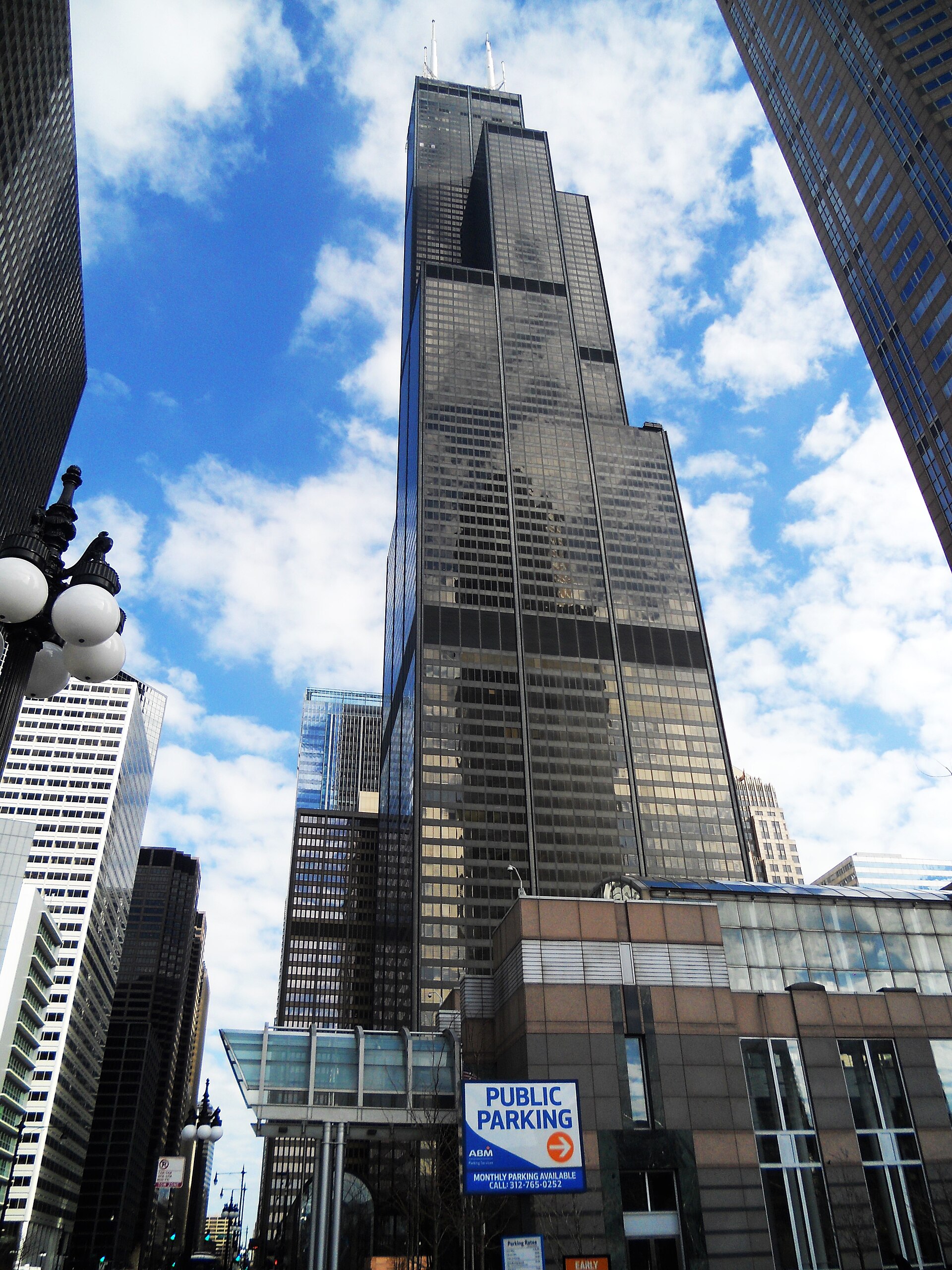
Willis Tower -- still called the Sears Tower by every Chicagoan who lived through the renaming controversy in 2009 -- dominated the world's skyline from its completion in 1973 until 1998, holding the title of tallest building on Earth for 25 consecutive years. Designed by architect Bruce Graham and structural engineer Fazlur Rahman Khan of Skidmore, Owings & Merrill, the tower introduced the bundled-tube structural system: nine square tubes of varying height bundled together, each tube reinforcing its neighbours against wind loads. This innovation allowed the building to reach 1,451 feet (including antennas) using less steel per square foot than a conventional skyscraper, fundamentally changing how engineers thought about supertall construction.
The tower rises from the corner of Wacker Drive and Franklin Street in Chicago's Loop, its black aluminum and bronze-tinted glass facade stepping back at the 50th, 66th, and 90th floors as tubes terminate, creating the distinctive tiered profile visible from every direction. The Skydeck on the 103rd floor has drawn over 40 million visitors since opening in 1974. On clear days, the view extends across Lake Michigan into four states: Illinois, Indiana, Wisconsin, and Michigan. In 2009, the Skydeck added the Ledge, a set of retractable glass boxes that extend 4.3 feet out from the building's west face, their glass floors placing visitors 1,353 feet directly above Wacker Drive with nothing visible beneath their feet but the street grid far below. The ride up takes approximately 60 seconds in elevators traveling at 1,600 feet per minute. Interactive exhibits on the Skydeck identify landmarks in every direction, and the pre-show experience walks visitors through the history of the building and the engineering breakthroughs that made it possible. Willis Tower remains the second-tallest building in the Western Hemisphere (behind One World Trade Center) and the third-tallest in the Americas. It stands within walking distance of the Art Institute of Chicago and Millennium Park, making it a natural starting point for a day exploring Chicago from the sky down.
Observation Points
The Ledge: Four glass boxes extending 4.3 feet from the building's west face with transparent floors -- standing on them places you 1,353 feet directly above Wacker Drive with nothing between you and the street below. Lake Michigan panorama: The eastern windows reveal the full arc of Chicago's lakefront, from the South Side steel mills to Navy Pier to the Gold Coast beaches stretching north toward Evanston.
Sunset transformation: If your ticket spans the golden hour, watch the city's steel-and-glass grid catch fire in amber light before dissolving into a constellation of artificial stars. Interactive skyline finder: Touchscreen exhibits on the observation deck identify buildings, neighbourhoods, and landmarks in every direction, with historical photos showing how the view has changed over decades. Engineering exhibit: The pre-show area includes displays about the bundled-tube innovation, the construction process, and the maintenance challenges of keeping a 110-story building operational for over 50 years. Four-state view: On exceptionally clear days (typically autumn and winter), you can see across Lake Michigan into Indiana and Michigan, and northwest into Wisconsin -- a 50-mile radius from one vantage point.
Engineering Facts
Structural engineer Fazlur Rahman Khan invented the bundled-tube system specifically for this building, and that innovation ranks among the most significant architectural breakthroughs of the 20th century. Nine square tubes of varying height bundled together, each reinforcing its neighbours against wind loads, allowed the tower to reach 1,451 feet using less steel per square foot than a conventional skyscraper. The influence of this system can be traced through every supertall building constructed since 1973, from the Petronas Towers to the Burj Khalifa.
From the 103rd-floor Skydeck, hundreds of buildings, bridges, parks, and waterways spread across four states. Guides provide what might be called skyline literacy, identifying every major structure while explaining the architectural ambitions and rivalries that shaped Chicago's skyline. They decode the city's perfect grid system from above, trace the three branches of the Chicago River, point out the railroad corridors that made the city a transportation hub, and explain why the lakefront parks exist at all. The glass Ledge extending 4.3 feet over Wacker Drive presents both a thrill and a photography challenge. The building was constructed by 2,400 workers in just three years.
When to Visit
Hours: Open daily 9 AM to 10 PM (last entry 9:15 PM); hours may be extended in peak summer season. Best for clear views: Weekday mornings in autumn offer the clearest skies and shortest lines; visibility can reach 50 miles on crisp October days.
Sunset visits: Book a timed ticket for 60-90 minutes before sunset to watch the city transition from daylight to the glittering grid of lights below -- the most dramatic experience available. Avoid: Weekend afternoons in summer, when wait times for the Ledge can exceed 30 minutes even with timed-entry tickets. Weather warning: The Skydeck closes during severe weather events, and heavy overcast can reduce visibility to near zero at 1,353 feet. Check conditions before visiting on cloudy days.
Admission and Costs
Structural engineer Fazlur Rahman Khan invented the bundled-tube system specifically for this building, and that innovation ranks among the most significant architectural breakthroughs of the 20th century. Nine square tubes of varying height bundled together like a cluster of cigarettes, each reinforcing its neighbours against wind loads, allowed the tower to reach 1,451 feet using less steel per square foot than a conventional skyscraper. Guides explain not just how this system works but why it matters, tracing its influence through every supertall building constructed since 1973, from the Petronas Towers to the Burj Khalifa. The pre-show exhibits touch on this engineering, but a guide transforms technical achievement into compelling narrative.
From the 103rd-floor Skydeck, hundreds of buildings, bridges, parks, and waterways spread across four states, yet most visitors cannot name what they are seeing. Guides provide what might be called skyline literacy, identifying every major structure while explaining the architectural ambitions and rivalries that shaped Chicago's skyline. They decode the city's perfect grid system from above, trace the three branches of the Chicago River, point out the railroad corridors that made the city a transportation hub, and explain why the lakefront parks exist at all. Patterns invisible from street level suddenly become legible, and the view transforms from impressive to meaningful.
The glass Ledge extending 4.3 feet over Wacker Drive presents both a thrill and a photography challenge, and guides know exactly how to navigate both. They advise on the best times for clear views, coach visitors through techniques for clean photos on reflective glass, and share the story of how 2,400 workers built the tower in just three years. After descending, the Loop stretches east toward Millennium Park and the Art Institute, while the Magnificent Mile awaits across the river to the north. General admission: $28 adults, $20 children ages 3-11, free under 3. Fast Pass: $50 per person. CityPASS: included in the Chicago CityPASS ($98). Private guided experience: $300-500 for a small group with priority access.
Tips for Visitors
Arrive early or late: The first hour after opening (9-10 AM) and the last hour before close (9-10 PM) are the least crowded; midday waits are longest. Combine with the Loop: Willis Tower sits at the western edge of the Loop. After your visit, walk east on Adams Street to reach Millennium Park and the Art Institute in about 15 minutes.
Transit access: The Brown, Orange, Purple, and Pink Line trains stop at Quincy/Wells, a 3-minute walk from the tower entrance on Wacker Drive. No large bags: Backpacks and large bags must go through security screening; travel light for a faster entry process. Compare the view: Willis Tower offers a western and southern panorama that differs dramatically from 360 CHICAGO (Hancock Center) on the Magnificent Mile; serious skyline enthusiasts visit both. Ground-level architecture: The building's base contains a recently renovated public space called Catalog with restaurants, shops, and a 30,000-square-foot outdoor terrace on Wacker Drive worth exploring before or after your Skydeck visit.