
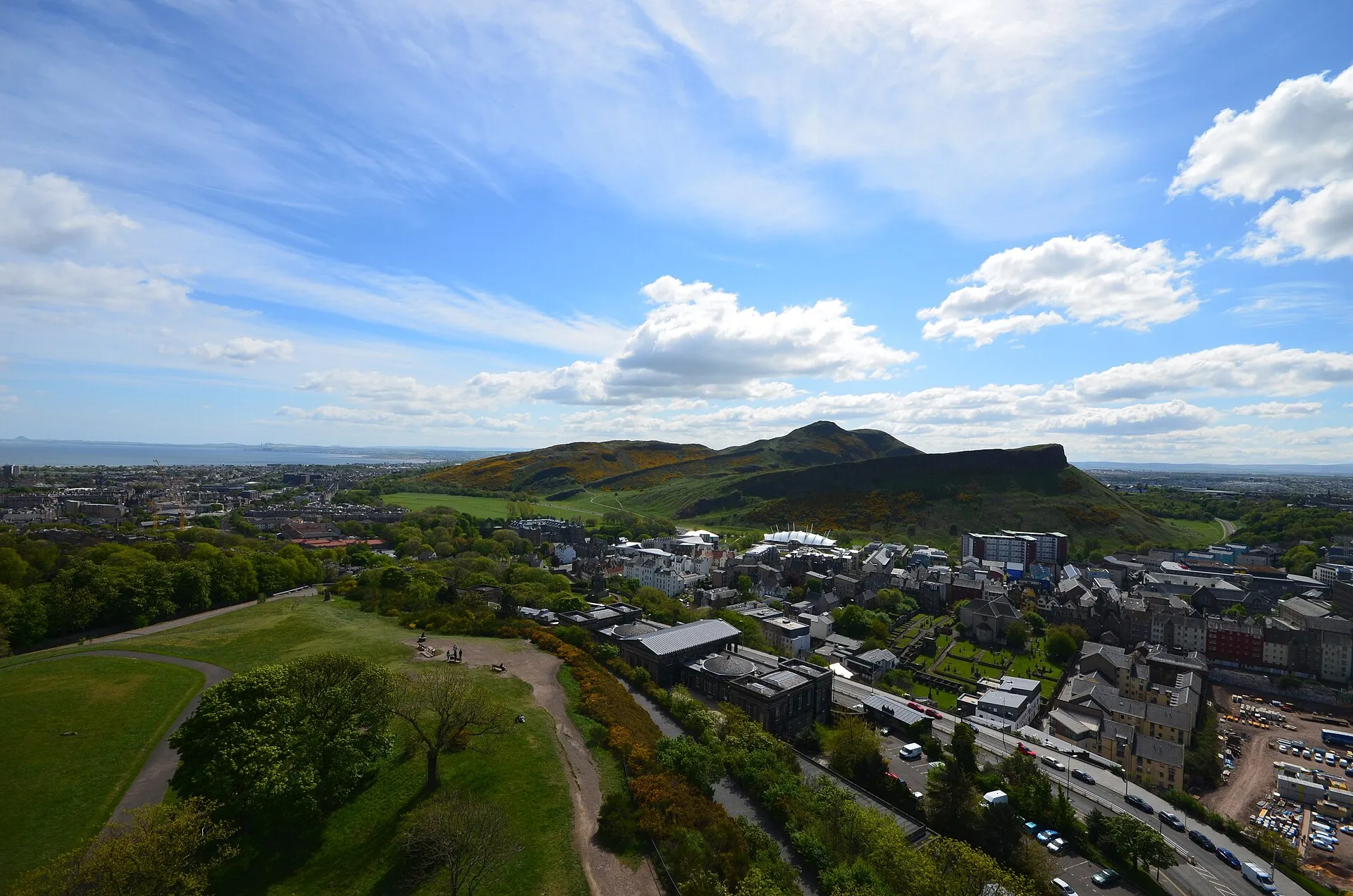
Observation Spots
Formation
Arthur's Seat is the eroded heart of a volcano that was active roughly 340 million years ago, in the Carboniferous period, when this part of Scotland sat near the equator amid shallow tropical seas. What you climb today is not the original cone but its hard interior — the vents, lava flows, and intrusions that survived after softer rock around them was worn away. The distinctive saddle shape comes from two former eruption centres, and Whinny Hill on the eastern flank preserves stacked lava flows tilted by the collapse of the volcano.
The most famous rock here is not the summit but the curving cliff of Salisbury Crags, a sill of hard dolerite that was forced between layers of sedimentary rock while still molten. In the 1780s the Edinburgh geologist James Hutton — often called the founder of modern geology — walked this escarpment and studied the junction now known as Hutton's Section, where the igneous rock clearly cuts across and bakes the sediments beside it.
The result, therefore, of our present enquiry is, that we find no vestige of a beginning — no prospect of an end.
That reading of deep time, drawn in part from these very crags, overturned the idea of a young, unchanging Earth. Later the whole landscape was reshaped again during the last Ice Age: sheets of ice grinding from west to east plucked away the western face to leave the steep crags, while sparing a long tail of softer rock behind — the same crag-and-tail process that lifts Edinburgh Castle above the sloping Royal Mile.
Wildlife
For a hill inside a capital, Arthur's Seat shelters surprising wildlife, and much of Holyrood Park is protected as a Site of Special Scientific Interest for its grassland and geology. The rough slopes are cloaked in gorse (locally called whin), whose coconut-scented yellow flowers blaze through spring, alongside wildflower turf that supports skylarks, meadow pipits, and hunting kestrels overhead. Rabbits and the occasional fox move through the bracken, and the exposed crags are a favourite of ravens riding the updraughts.
The park's three lochs are the best places to pause and watch. St Margaret's Loch, below the ruined St Anthony's Chapel, is busy with mute swans, greylag geese, and gulls; Dunsapie Loch, high on the eastern shoulder, draws ducks and reflects the summit on still mornings; and Duddingston Loch at the south-eastern foot is a designated bird sanctuary fringed by the reedbeds of a nature reserve. Bring binoculars in autumn and winter, when migrating and wintering wildfowl gather on the water.
Trails
Choose a route for your fitness, the ground conditions and how you will reach its starting point. A shorter climb from an elevated loch can still mean a longer walk from the park entrance.
- The Holyrood route (most popular): Begin near the Palace of Holyroodhouse at the foot of the Royal Mile, climb past the ruins of St Anthony's Chapel above St Margaret's Loch, then follow the valley path to the final rocky pull. Allow 45 minutes to an hour up.
- The Dunsapie Loch route: From the loch on the eastern shoulder, allow roughly 30–40 minutes to the summit, with rough final rocks. This estimate excludes reaching the loch and descending. The current High Road motor closure means you should plan a walking approach rather than assume access to the elevated car park.
- The Salisbury Crags terrace: The upper path gives city views without climbing Arthur's Seat, but still has uneven ground and exposed edges. On the lower Radical Road, HES currently allows access to the southern section from the Hawse to South Quarry and Hutton's Section; the northern section remains closed and fenced off. Follow signs and barriers on the day.
- The Gutted Haddie: A steep, eroded scramble straight up the western scree — direct but slippery, and best avoided in the wet or by anyone unsure on loose ground.
Stay on the marked paths. The hill suffers serious erosion, and shortcutting scars the slopes and dislodges rock onto walkers below.
Arthur's Seat timeline
- c. 340 million years ago
A volcano erupts
In the Carboniferous period a volcano built up here from lava flows and vents; long erosion later stripped it back to the hard volcanic core that forms the hill today.
- c. 15,000 years ago
Ice sheets carve the crags
Glaciers grinding west to east plucked and steepened the western cliffs, shaping the crag-and-tail landforms that also carry the Old Town ridge toward Holyrood.
- Iron Age
Hillforts crown the slopes
Prehistoric people built forts and cut cultivation terraces across the hill; the earthwork remains near Dunsapie and Crow Hill are protected as a scheduled monument.
- 1770s-1780s
Hutton reads the rocks
James Hutton studied the igneous sill in Salisbury Crags, finding evidence that some rock forms from molten material — a cornerstone of modern geology.
-
The seventeen miniature coffins
Boys found seventeen tiny carved coffins hidden in a recess on the north-east slope; eight survive in the National Museum of Scotland and remain unexplained.
- 1840s-1850s
A royal park is landscaped
Under Prince Albert's direction the ground was drained and planted, and the artificial Dunsapie and St Margaret's Lochs were created as ornamental features.
-
The Radical Road closes
Rockfalls led to the closure of the path below Salisbury Crags. The northern section remains fenced off; current HES guidance allows access to the southern section and Hutton's Section.
When to Visit
Pedestrian access to the park is generally available around the clock, but individual paths and roads can close. Plan around light, weather and current access notices. Aim for early morning, when the summit is quiet and the low sun rakes across the Old Town, or late afternoon into sunset for golden light over the castle and Firth of Forth. In high summer the days are extraordinarily long this far north, with the sun setting after 10 PM in June, while midday in July and August brings the heaviest crowds and least shade.
Season shapes the experience as much as the clock. May and June offer the driest weather and flowering gorse; September brings crisp air and thinner crowds; and winter rewards early risers with dramatic light but demands care on icy, exposed rock. Edinburgh's weather turns fast in any month, so check the forecast, watch for sudden wind that funnels hard over the ridge, and turn back if cloud closes over the summit.
Admission and Costs
Arthur's Seat is one of the great free days out in the city — there is no entry fee to Holyrood Park or the hill.
- Entry: Free — open public parkland managed by Historic Environment Scotland.
- Parking: Broad Pavement near Holyrood Palace costs £1 (about US$1.35) per hour, 08:30–17:30 on chargeable weekdays, with weekends and the listed holidays exempt. Park roads close to vehicles during the day on both Saturday and Sunday; designated lower car parks normally retain access unless separately closed. The High Road is currently closed to motors, overriding Dunsapie's usual Tuesday–Thursday 09:30–15:00 vehicle window.
- Guided hike: Around £20-35 ($25-45) per person for a small-group walk sharing geology, history, and folklore; private guides cost more but tailor the route and pace.
- Equipment: No special gear or ticket required — sturdy shoes and a windproof layer are the only real costs.
The Case for a Guide
Arthur's Seat can be climbed alone in an hour, but almost everything that makes it remarkable is invisible without context — the 340-million-year-old volcano underfoot, the cliff that helped rewrite the age of the Earth, the vanished hillforts, and the unexplained coffins. A guide connects the geology, archaeology, and folklore into a single story and steers you to the routes and viewpoints that suit your group.
- Reading the volcano: A guide points out the tilted lava flows of Whinny Hill and the dolerite of Salisbury Crags, explaining how erosion and ice left today's shape.
- Hutton's revolution: A guide can explain the contact between molten and sedimentary rock at Hutton's Section. Use the southern access described in HES's current park guidance; hiring a guide does not permit entry beyond a closed barrier.
- Hidden history: From the ruined St Anthony's Chapel to the Iron Age forts and the miniature-coffins mystery, a guide finds the human traces most walkers miss.
- The right route and light: Local guides match the climb to your fitness and time it for sunrise or sunset, and know where the wind is least brutal.
Tips for Visitors
- Wear proper shoes: The terrain is rocky, uneven, and often muddy — trainers with grip or light hiking boots, never sandals.
- Dress for the wind: The summit is fully exposed and markedly colder and windier than the streets below; carry a windproof, waterproof layer even on bright days.
- Pick your route: Holyrood gives a direct walk from the city. A Dunsapie route needs extra approach time while the High Road is closed to motors; include that walk when choosing a loop and deciding how much daylight you need.
- Accessibility: All summit routes are steep, rough, and unsuitable for wheelchairs or buggies, though the lochside paths at St Margaret's and Dunsapie are far gentler for a shorter visit.
- Stay on the paths: Erosion is a real problem — keep to marked trails to protect the slopes and avoid loose rock.
- Getting there: Buses serve streets around Holyrood and Duddingston; continue into the park on foot. Dunsapie Loch is higher inside the park, not a bus stop. Check HES's road and car-park notices before relying on any vehicle route.
Frequently Asked Questions
What are the best times of day to visit Arthur's Seat?
Park: Open 24 hours year-round. Best: Early morning for sunrise or late afternoon for sunset. Summer: Very long daylight hours (sunset after 10 PM). Avoid: Midday in summer - hot and very crowded
What types of guided tour are available for Arthur's Seat?
Guided experiences range from group hill walks that share the geology and folklore on the way up, to private guides who tailor the pace and route. Group walks are the most affordable option, while private guides cost more but let you set the timing around sunrise, sunset, or a family's fitness.
What should visitors know before hiking Arthur's Seat?
Allow 1.5-2 hours: 45 minutes up, 30 minutes down, time at top. Wear proper shoes: Rocky, uneven terrain - trainers or hiking boots. Windy at summit: Bring windproof jacket, exposed on top.
How do you get to Arthur's Seat and where can you start the climb?
Walk to the Holyrood entrance at the foot of the Royal Mile, or use buses to the streets around the park and continue on foot. Do not plan on a bus or car dropping you at Dunsapie Loch: HES currently lists the High Road as closed to motor traffic. The usual vehicle-access window, when no overriding closure applies, is Tuesday–Thursday 09:30–15:00. Check the current HES road notice before travelling.
Is Arthur's Seat suitable for children and less experienced walkers?
Choose a route that suits the group's fitness and the weather. Allow roughly 30–40 minutes from Dunsapie Loch to the summit, plus the descent, stops and the walk needed to reach the loch; current road restrictions prevent treating it as a guaranteed drive-up start. The final rocks are steep and exposed. Keep young children close and turn back in high winds or slippery conditions.