

Overview
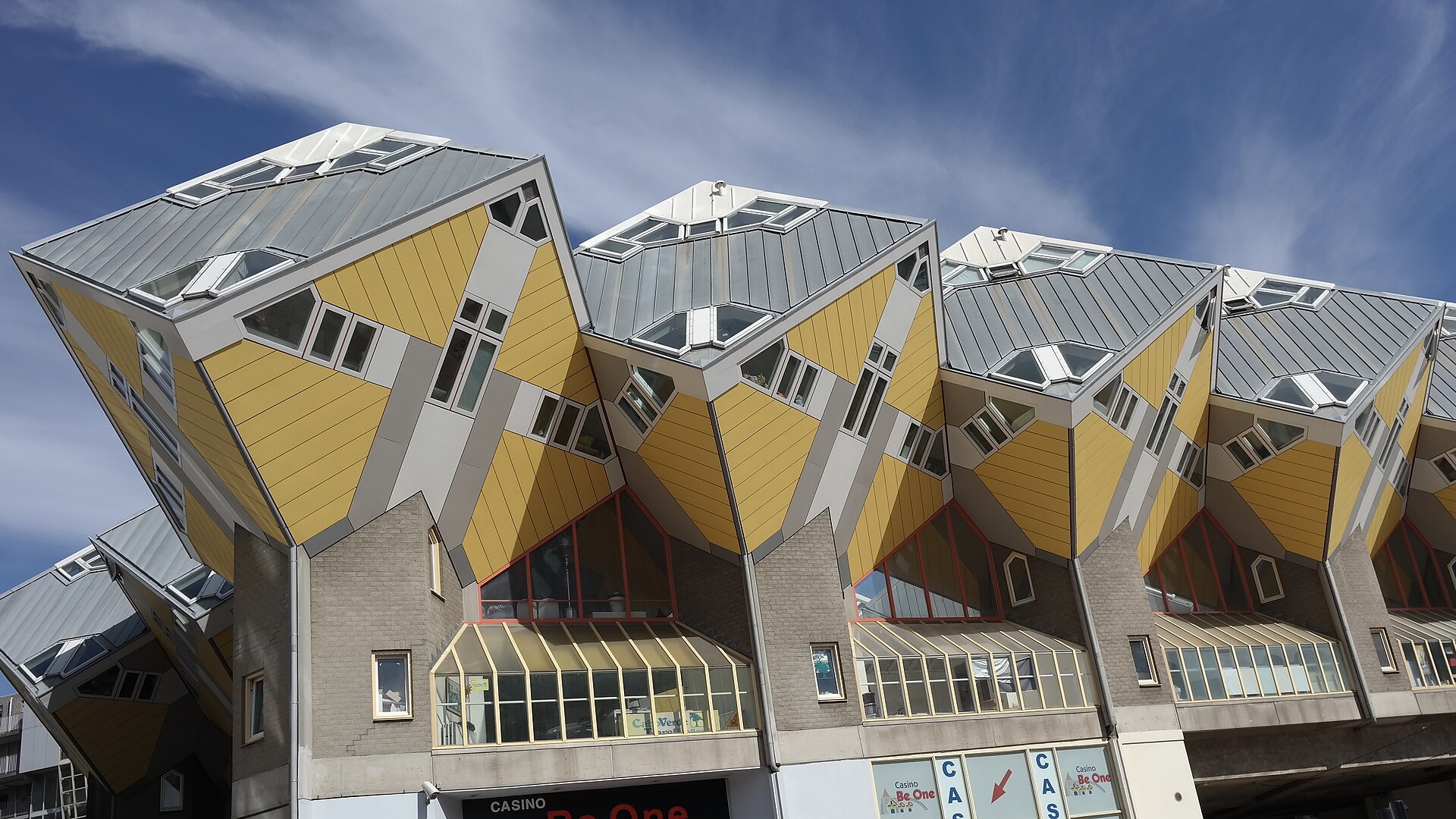
Architect Piet Blom conceived the Cube Houses (Kubuswoningen) as an "abstract forest" — each tilted cube representing a tree, and the entire complex forming a canopy over the pedestrian walkway below. Completed in 1984, the 38 cubes sit rotated 45 degrees atop hexagonal concrete pillars above the Blaak station area in Rotterdam. Each cube contains a three-story dwelling: the ground floor serves as a living room where all walls and windows lean at angles, the middle floor holds bedrooms and a bathroom, and the top floor — a pointed pyramid space with windows on all sides — functions as a study, extra bedroom, or miniature garden. The total living space is roughly 100 square meters, though the tilted geometry means about a quarter of each floor is practically unusable.
Blom's design provoked fierce debate when it was built. Critics called the cubes impractical gimmicks — furniture doesn't sit flat against angled walls, rain leaks are chronic, and heating an irregularly shaped space costs more than heating a conventional box. Residents counter that the unusual geometry creates distinctive, characterful homes and that the communal walkways between cubes foster neighborly interaction. One cube has been converted into the Kijk-Kubus show house, fully furnished to demonstrate how people actually live inside a tilted box. The complex sits directly beside the Markthal, creating a striking architectural pairing — one of Rotterdam's most photographed juxtapositions. A guide contextualizes Blom's work within Rotterdam's postwar willingness to experiment: a city with no historic center to preserve became a laboratory where architects could test ideas that would be rejected anywhere else.
Engineering Facts
Kijk-Kubus (Show Cube): The furnished show house reveals how residents adapt to tilted walls — custom-angled shelving, diagonal window views, and the pyramidal top floor that residents use as a sun-drenched reading nook. 45-Degree Geometry: Each cube is tilted exactly 45 degrees and rotated 45 degrees on its hexagonal pylon, creating the tree-like appearance Blom envisioned for his "forest." Elevated Walkways: The pedestrian passages beneath the cubes connect Blaak station to the Old Harbor, creating a covered public route that functions as a communal neighborhood between the private dwellings above. Hostel Experience: One cube operates as a hostel, giving budget travelers the chance to sleep at 45 degrees and understand first-hand why residents either love or endure the tilted geometry. Photography: The best exterior views come from the pedestrian bridge spanning Blaak, where the full cluster of yellow cubes frames against the sky with the Markthal arch behind.
When to Visit
Show Cube (Kijk-Kubus): Daily 10:00-17:00. Exterior viewing: Always accessible — the cubes sit over public walkways. Best: Morning light illuminates the yellow facades; visit by 11:00 before tour groups from Amsterdam arrive. Allow: 30-45 minutes for the show cube; longer if combined with adjacent Markthal.
Admission and Costs
Show Cube entry: €3 adults; €1.50 children. Exterior viewing: Free. Cube House hostel: One cube operates as a Stayokay hostel — book a night for the full experience (from €35/bed in a dorm). Architecture walking tour: €15-30 per person (typically includes Markthal, Central Library, and Blaak station area).
Tips for Visitors
Combine with Markthal: The Markthal is a 2-minute walk. Visit both in one outing and grab lunch at the market stalls afterward. Respect residents: Most cubes are private homes. Don't peer into windows, knock on doors, or climb on structures — the show cube exists specifically for visitor curiosity. Stay overnight: Booking a bed in the Stayokay hostel cube is the best way to understand the space. Waking up with morning light pouring through tilted windows is memorable. Architecture context: From the Cube Houses, walk to the nearby Central Library (a series of stacked, shifted blocks), Blaak station (flying saucer shape), and the Witte Huis (1898 Art Nouveau, Rotterdam's first "skyscraper") for a concentrated architecture tour. Rain photography: The yellow cubes look striking against grey skies and wet pavement. Rotterdam's frequent rain creates atmospheric conditions that actually improve the photographs.