
Visitor Etiquette
The Hassan Tower esplanade and the column field are open to all visitors without dress code restrictions, as the mosque itself was never completed and no active place of worship stands on the main platform. However, the Mausoleum of Mohammed V adjacent to the tower is a royal tomb and active religious site — different rules apply there. To enter the mausoleum: dress conservatively (shoulders and knees covered for both men and women; women should cover their hair as a mark of respect, though this is not always enforced for foreign visitors), speak quietly, and follow the clockwise circumambulation direction around the central sarcophagi. Photography inside the mausoleum is not permitted — the Royal Guards who stand watch will intervene if cameras are raised. Non-Muslim visitors are welcome inside the mausoleum. Do not touch the ornamental railings or lean over the interior balustrades. On the tower esplanade itself, photography is unrestricted and the atmosphere is relaxed; the changing of the guard at the mausoleum entrance is a formal ceremony observed from a respectful distance.
Spiritual Significance
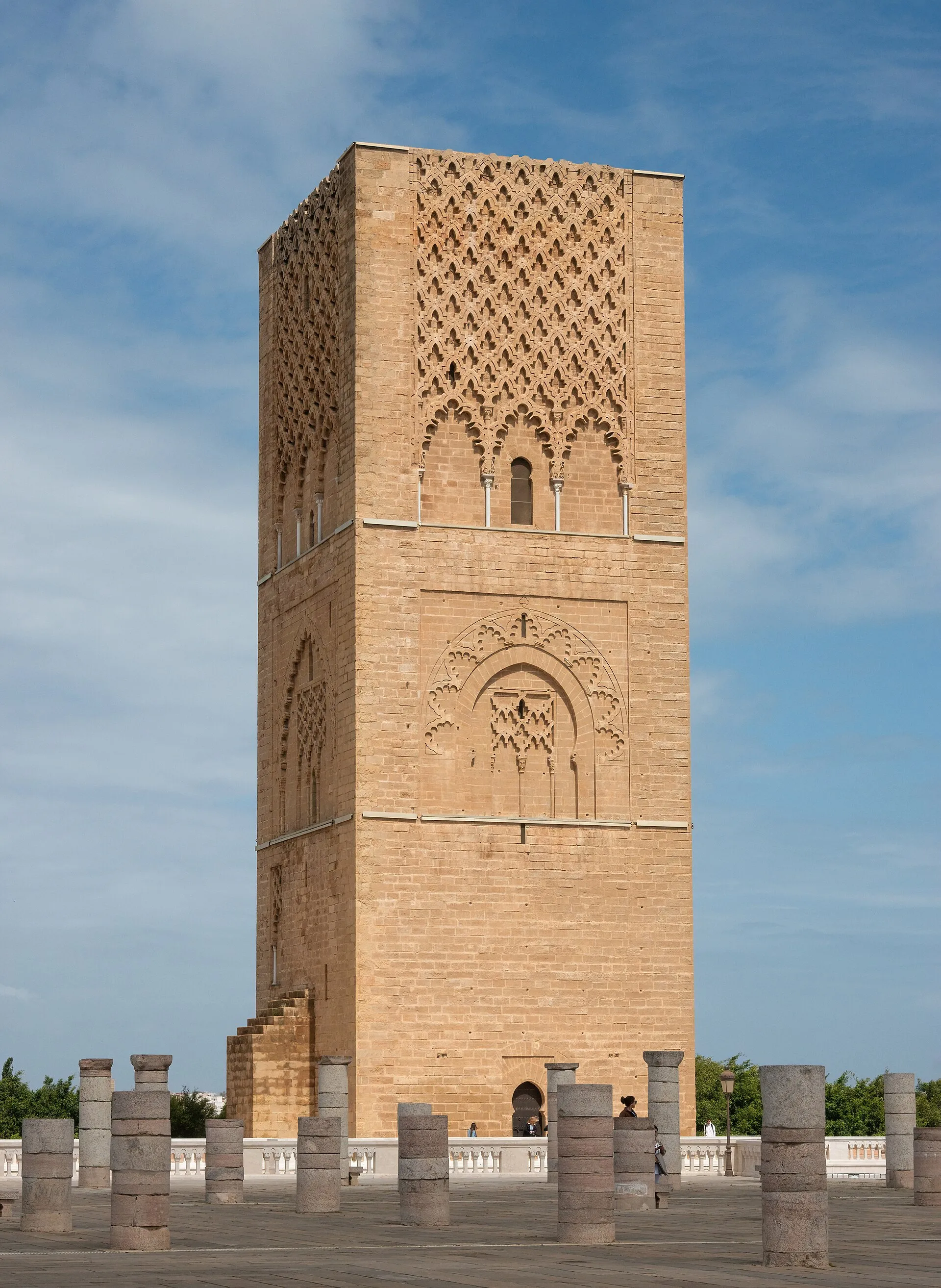
The Hassan Tower encodes one of the most audacious religious ambitions in Islamic history. When Sultan Yacoub al-Mansour commissioned it in 1195 CE, fresh from his crushing victory over the Castilian army at the Battle of Alarcos, he envisioned a mosque that would hold 40,000 worshippers and a minaret that would be the tallest structure in the Islamic world at a planned 86 meters — surpassing even the Koutoubia in Marrakech and the Giralda in Seville, the two Almohad minarets that served as its architectural siblings. The unfinished tower stands at 44 meters, frozen at the moment of al-Mansour's death in 1199: a monument to both the reach of Almohad imperial theology and its sudden collapse.
The Almohad dynasty grounded its political legitimacy in a rigorous Islamic reform movement, and this mosque was intended as the physical statement of that ideology — the qibla encoded in its precise orientation toward Mecca, the decorative geometric tracery on each face of the minaret expressing the dynasty's theological rejection of figural representation. The 200 column stubs that still march across the platform are the footprint of a prayer hall that was never roofed, making the entire esplanade an accidental open-air mosque of extraordinary scale.
The adjacent Mausoleum of Mohammed V — completed in 1971 to house Morocco's first post-independence king — deliberately anchors the Alaoui dynasty's modern legitimacy to this medieval Islamic monument, fusing the country's ancient faith with its national sovereignty in a single sacred precinct that remains active today.
When to Visit
Hassan Tower esplanade: Open daily 8:30 AM - 6:00 PM. Mausoleum of Mohammed V: Same hours; non-Muslims may enter the vestibule to view the tomb chamber from above. Best time: Morning (9-10 AM) for warm light on the sandstone tower, or late afternoon for sunset colors. Allow: 45 minutes - 1 hour for the tower, columns, and mausoleum combined. Sunset: The esplanade facing the river is a popular sunset spot among locals.
Admission and Costs
Admission: Free (both the tower esplanade and the mausoleum). Private guide: 200-400 MAD (€18-37) for a 1-hour focused visit. Combined Rabat tour including Hassan Tower: 500-900 MAD (€46-83) for a half-day covering all major sites. Group walking tour: 120-250 MAD (€11-23) per person.
Tips for Visitors
Dress modestly: This is a religious site; cover shoulders and knees, especially for the mausoleum. Photography: Exterior photography freely permitted; mausoleum interior photography allowed but be respectful. No entry to the tower: The Hassan Tower itself is closed to visitors; you view it from the esplanade. Combine with nearby sites: Kasbah of the Udayas is a 15-minute walk along the river. Tramway: Closest tram stop is "Hassan" on line L2. Guard ceremony: Ask your guide about timing the visit with the guard changing for a more ceremonial experience. Shade is limited: The exposed esplanade gets hot in summer; visit morning or late afternoon.
Frequently Asked Questions
What season offers the best conditions at Hassan Tower?
May through October is the prime window, with Rabat's mild Atlantic climate keeping the open esplanade comfortable and the sandstone minaret bathed in warm, consistent light. September and October combine clear skies with fewer tourist crowds, making them arguably the finest months. The exposed column field offers no shade, so summer visits are best timed for morning or late afternoon, while winter rain in December through February can make the marble-paved mausoleum area slippery.
When is Hassan Tower open outside of worship services?
Hassan Tower esplanade: Open daily 8:30 AM - 6:00 PM. Mausoleum of Mohammed V: Same hours; non-Muslims may enter the vestibule to view the tomb chamber from above.
How much does it cost to visit Hassan Tower?
Admission: FREE (both the tower esplanade and the mausoleum). Private guide: 200-400 MAD (€18-37) for a 1-hour focused visit. Combined Rabat tour including Hassan Tower: 500-900 MAD (€46-83) for a half-day covering all major sites.
Is a guided tour of Hassan Tower worth booking?
Guides explain why Sultan al-Mansour planned the world's largest mosque after his victory at the Battle of Alarcos, and how the 200 remaining columns mark the original prayer hall's layout. They also connect Hassan Tower to its Almohad siblings in Marrakech and Seville.