
Walking Route
Photo Spots
The strongest images here trade on contrast — stillness against motion, day against night. Rooftop terraces on the square's east side, Café de France foremost among them, give the postcard overhead shot: the whole place fanned out with the Koutoubia minaret catching the last light behind it. At ground level, the numbered food stalls after dark are pure atmosphere — steam, lantern glow, and the blur of vendors — though it is courteous to buy something, or at least ask, before pointing a lens at a particular stall. The daytime square rewards patience too: low morning sun rakes across the empty pavement, and the water-sellers' fringed hats and brass cups turn saturated in the light. Framing the halqa circles or Gnawa troupes calls for tact — a few dirhams offered first turns a furtive snapshot into a welcome portrait. A guide knows which rooftop catches the best angle at each hour and how to approach performers so the camera is met with a smile rather than a raised hand.
Landmarks Along
- Orange-juice row — Dozens of numbered carts line the north edge; the going rate is 5-10 MAD (€0.50-1) a glass, and vendors will happily refill a bottle.
- The halqa circles — Oral performers gather crowds with tales told in Darija (Moroccan Arabic), a tradition so central that UNESCO's 2001 designation protects it by name.
- Gnawa musicians — Descendants of sub-Saharan spiritual brotherhoods play iron qraqeb castanets and guembri lutes in hypnotic, trance-inducing rhythms.
- The numbered food stalls — Each night-market kitchen carries a number from 1 to 100+; locals argue endlessly over favourites, and a guide settles it on freshness and hygiene.
- Café de France and the rooftop terraces — The east-side cafés offer the classic elevated view over the whole square; guides know the quieter alternatives with the same sunset angle.
- Souk Semmarine gateway — The main covered market corridor opens off the square's north side, leading to textiles, lanterns, spices, and leather deeper in the medina.
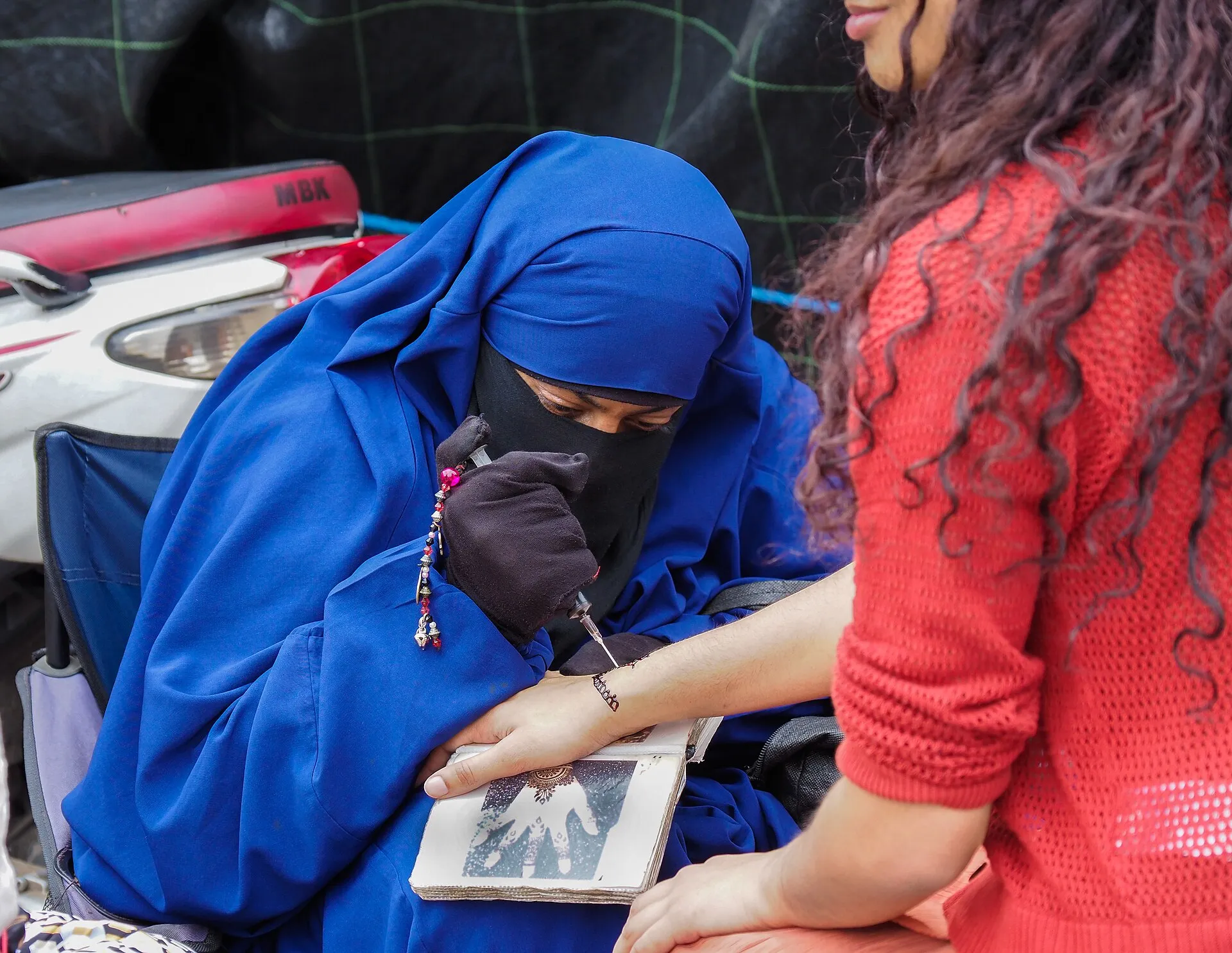
- Henna artists — Along the edges, they offer traditional geometric and floral designs — best negotiated with a guide present to avoid inflated tourist pricing.
When to Visit
The square itself never closes, but its character turns over completely across the day:
- Morning (8-11 AM) — Orange-juice carts, henna artists setting up, and unhurried browsing before the heat; the best window for photos of the near-empty place.
- Afternoon (2-5 PM) — Snake charmers, monkey handlers, Berber herbalists, and the first halqa storytelling circles claim their patches of ground.
- Evening (6-11 PM) — Peak energy: 100+ food stalls fire up, Gnawa troupes drum, acrobats tumble, and fortune-tellers work the crowd under strings of bare bulbs.
Best time: arrive around 5 PM and stay through dusk to watch the daytime market dissolve into the evening spectacle — the single most dramatic transformation in Marrakech. During Ramadan the rhythm shifts later, with stalls busiest well after the iftar meal.
Admission and Costs
Entering the square is free — it is a public place, not a ticketed site. Expect these typical rates once you engage with it:
- Fresh orange juice — 5-10 MAD (€0.50-1) a glass from the numbered north-edge carts.
- Food-stall dinner — 30-80 MAD (€3-7) per dish at the nightly market; agree the price before you sit.
- Photo with a performer — 10-20 MAD is fair for henna, snake charmers, or water-sellers; always ask first.
- Group walking tour including the square — 150-300 MAD (€14-28) per person for 2-3 hours.
- Private guide for the square — 300-600 MAD (€28-55) for 2 hours.
- Private evening food tour — 400-800 MAD (€37-74) per person, tastings included.
The Case for a Guide
Jemaa el-Fnaa is exhilarating and, without context, genuinely confusing — a guide converts the sensory overload of Marrakech's great square into cultural literacy.
- Performer decoding — A guide tells the Gnawa musicians (descendants of sub-Saharan spiritual brotherhoods) from the halqa oral storytellers and the Berber herbalists, explaining what each living tradition actually means rather than letting them blur into spectacle.
- Scam navigation — Henna artists, snake charmers, and monkey handlers all work to fixed tourist prices; a guide negotiates on your behalf and heads off the aggressive demands that sour solo visits.
- Food-stall selection — Out of 100+ numbered kitchens, guides know which have the turnover, handling, and local following that separate a great dinner from a queasy night.
- Dawn-to-dusk rhythm — The square at 7 AM (juice carts, bakers, calm) is a different world from 8 PM (smoke, drums, fire); a guide explains the daily cycle and why UNESCO chose to protect a living practice rather than a building.
- Gnawa history — The iron castanets and trance chants trace directly to enslaved sub-Saharan communities brought to Morocco centuries ago — context that turns a street performance into a story of survival and memory.
Tips for Visitors
- Guard your belongings — Pickpockets work the dense evening crowds; keep bags zipped and worn in front of you.
- Agree prices first — Settle the cost of food, henna, or a photo before you commit; a friendly "bshhal?" (how much?) sets the tone.
- Ease your stomach in — If you have a sensitive gut, start with dishes cooked to order in front of you rather than pre-prepared trays.
- Wear comfortable shoes — The place is large and its surface uneven; you will be on your feet for hours.
- Come for the transition — The square's character shifts completely after dark, so plan to stay through sunset.
- Respect the performers — Photographing halqa circles or musicians without paying is frowned upon; a few dirhams keeps the tradition alive.
- Explore outward — The souks begin just north through Souk Semmarine; Bahia Palace is a 10-minute walk southeast, and the Koutoubia gardens a similar stroll southwest.
Frequently Asked Questions
When is the best time to walk through Jemaa el-Fnaa?
Hours: Open 24 hours - the square never fully sleeps. Morning (8-11 AM): Fresh orange juice stalls, quieter browsing, henna artists setting up. Afternoon (2-5 PM): Snake charmers, monkey handlers, herbalists, storytellers (halqa circles). Evening (6-11 PM): Peak energy with 100+ food stalls, Gnawa musicians, and acrobats.
Is Jemaa el-Fnaa free to visit?
Entering the square: FREE (it's a public space). Group walking tour including Jemaa el-Fnaa: 150-300 MAD (€14-28) per person (2-3 hours). Private evening food tour: 400-800 MAD (€37-74) per person including tastings.
What safety and etiquette tips should visitors follow at Jemaa el-Fnaa?
Watch your belongings: Pickpockets operate in the crowds, especially during peak evening hours. Photography rules: Performers demand payment for photos (10-20 MAD is fair); always ask first. Agree food prices before you sit down at a stall.
How do you get to Jemaa el-Fnaa?
The square anchors the Marrakech medina, so most riads are a 5-15 minute walk away through the alleys. Beige petit taxis drop you at the edges (agree the fare or ask for the meter, roughly 20-40 MAD from Gueliz); cars cannot enter the pedestrian medina core. The Koutoubia minaret is the easiest landmark to navigate back toward.
What food should you try at the Jemaa el-Fnaa night market?
Signature stalls serve grilled lamb and merguez skewers, harira soup, bowls of snails (babbouche) in aromatic broth, and slow-cooked tangia, plus sheep's head for the adventurous. Choose stalls with high turnover and food cooked to order, agree the price before sitting, and finish with fresh orange juice from the north-edge carts.