
,_Zona_Arqueol%C3%B3gica_de_Uxmal,_Yucatan,_Mexico.jpg)
Overview
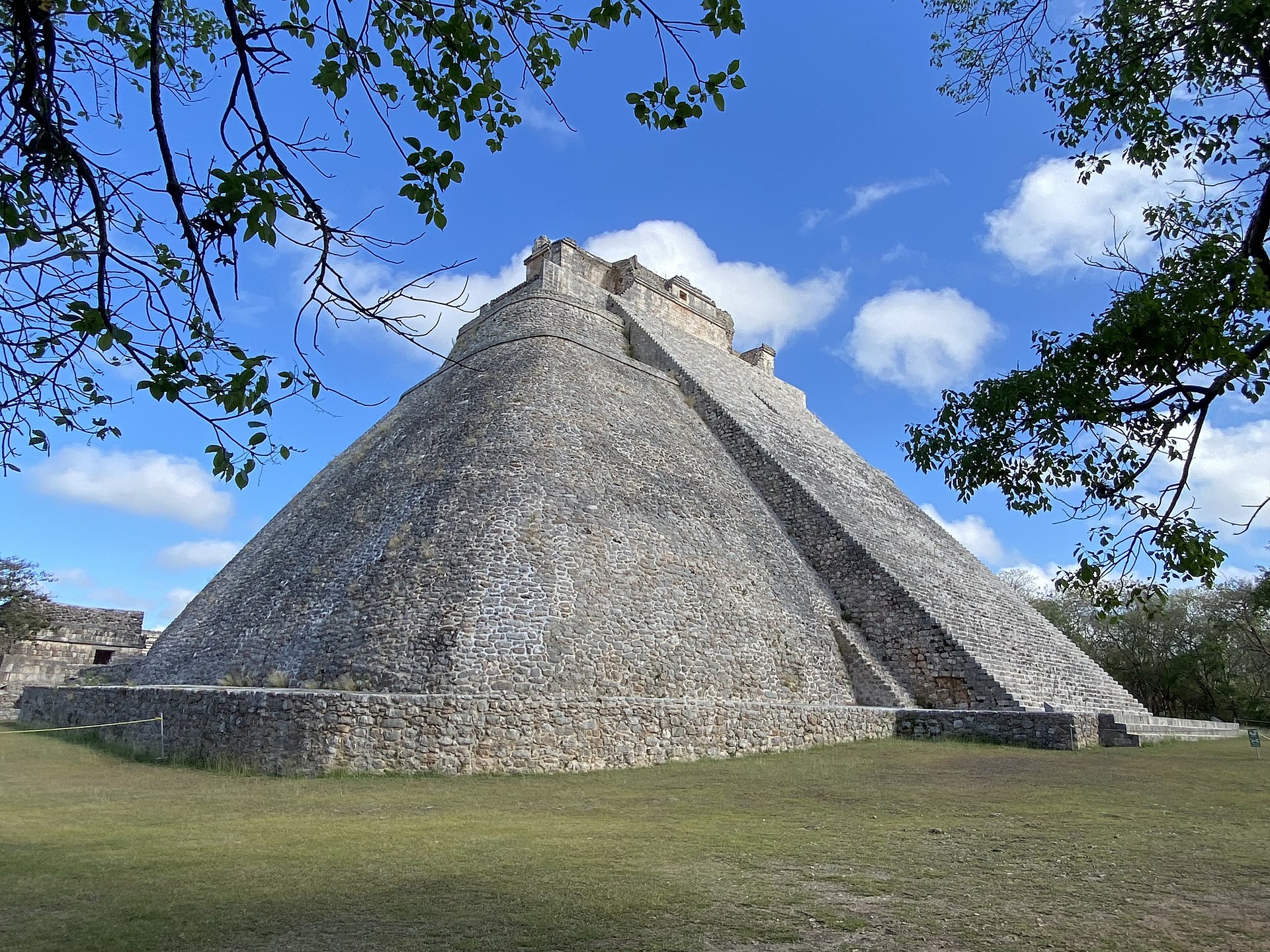
Uxmal (pronounced oosh-MAHL) is the finest example of Puuc-style Maya architecture and a UNESCO World Heritage Site located 80 kilometers south of Merida. The site reached its peak between 600 and 1000 CE, when it served as the political and ceremonial capital of the western Yucatán. The Pyramid of the Magician immediately dominates the skyline with its distinctive oval base — unique among all Maya pyramids, with rounded corners that give it an almost organic quality.
Many scholars consider the Governor's Palace the site's true masterpiece: a 100-meter-long limestone platform decorated with over 20,000 individually carved stone elements forming intricate geometric mosaics of Chaac rain masks, serpents, and lattice patterns. It has been called one of the most beautiful buildings in pre-Columbian Americas. The Nunnery Quadrangle, a four-building complex surrounding a central courtyard, features equally elaborate stone mosaic facades that demonstrate a level of architectural refinement that took Puuc masons generations to perfect. Combine with the Cenotes for an unforgettable archaeology-and-swimming day.
Excavation History
Pyramid of the Magician: The only oval-based pyramid in the Maya world, rising 35 meters with five superimposed construction phases spanning four centuries. Governor's Palace: Over 20,000 carved stone elements form mosaic facades that scholars rank among the greatest architectural achievements of pre-Columbian Americas. Nunnery Quadrangle: Four buildings enclosing a courtyard, each facade a masterclass in geometric stone mosaic — serpents, Chaac masks, and lattice patterns in perfect symmetry. House of Turtles: An understated gem with a cornice of carved turtle sculptures, one of the most elegant small buildings at any Maya site. The son et lumière show illuminates the ruins after dark while a narrator recounts Maya creation mythology.
Key Artifacts
The Governor's Palace facade contains a precise astronomical alignment: its central doorway faces the point on the horizon where Venus rises at its southernmost extreme, occurring once every 8 years — evidence that Puuc architects incorporated planetary cycles into monumental architecture. The Chaac rain masks repeated across Uxmal's buildings represent the most important deity for a city that had no natural water source — unlike sites near cenotes, Uxmal relied entirely on chultunes (underground cisterns) to collect rainwater. The Puuc veneer masonry technique — thin, precisely cut limestone blocks over a rubble core — allowed the construction of elaborate facades that would have been impossible with solid stone, a technical innovation comparable to Roman concrete in its architectural impact.
When to Visit
Open: Monday-Sunday 8 AM - 5 PM. Best: Arrive at opening (8 AM) for cooler temperatures and empty plazas. Son et lumière show: Nightly at 7 PM (winter) or 8 PM (summer) — separate ticket. Avoid: Midday from 11 AM to 2 PM when the exposed limestone reflects brutal heat.
Admission and Costs
Site entry: MX$494 per person (combined federal and state fee). Sound and light show: MX$120 additional. Certified guide at site: MX$800-1,200 for groups up to 6. Private day trip from Merida: MX$2,000-3,500 including transport and guide. Parking: MX$60.
Tips for Visitors
Far less crowded than Chichén Itzá: Uxmal receives a fraction of the visitors — during weekday mornings, you may have entire plazas to yourself. Stay for the light show: The evening son et lumière illuminates the Nunnery Quadrangle and Pyramid while a narrated Maya creation story plays. Bring insect repellent — mosquitoes emerge at dusk. Hire a guide for Puuc details: The architectural vocabulary — boot-shaped vault stones, veneer masonry technique, different Chaac nose configurations — is invisible without expert interpretation. Combine with the Ruta Puuc: The road south passes Kabah, Sayil, Labná, and the Loltún caves. Bring water: Two liters per person minimum, plus a hat and sunscreen.