
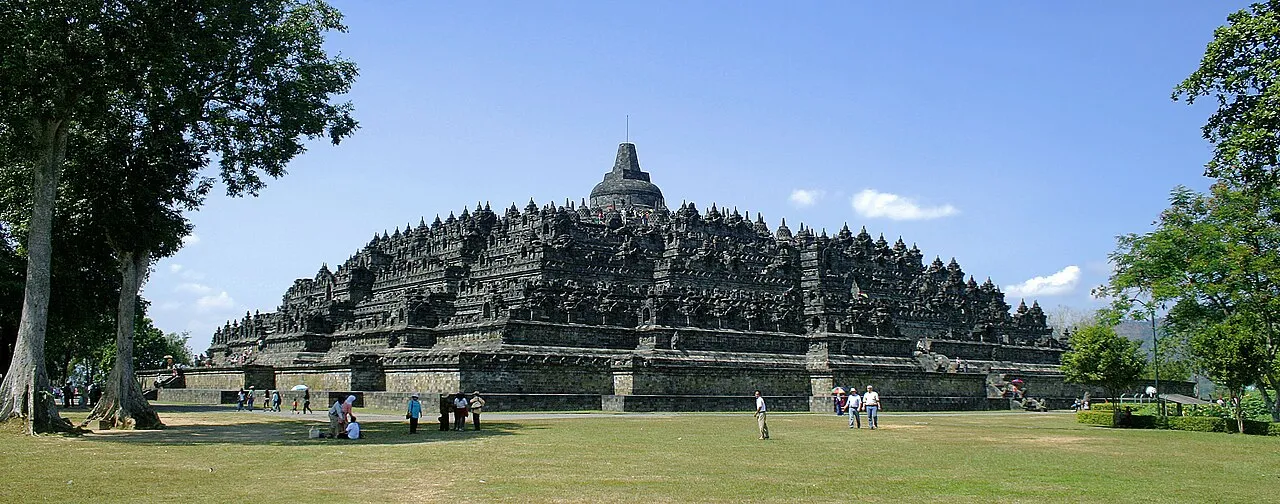
Excavation History
The story of Borobudur's recovery is nearly as remarkable as the monument itself. When Raffles ordered Herman Cornelius Cornelius to investigate a "hill of accumulated stones" in 1814, the excavation revealed a structure so vast that Cornelius abandoned the clearing after two months having exposed only the upper terraces. Full archaeological investigation began under Dutch colonial authorities in the 1880s and continued through the early 20th century, revealing the complete gallery programme across eight decades of incremental clearing.
The monument's foundation problem — water infiltrating through the stone and undermining the volcanic clay core — threatened structural collapse throughout the 20th century. UNESCO declared an international emergency in 1968; the restoration project from 1975 to 1983 spent USD 25 million and employed engineers from Indonesia, the Netherlands, and France to dismantle each gallery terrace stone by stone, waterproof the core, and reassemble the panels in their original positions. Every panel was documented photographically before removal; a total of 1,460,000 blocks were individually catalogued and replaced.
Key Artifacts
Beyond the relief panels, Borobudur contains several significant sculptural elements that reward close attention with a guide:
- Dhyani Buddhas: The 504 seated Buddha statues arranged in niches throughout the gallery walls and open terraces represent five transcendent Buddhas (Dhyani Buddhas) — each direction of the monument corresponds to a specific Buddha and mudra
- Kala-Makara gates: The temple's four gateways are framed by kala monster-face lintels and makara sea-creature balustrades — iconography combining Hindu and Buddhist symbolism characteristic of the Indianised kingdoms of ancient Java
- Hidden foot carvings: The monument's base contains a hidden lower gallery (the Kamadhatu) whose 160 relief panels — covered by buttressing stones during original construction — were deliberately concealed, possibly to hide explicit cause-and-effect scenes; sections were briefly exposed in 1885 and photographed before being re-covered
When to Visit
Standard opening hours: Daily 6 AM – 5 PM. Sunrise platform access: Approximately 4:30 AM arrival required; advance ticket purchase mandatory (USD 65 per person, 2025 rate). Best standard visit time: 6–9 AM for cool temperatures and dramatic morning light on the relief carvings. Avoid: 10 AM–2 PM in the hot season (April–October) when stone surfaces reach uncomfortable temperatures and direct overhead sun eliminates the shadows that make the relief panels legible. Visit duration: 2–3 hours for a thorough gallery circuit; 4–5 hours with a guide covering all nine levels.
Admission and Costs
- Domestic ticket: IDR 50,000 (approximately USD 3)
- Foreign visitor ticket: USD 25 (2025 rate)
- Sunrise platform ticket: USD 65 (foreign) — includes standard admission
- On-site licensed guide: IDR 150,000–300,000 (USD 10–20) for a 2-hour circuit
- Combined Borobudur + Prambanan guide with transport from Yogyakarta: IDR 600,000–1,200,000 (USD 40–75)
- Transport from Yogyakarta: IDR 150,000–250,000 each way by private car (45 km, approximately 1 hour)
The Case for a Guide
No site in Indonesia demonstrates the transformative value of a knowledgeable guide more starkly than Borobudur. The relief panels are the monument's greatest achievement — and the most inaccessible without expert interpretation:
- Relief narrative sequence: The eight gallery levels form a complete Buddhist doctrinal programme; a guide walks the narrative circuit identifying the Jataka tales, the Gandavyuha sutra episodes, and the cosmological diagram of the monument itself as the pilgrim ascends
- Iconographic reading: Each Buddha statue's mudra, position, and direction encodes specific doctrinal meaning; the kala-makara gateway iconography combines Hindu and Buddhist symbolism unique to the Indianised Javanese tradition; none of this is accessible from signage
- Construction engineering: How 2 million andesite blocks were cut, transported, and fitted without mortar is one of the great logistics stories of the ancient world; a guide explains the evidence for the construction methods inferred by engineers during the 1975–1983 restoration
- UNESCO restoration story: The restoration project's decision to dismantle and reassemble the entire monument rather than patch it in place was controversial and technically unprecedented; a guide explains what was changed, what was preserved, and where the restoration's compromises are visible in the stonework
Tips for Visitors
Advance sunrise booking: The sunrise platform quota sells out days in advance during peak season (July–August); book through the official Taman Wisata Candi Borobudur website or a certified operator at least 3–5 days ahead. Relief panel strategy: To read the panels in narrative sequence, begin at the eastern staircase of the first gallery and walk clockwise; do not ascend to the next level until completing the full circuit of the current one — this is the intended pilgrimage sequence. Photography timing: The first gallery's reliefs (most detailed) are best lit between 8–10 AM on the east-facing walls; the upper circular terraces photograph best in the 2 hours before sunset. Footwear: Stone steps are polished smooth by millions of visitors and become extremely slippery when wet; closed shoes with grip are far safer than sandals after rain. Candi Mendut: The smaller 9th-century Buddhist temple 3 km east, containing three large original stone Buddhas in near-perfect condition, is almost always empty — a guide combines it with Borobudur for a complete Sailendra-era Buddhist experience. Back in the city: the living court of the Kraton palace rounds out a Yogyakarta itinerary that spans Buddhist, Hindu, and Javanese court traditions in a single visit.
Frequently Asked Questions
How do I visit Borobudur at sunrise?
Borobudur's sunrise experience requires advance planning. The standard temple opens at 6 AM for all visitors, but the restricted sunrise platform ticket — which grants access to the upper terrace levels before dawn — must be purchased separately through the official Borobudur ticket office or certified tour operators and costs approximately USD 65 per person (2025 pricing). Sunrise platform visitors typically arrive at the site at 4:30–5 AM for a guided predawn climb up the monument in darkness, reaching the upper bell-shaped stupas as the sky brightens over the volcanic peaks of Merapi and Merbabu. The experience — watching first light reveal the jungle-covered Kedu Plain with 72 stupas silhouetted on all sides — is genuinely extraordinary. A certified guide is mandatory for sunrise platform access.
What do the relief panels at Borobudur depict?
Borobudur's 2,672 individual relief panels form one of the world's most comprehensive visual encyclopedias of Buddhist doctrine. The panels are arranged across the monument's lower and middle terraces in a narrative sequence designed to be read during a clockwise circumambulation (pradakshina) that ascends from the base to the summit. The first gallery depicts the Karmavibhangga — cause and effect in human behaviour, illustrating the consequences of virtuous and sinful actions. Higher galleries narrate the life of the historical Buddha Shakyamuni, the Jataka tales of the Buddha's previous lives, and the pilgrim Sudhana's spiritual journey through the Gandavyuha sutra. The complete narrative, if the panels were laid end-to-end, would extend over 6 km — a textual and visual achievement that has no parallel in any Buddhist tradition.
How large is Borobudur and how long was it in use?
Borobudur covers an area of approximately 2,500 square metres at its base and rises to a height of 35 metres across nine stacked platforms. Construction began under the Sailendra dynasty around 770 CE and was completed approximately 75 years later, requiring an estimated 2 million stone blocks without mortar. The monument was actively used until approximately the 11th–13th centuries, when the centre of Javanese political power shifted east and the site fell gradually out of maintenance, eventually becoming buried under volcanic ash and jungle vegetation. It was rediscovered in 1814 by Sir Thomas Stamford Raffles during his tenure as British Lieutenant Governor of Java. The UNESCO-led restoration from 1975 to 1983 — the largest such project in Southeast Asian history — dismantled and re-assembled the entire monument using the original stones.