
Spiritual Significance
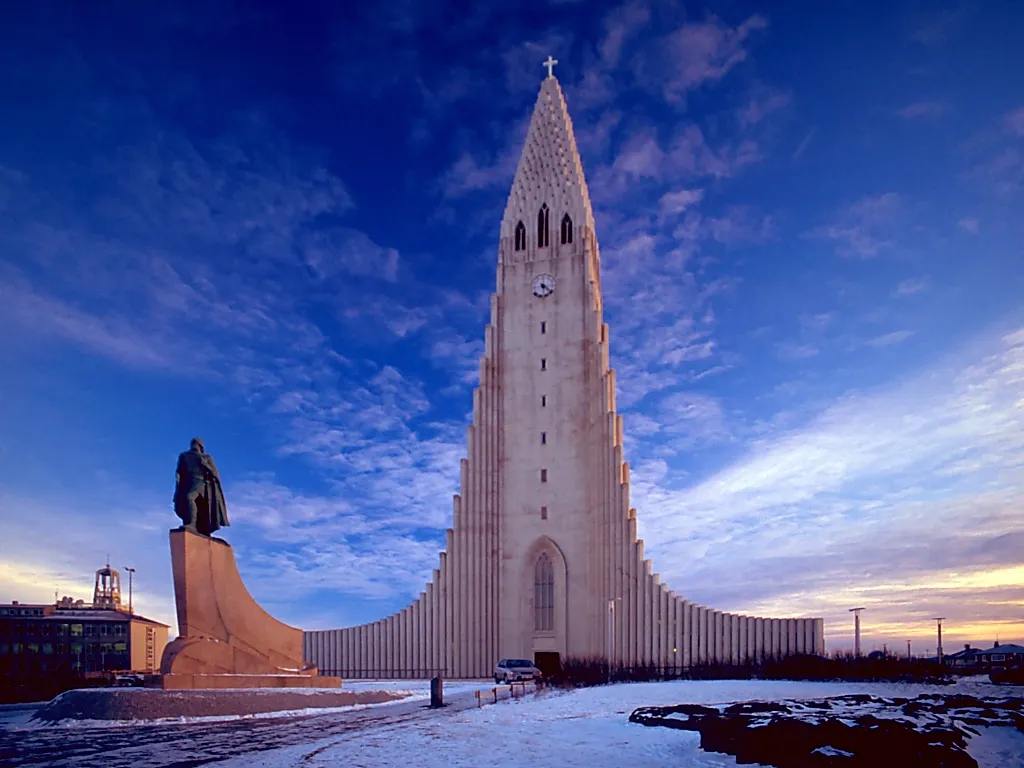
Expressionist-Modernist design: Samúelsson's style combined 20th-century structural modernism with explicit references to Iceland's natural landscape — hexagonal basalt columns rising from a stepped base that mirrors the talus slopes below Iceland's lava flows. The tower's profile tapers as it rises, the lateral wings sweeping back in a composition that some observers compare to a rocket ship, others to a launching wave of volcanic rock. Interior nave: White reinforced concrete vaulting, 73 metres long, with side aisles of grey stone. The windows are intentionally small — Iceland's winter light is precious enough that artificial lighting fills the nave for most of the year. The organ: Designed by German builder Johannes Klais Orgelbau in 1992; its symmetrical polished tin-pipe facade is the single decorative focal point in a nave that otherwise lets nothing compete with the vertical thrust of the vaulting overhead. Tower observation deck: Open metal grill floor and glass-panel walls at approximately 75 metres — the sensation of height above Reykjavik's low roofline is more dramatic than the altitude suggests because few buildings in the city exceed five storeys.
Visitor Etiquette
Iceland's National Church has used Hallgrímskirkja as its primary cathedral-equivalent since the building's completion, though the country technically lacks a cathedral by Anglican or Catholic definitions — the Lutheran tradition does not require a bishop's seat in a dedicated building. The church was consecrated in 1986 though parts had been in use since the 1940s. It replaced the previous Dómkirkja as the largest Lutheran church in Iceland at the moment of completion. The building has become the de facto visual symbol of the Icelandic nation — appearing on more tourist photographs, more magazine covers, and more government publications than any other single structure in the country. The Leif Eriksson statue outside adds a specifically Icelandic assertion of historical precedence: the Norse explored North America half a millennium before the voyages that European and American history textbooks placed at the centre of the Age of Discovery.
When to Visit
Tower queues: Shortest at opening (9 AM) and in the evening from 6 PM. Midday in summer (11 AM–3 PM) brings the longest waits — up to 45 minutes. Clear days for tower panorama: Check the Veðurstofa (Icelandic Met Office) forecast before visiting; cloud sitting below the church spire is common. Organ concerts: Sundays at 5 PM are the most atmospheric time to visit the nave without paying separately for the tower. Christmas services: The midnight mass on December 24th fills the church to capacity — plan weeks ahead.
Admission and Costs
Church admission: Free. Tower elevator: ISK 1,200 adults, ISK 700 children (6–16). Opening hours: 9 AM–9 PM daily (tower until 8:30 PM, last elevator 8 PM). Organ concerts on Sundays at 5 PM — free to attend during services. Photography inside the nave: Permitted when services are not in progress. Large backpacks and food are not permitted inside the church.
The Case for a Guide
Hallgrímskirkja appears self-explanatory but rewards close attention with someone who knows the building's context:
- The basalt column reference: A guide who has visited Svartifoss waterfall and the Westman Islands cliff faces can show you the exact geological formation Samúelsson was referencing, turning the facade from an abstract design into a direct conversation with Iceland's volcanic landscape.
- 41 years of construction: A guide explains why the tower was built first — Icelanders could see it rising above the city for decades while the nave was still under construction — and how the phased building process shaped the relationship between Reykjavik's residents and the building they watched go up across their lifetimes.
- Leif Eriksson's connection to Iceland: The statue's western orientation is intentional, and a guide decodes the politics of the 1930 gift from the US — an assertion of Norse priority in North American discovery during the exact decade when Scandinavian-American communities were politically active in asserting Viking heritage.
- The organ: 5,275 pipes installed in 1992 make this one of the largest mechanical organs in Iceland; a guide can arrange a closer look and explain why the absence of competing ornament makes the organ the focus of the entire interior composition.
- Views from the tower: On a clear day a guide can identify Mount Esja (914 m), Snæfellsjökull glacier 120 km distant, and the volcanic ridge of the Reykjanes Peninsula — turning a panorama into a geological and geographical orientation for the rest of your Iceland trip.
Tips for Visitors
Book tower tickets in advance during summer (June–August) — the elevator has limited capacity and queues build quickly. Visit on a clear morning for the best tower panorama; the Icelandic Met Office website (en.vedur.is) gives hour-by-hour cloud forecasts. Attend a Sunday service or concert — the acoustics in the nave are superb, and the 5 PM Sunday organ concert is free. Photograph from Skólavörðustígur — the street below the church provides the classic straight-on view; late-afternoon light from the west hits the facade most dramatically. Leif Eriksson statue at sunrise — the bronze catches the first light before the tour groups arrive. Combine with the Settlement Exhibition — 20 minutes' walk downhill, it provides the Viking context that makes the Leif Eriksson statue directly relevant. Pair the tower panorama with the harbour — from the observation deck you can pick out the Harpa Concert Hall on the waterfront, an easy downhill walk for an evening concert or a stroll through its free glass atrium.
Frequently Asked Questions
When was Hallgrímskirkja built, and why did construction take so long?
Hallgrímskirkja was designed in 1937 by state architect Guðjón Samúelsson, but construction did not begin until 1945 and was not completed until 1986 — a span of 41 years. The delay reflects both Iceland's limited construction resources in the mid-20th century and the extraordinary ambition of the project: at 73 metres, it is the largest church ever built in Iceland and the country's tallest structure. Construction proceeded in phases, with the tower completed first and the nave following over subsequent decades. The resulting building is one of the finest examples of Expressionist ecclesiastical architecture in northern Europe, its exterior designed to evoke the hexagonal basalt columns found at sites like Svartifoss waterfall in Vatnajökull National Park and the coastal cliffs of the Westman Islands.
What is in the tower, and how do you get up?
The tower contains an elevator that carries visitors to the observation deck at approximately 75 metres — the highest public viewpoint in Reykjavik. The panorama takes in the entire city, the Esja mountain across the bay, the Faxaflói bay stretching west, and on clear days the distant peaks of the Snæfellsnes Peninsula and the Reykjanes volcanic ridge to the southwest. The tower also holds the church's five-bell carillon, installed in 1960, which plays before Sunday services and on special occasions. The elevator admission fee is separate from the church itself, which is free to enter. The queue for the tower is shortest at opening time (9 AM) and in the evening between 5 PM and closing.
Who is the statue in front of Hallgrímskirkja?
The bronze statue in the plaza before the main entrance depicts Leif Eriksson (Leifur Eiríksson), the Norse explorer credited with reaching North America approximately 500 years before Christopher Columbus. The statue was a gift from the United States government to Iceland in 1930, commemorating the 1,000th anniversary of the Althing (the world's oldest parliament, founded at Þingvellir in 930 CE). Leif Eriksson was born in Iceland — his father, Eiríkur rauði (Erik the Red), settled Greenland, and Leif's westward voyage around 1000 CE reached Vinland, now believed to be Newfoundland, Canada. The statue stands with its back to the church entrance, facing west toward North America — the direction of Leif's great voyage.