
Innsbruck by Old Town and Alpine Peak: Which Tour Fits
How to choose the right guided tour in Innsbruck — old-town walks, the Nordkette cable car, Olympic-heritage visits and Alpine hikes.
Read the full guideUpdated · 10 min read
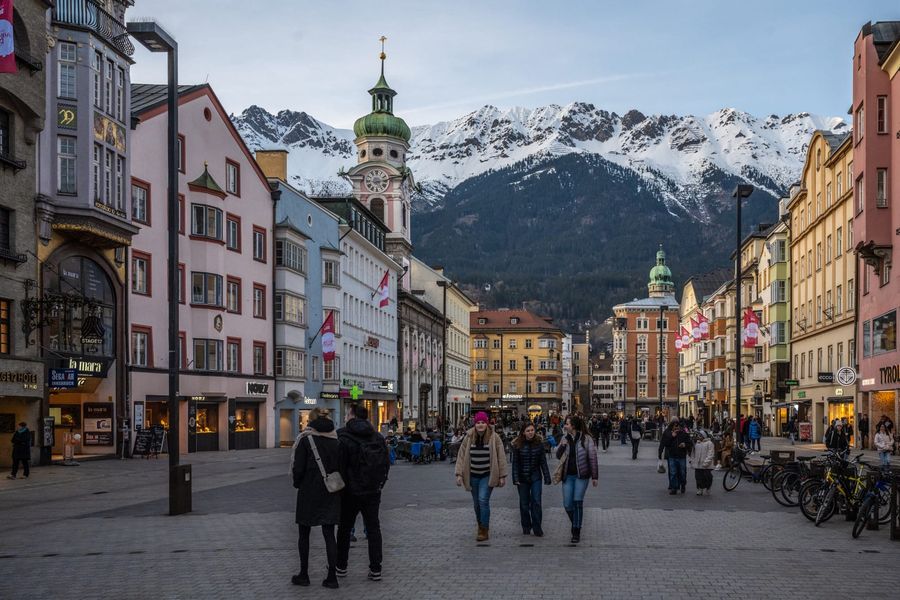
Innsbruck compresses a decision most Alpine trips spread across a whole week: in the same afternoon you can cross a car-free Gothic square on foot and ride a cable car to a 2,256-metre ridge, and only one of those two halves usually rewards a hired guide. Skip the guide for the square, the arcades and the ride itself — book one for the Hofkirche's locked interior, Ambras Castle's Renaissance rooms, the Olympic story behind Bergisel, and any route that starts where the cable car stops.
The Tyrolean capital's medieval and baroque core is a 15-minute walk end to end, while the Nordkette range rises straight off the rooftops behind it. That geography — flat, dense old town against sheer, high mountain — is what makes the self-guided-or-guided call here so binary. Read this alongside the Innsbruck city guide and the wider Austria overview for practical details on getting around and staying.
Wandering the Altstadt without a guide
The historic core asks nothing of a visitor except a working pair of legs. The Golden Roof square, the arcaded length of Maria-Theresien-Straße, and the cathedral sit within a 15-minute walk of each other, and none of it is gated.
Innsbruck's Altstadt is small enough that a paper map beats an app, let alone a booked walk. You can photograph the Golden Roof from the cobbled square below it, follow Maria-Theresien-Straße's baroque façades with the snow line of the Nordkette framed at the far end, and duck into the cathedral for free, all before a guided group has finished its introduction. A tip-based free walking tour or a licensed small-group walk covers the same ground and adds narrative — useful on a first morning if you want the Habsburg backstory handed to you rather than pieced together from plaques — but nobody needs a guide simply to find these places or to stand in front of them.
Where licensing, not choice, puts a guide between you and the room
Two of Innsbruck's best interiors are only fully open through a licensed guide: the Hofkirche, where 28 larger-than-life bronze figures stand watch over Emperor Maximilian I's empty cenotaph, and Ambras Castle, whose Renaissance rooms and Chamber of Wonders reward someone who can explain what's on the shelves.
Austrian guiding inside museums and monuments is state-licensed, so the choice at these two sights isn't really self-guided versus guided — it's whether you go in with context or without it. At the Hofkirche, the 28 bronze figures are striking on sight but make far more sense once someone explains why Maximilian commissioned an empty tomb guarded by ancestors and heroes he was never actually buried near. At Ambras Castle, Archduke Ferdinand II's Kunst- und Wunderkammer — one of the world's oldest Chambers of Wonders — and the Spanish Hall are dense with objects that mean little without a guide's framing.
| Sight | Independent option | What a licensed guide adds |
|---|---|---|
| Golden Roof & old-town squares | Free to view any time, self-explanatory | Little beyond backstory — skippable for most visitors |
| Maria-Theresien-Straße | Free to walk, photograph, and browse | Context on the baroque façades and Habsburg patronage |
| Hofkirche interior | Open to visit alone | Explains the 28 bronze figures and Maximilian's empty cenotaph |
| Ambras Castle | Self-guided admission available | Unpacks the Chamber of Wonders and Spanish Hall for Archduke Ferdinand II |
The Nordkette split: a cable car ticket versus a certified guide
Riding the Nordkette cable car from the Congress station through Hungerburg to Hafelekar at 2,256 metres needs nothing more than a ticket. Going anywhere beyond the top station — ridge routes, the Goetheweg trail, via ferratas, winter ski touring — is where a certified Alpine guide stops being optional.
The cable car itself is a simple, well-signed ride, and plenty of visitors ride up, admire the view over the city and the Inn valley, and ride back down without ever needing a guide. The decision changes the moment you step off the platform and onto unmarked or exposed terrain. A certified mountain guide turns a vague plan to "go hiking above Innsbruck" into a route-planned day, handles navigation on the Goetheweg or a via ferrata, and carries the training that ski touring and shoulder-season snow conditions genuinely require. Treat the line at the top station as the real boundary between what you can do alone and what needs a professional.
Bergisel and the two-time Olympic city
Innsbruck is one of only three cities to have hosted the Winter Olympics twice, in 1964 and 1976, and the Zaha Hadid-redesigned Bergisel ski jump — reopened in 2002 and still the January home of the Four Hills Tournament — carries that whole story.
A funicular and tower lift get anyone to the panoramic café at the top of Bergisel without assistance, and the view alone justifies the trip. What a specialist guide adds is the thread connecting a city of 130,000 to two Olympic Games and a ski jump redesigned by one of the era's most prominent architects — the kind of layered, sport-and-design history that a plaque summarizes but a guide can actually narrate. This is a compact addition to a culture-focused day rather than a trip in itself, and it pairs naturally with the Ambras Castle visit above.
Timing the cable car and the calendar
Summer (June–September) is the season for pairing old-town walks with high Alpine trails, with wildflowers peaking in July; winter (December–March) is ski season with Christmas markets in the old town and the Four Hills Tournament at Bergisel each January.
Ride the first Nordkette cable car of the day, around 8:30 AM, for the clearest views — clouds tend to build over the peaks by midday, especially in summer. Shoulder months (April and October) bring mild weather and thin crowds but also carry the risk that some Alpine lifts and high trails are closed for maintenance between seasons, so check before planning a mountain day. Whatever the month, carry a warm layer: the temperature can drop 15°C between the old town and the Nordkette summit, even in July.
What the day, or the trip, actually costs
Prices split cleanly between the free old-town layer and the paid mountain-and-interior layer. A tip-based walk costs nothing to €12, a licensed group walk is €20–35, and the Nordkette cable car runs around €44 return; private guiding starts at €160 for a half-day and certified mountain guides charge €300–550 per day.
| Item | Approximate cost |
|---|---|
| Free old-town walking tour | Free–€12 tip per person |
| Licensed group walking tour | €20–35 per person |
| Nordkette cable car (return) | Around €44, or covered by the Innsbruck Card |
| Bergisel ski jump admission | Single ticket, or covered by the card |
| Private half-day city guide | €160–280 for a small group |
| Private full-day city guide | €300–500 for a small group |
| Certified mountain guide | €300–550 per day |
The Innsbruck Card is worth pricing in before anything else: it bundles the Nordkette cable car, public transport, the sightseeing bus, Ambras Castle, the Bergisel jump, and most museums, and a single round trip to Hafelekar already costs close to a 24-hour card — so riding the cable car plus visiting two or more paid sights in a day usually makes it pay for itself. Mountain-guide fees are charged per group rather than per head, so splitting one across three or four hikers brings the per-person cost down sharply, and around 10% is customary tipping for private guides. Innsbruck's large student population also keeps dining and drinking cheaper than in Vienna, which leaves more room in the budget for the guiding that actually matters. Confirm current rates before booking — lift, museum, and guide prices shift each season.
Building the trip around one peak, one castle, and the border
One day is enough for an old-town morning plus a Nordkette afternoon; two days add Ambras Castle or Bergisel, or a half-day guided hike from the top cable-car station; three or more open up a day trip toward the Stubai Glacier, Swarovski Crystal Worlds, or the Brenner Pass into Italy, about 30 minutes away.
With a single day, pair a self-guided or lightly guided old-town morning with an afternoon Nordkette cable-car ride — that combination alone captures both halves of the city. A second day is where the guided-versus-self-guided choices above come into play: Ambras Castle and Bergisel for culture, or a certified guide for a half-day hike beyond the lift. From three days, Innsbruck functions as a base — Swarovski Crystal Worlds, the Stubai Glacier, and the cross-border run toward the Brenner Pass are all realistic day trips, though a guided crossing into Italy still fills a full day, so don't stack a tight evening plan on top of one. When booking any of the interior or mountain guiding above, look for the same two credentials throughout: a state-licensed guide for the Hofkirche and Ambras Castle, since that licensing is a legal requirement rather than a marketing label, and a certified Alpine guide for anything past the Nordkette's marked paths. Small groups get more from either — there's room for questions and the guide can adjust pace rather than run a fixed script.
Related Guides
- Innsbruck city guide — neighbourhoods, attractions, and practical tips for the wider stay
- Austria country guide — how Innsbruck fits into a longer trip across the country
- Planning a Vienna Trip — pairing the Alps with the imperial capital
- Best Time to Visit Hallstatt — extending the trip to Austria's lakeside Alpine village
Final thoughts: In a city where a Gothic quarter and a 2,256-metre summit sit twenty minutes apart, the smartest approach is to spend on the experiences that genuinely need a guide — the Hofkirche interior, Ambras Castle, the Olympic story, a mountain hike beyond the lifts — and lean on the Innsbruck Card and your own two feet for everything else. Decide which half of Innsbruck you came for, book the marquee slots ahead, ride the first cable car of the day, and let the mountains do the rest.
Frequently Asked Questions
Do you need a guided tour to see Innsbruck?
Not for the basics — the old town is tiny, walkable, and free to wander, and you can ride the Nordkette cable car or visit most museums on your own with an Innsbruck Card. A guide earns its place where context or access matters: the Hofkirche interior and Maximilian's cenotaph, the Renaissance collections at Ambras Castle, the Olympic story behind the Bergisel ski jump, and full-day mountain hikes or cross-border trips toward Italy where a certified guide handles the route and the risk.
How much does a guided tour in Innsbruck cost?
Tip-based old-town walking tours run roughly €8–12 per person. A licensed two- to three-hour group walk is about €20–35, a private half-day city guide for a small group is €160–280, and a full day is €300–500. Specialist or certified mountain guides for Alpine hikes and ski touring typically charge €300–550 per day. The Nordkette cable car and most museums are separate tickets unless covered by your Innsbruck Card.
When is the best time to take a tour in Innsbruck?
June through September is ideal for pairing old-town sightseeing with Alpine hiking, with wildflowers peaking in July. December to March is ski season, with slopes reachable straight from the city and Christmas markets in the old town. Take the first morning Nordkette cable car for the clearest mountain views before midday clouds build, and book the January Bergisel ski-jumping events well ahead.
Is the Innsbruck Card worth it for a tour-focused trip?
For most visitors, yes. A single round trip on the Nordkette cable car to Hafelekar already costs close to a 24-hour card, and the card adds public transport, the Bergisel jump, Ambras Castle, the sightseeing bus, and other museums on top. If you plan to ride the cable car and visit two or more paid sights in a day, the card usually pays for itself — always check the current rates before buying.
What is the best Innsbruck tour for first-time visitors?
Start with a guided old-town walk taking in the Golden Roof, the Hofkirche, and Maria-Theresien-Straße to grasp the Habsburg story, then ride the Nordkette cable car the same afternoon for the Alpine half of the city. With a second day, add Ambras Castle or a half-day mountain hike with a certified guide.