

Overview
Luxor Temple occupies a dramatic position on the east bank of the Nile in the heart of modern Luxor, its floodlit columns visible from hotels and restaurants along the Corniche. Unlike most Egyptian monuments isolated in the desert, this one sits embedded in a living city where traffic circles the ancient walls and café tables line the perimeter. Amenhotep III began construction around 1380 BC, dedicating the core structure to the Theban triad of Amun, Mut, and Khonsu. Ramesses II expanded it dramatically a century later, adding the massive entrance pylon and stamping the complex with his signature monumental style. What makes Luxor Temple singular is its unbroken thread of religious use across four millennia. The pharaohs processed here during the annual Opet Festival. Alexander the Great rebuilt the inner sanctuary. Roman legions converted a section into a military shrine. And when centuries of Nile silt buried the temple to its column capitals, medieval Egyptians built a mosque directly on top — a mosque that remains active today, perched above the excavated temple floor. An Egyptologist guide weaves these threads together, showing how one building absorbed thousands of years of civilization without ever losing its sacred purpose.
Key Artifacts
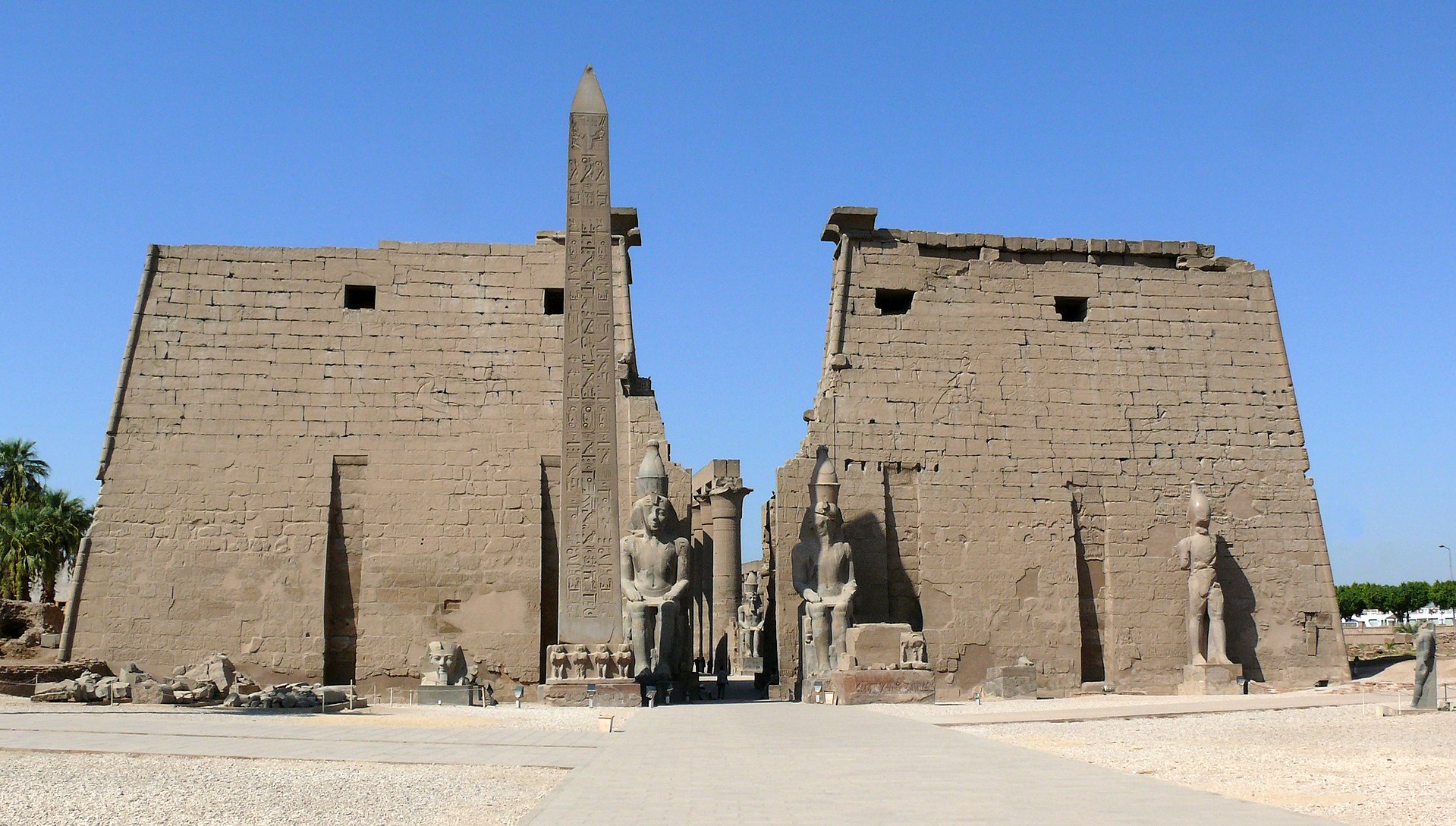
The entrance is dominated by two seated statues of Ramesses II -- each carved from a single block of red granite -- flanking a pylon gateway that once held a pair of obelisks. One obelisk remains; its twin has stood in the Place de la Concorde in Paris since 1836, a gift from Muhammad Ali Pasha to France. The surviving obelisk rises 25 meters and still bears hieroglyphs praising Ramesses as a living god. The architectural heart of Luxor Temple lies in two connected spaces: Amenhotep III's colonnade and Ramesses II's court. The colonnade consists of fourteen papyrus-bud columns, their shafts rising over 15 meters. The walls carry elaborate reliefs depicting the Opet Festival in extraordinary detail -- musicians, dancers, sacrificial cattle, and the sacred barques of Amun, Mut, and Khonsu. Ramesses II's court is surrounded on three sides by a double row of columns with papyrus-cluster capitals. No feature illustrates the temple's layered history more dramatically than the Mosque of Abu Haggag, built in the thirteenth century CE atop accumulated debris -- its foundation sits roughly nine meters above the pharaonic pavement. The mosque honors a Sufi saint whose annual moulid festival draws thousands, with wooden boats paraded through the streets in a tradition some scholars link to the ancient Opet Festival.
Excavation History
Luxor Temple's urban context is not a modern intrusion but a continuation of its original character: ancient Thebes was a densely populated capital, and the temple served as its spiritual heart. The site's unbroken thread of religious use across four millennia makes it singular. The pharaohs processed here during the annual Opet Festival. Alexander the Great rebuilt the inner sanctuary. Roman legions converted a section into a military shrine. When centuries of Nile silt buried the temple to its column capitals, medieval Egyptians built a mosque directly on top -- a mosque that remains active today. When archaeologists excavated the courtyard in the nineteenth and twentieth centuries, they carefully preserved the mosque in place, creating the surreal sight of a minaret rising from what was once a temple rooftop. Whether coincidence or continuity, the parallel between the boat procession of Abu Haggag's festival and the ancient Opet Festival suggests that Luxor's role as a site of processional worship has outlasted its original religion by three thousand years.
When to Visit
No feature illustrates Luxor Temple's layered history more dramatically than the Mosque of Abu Haggag. Built in the thirteenth century CE atop accumulated debris, the mosque's foundation sits roughly nine meters above the pharaonic pavement. When archaeologists excavated the courtyard below in the nineteenth and twentieth centuries, they carefully preserved the mosque in place, creating the surreal sight of a minaret rising from what was once a temple rooftop. The mosque honors Sheikh Yusuf Abu Haggag, a Sufi saint whose annual moulid festival draws thousands of pilgrims to Luxor each year. During the celebration, wooden boats are paraded through the streets -- a tradition some scholars link to the ancient Opet Festival when Amun's sacred barque traveled between Karnak and Luxor temples. Whether coincidence or continuity, the parallel suggests that Luxor's role as a site of processional worship has outlasted its original religion by three thousand years.
Admission and Costs
The architectural heart of Luxor Temple lies in two connected spaces: Amenhotep III's colonnade and Ramesses II's court. The colonnade consists of fourteen papyrus-bud columns arranged in two rows, their shafts rising over 15 meters to support missing architraves. The walls between them carry elaborate reliefs depicting the Opet Festival in extraordinary detail -- musicians, dancers, sacrificial cattle, and the sacred barques of Amun, Mut, and Khonsu being carried by priests. These carvings constitute one of the most complete visual records of a pharaonic religious ceremony.
Ramesses II's court, added in front of the colonnade, is surrounded on three sides by a double row of columns with papyrus-cluster capitals. Colossal statues of the pharaoh -- some standing, some seated -- punctuate the space, and the walls are carved with scenes of Ramesses smiting enemies and making offerings to the gods. An Egyptologist can point out where Ramesses usurped earlier monuments by re-carving cartouches, a common practice that makes attribution tricky without expert guidance.
Tips for Visitors
The temple opens daily at 6 AM and closes at 9 PM year-round. General admission costs EGP 360 (about $7), with student rates available for holders of valid international student IDs. Photography is included with the standard ticket -- no additional camera permit is required, making Luxor Temple one of the most photography-friendly major sites in the region. Group tours with licensed guides typically run $25-40 per person excluding the entrance fee; private Egyptologists charge $60-120 for a 90-minute to two-hour session for up to six visitors.
The main courtyard and colonnade are largely flat, making Luxor Temple one of the more accessible ancient sites for visitors with mobility limitations, though sand and some stone thresholds remain challenging for wheelchairs. For those planning to walk the restored Avenue of Sphinxes to Karnak, starting early in the morning at Karnak and arriving at Luxor Temple by late morning offers ideal light for photography at both ends. The nearly three-kilometer walk retraces the ancient processional route and provides wonderful perspective shots as the sphinx corridor stretches toward the horizon.