

Overview
Karnak is not a single temple but a sprawling sacred city that thirty successive pharaohs expanded over nearly two thousand years, from the Middle Kingdom around 2000 BC through the Ptolemaic period. Covering more than 200 acres on Luxor's East Bank, it dwarfs every other religious complex on the planet — the entire footprint of Notre-Dame Cathedral would fit inside its Great Hypostyle Hall alone. Each ruler who added a pylon, obelisk, or chapel was competing with predecessors for divine favor, and the result is an overwhelming palimpsest of Egyptian history carved in sandstone. The complex is dedicated primarily to Amun-Ra, king of the gods during Thebes' golden age, though smaller precincts honor Mut and Montu. Visiting with a licensed Egyptologist transforms the maze of walls and columns into a legible timeline that stretches from the earliest pharaohs to the Greco-Roman occupation. Without guidance, the sheer accumulation of monuments can feel chaotic; with it, each court and chapel reveals its builder's ambitions and the theological currents of its era.
Key Artifacts
No photograph prepares you for the scale of the Great Hypostyle Hall. One hundred thirty-four columns fill an area the size of a football pitch, arranged in sixteen rows that create a stone forest where shafts of morning light slice through clerestory windows. The twelve central columns rise to nearly 24 meters and are thick enough that six adults linking hands cannot encircle their bases. Their papyrus-bud capitals once supported a cedar roof, now vanished, that would have plunged the interior into sacred twilight. Every visible surface is carved. Battle scenes from Seti I's Syrian campaigns cover the north exterior wall in exquisite low relief; Ramesses II's less refined but more emphatic carvings dominate the south. Traces of original paint survive on sheltered capitals — ochre, blue, and green pigments that hint at how blindingly colorful the hall once appeared. Guides know where to find these fragments and can decode the hieroglyphic hymns to Amun that march in vertical columns up each shaft.
Excavation History
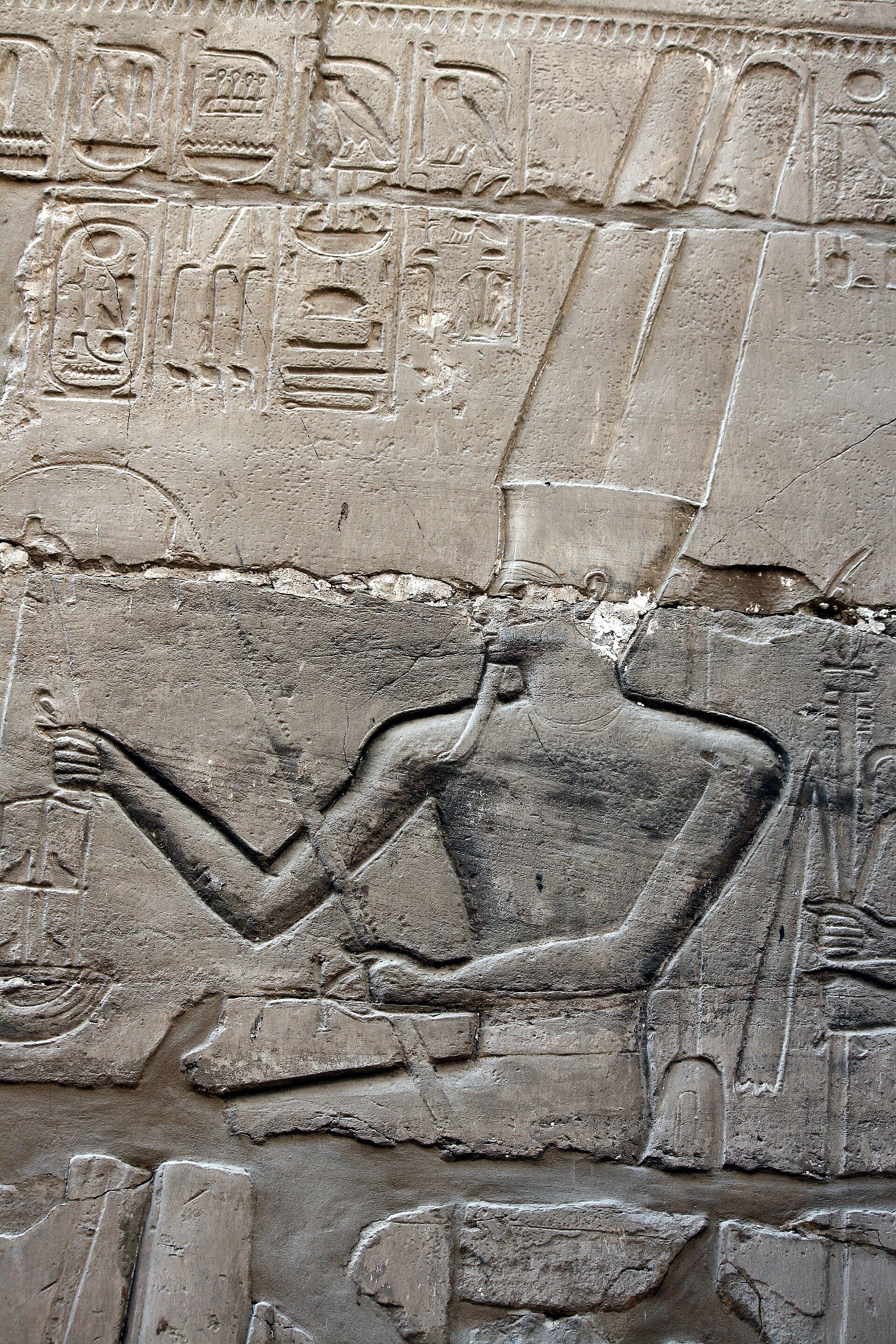
Karnak's oldest surviving structure dates to the Middle Kingdom reign of Senusret I, around 1950 BC, but most visible remains span the New Kingdom's five centuries of expansion. Thutmose I erected the fourth and fifth pylons and raised Egypt's first monumental obelisks here. His daughter Hatshepsut added her own towering obelisk -- at 29.5 meters still the tallest standing in Egypt -- and built a quartzite chapel whose blocks were later dismantled and hidden inside the third pylon by her nephew Thutmose III, who resented her claim to the throne. Ramesses II, never one for subtlety, stamped his cartouche across earlier monuments and constructed much of the forecourt visible today. The Ptolemies, ruling a thousand years after Ramesses, added the massive first pylon that now serves as the entrance but left it unfinished -- the mud-brick construction ramps still lean against its inner face, frozen in mid-project. A processional avenue once linked Karnak to Luxor Temple three kilometers to the south. For centuries the corridor lay buried, but a decades-long excavation project restored its length and reopened the route in 2021. This layered accumulation means that walking into Karnak is walking backward through time: the newest construction greets you first, and the oldest sanctuaries wait at the complex's heart.
When to Visit
Behind the central temples lies a rectangular pool measuring roughly 120 by 77 meters, its stone-lined banks still holding water after three millennia. Priests purified themselves here before performing rituals, descending steps that remain visible on the northern edge. In the early morning, before tour groups arrive, the lake's surface mirrors the temple pylons with glassy stillness -- a scene that has changed little since the New Kingdom.
At the lake's northwest corner sits a large granite scarab beetle mounted on a pedestal. Local tradition holds that walking counterclockwise around it seven times brings good luck, though the statue's original purpose was to honour Khepri, the dawn aspect of the sun god. Whether or not you subscribe to the superstition, the scarab offers a quiet spot to rest and observe the complex's geography before continuing exploration.
Admission and Costs
Karnak's oldest surviving structure dates to the Middle Kingdom reign of Senusret I, around 1950 BC, but most visible remains span the New Kingdom's five centuries of expansion. Thutmose I erected the fourth and fifth pylons and raised Egypt's first monumental obelisks here. His daughter Hatshepsut added her own towering obelisk -- at 29.5 meters still the tallest standing in Egypt -- and built a quartzite chapel whose blocks were later dismantled and hidden inside the third pylon by her nephew Thutmose III, who resented her claim to the throne.
Ramesses II, never one for subtlety, stamped his cartouche across earlier monuments and constructed much of the forecourt visible today. The Ptolemies, ruling a thousand years after Ramesses, added the massive first pylon that now serves as the entrance but left it unfinished -- the mud-brick construction ramps still lean against its inner face, frozen in mid-project. This layered accumulation means that walking into Karnak is walking backward through time: the newest construction greets you first, and the oldest sanctuaries wait at the complex's heart. General admission costs EGP 450 (about $9), with a supplementary EGP 50 for the open-air museum. A separate evening ticket (EGP 400) grants access to the Sound and Light Show.
Tips for Visitors
Behind the central temples lies the Sacred Lake, a rectangular pool measuring roughly 120 by 77 meters still holding water after three millennia. At the lake's northwest corner sits a large granite scarab beetle; local tradition holds that walking counterclockwise around it seven times brings good luck. Visiting both Karnak and Luxor Temple in a single morning and walking the restored Avenue of Sphinxes between them provides the most complete experience of Theban worship. The Karnak end of the avenue is flanked by criosphinxes -- ram-headed sphinxes sacred to Amun. Wear sturdy closed-toe shoes, carry ample water, and remember that the entire complex is unshaded sandstone: a wide-brimmed hat and sunscreen are essential gear year-round. The temples of Montu and Mut, the Botanical Garden of Thutmose III with its carved Syrian flora, and the Festival Hall whose columns are uniquely shaped like tent poles reward those who explore beyond the main axis.