

Overview
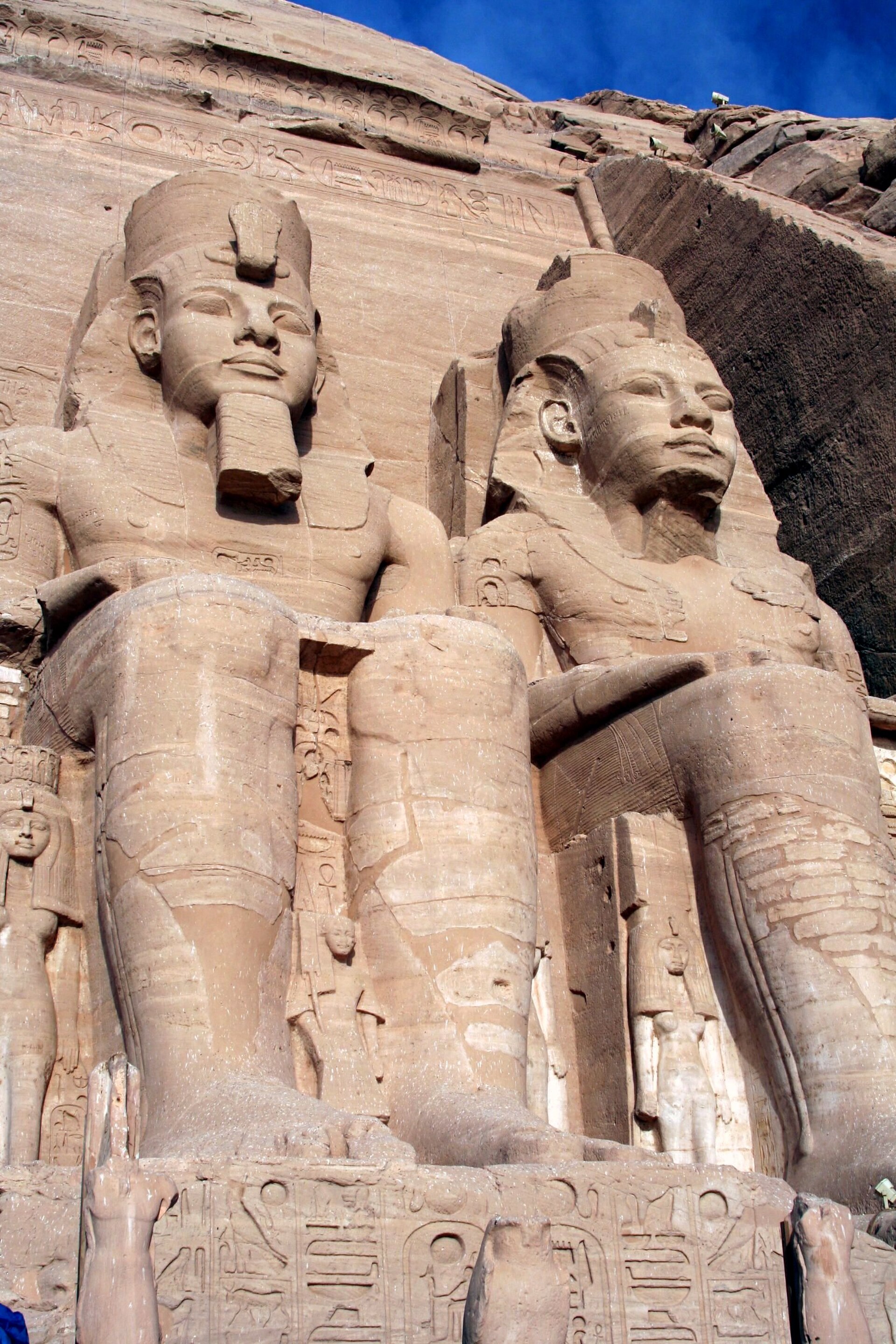
Abu Simbel comprises two temples carved directly into a sandstone cliff on the western bank of Lake Nasser, roughly 280 kilometers south of Aswan and just 40 kilometers north of the Sudanese border. Ramesses II commissioned the Great Temple around 1264 BC to commemorate his claimed victory at the Battle of Kadesh and to project pharaonic power toward Nubia. Four seated colossi of Ramesses, each standing 20 meters tall, flank the entrance and stare eastward across the water with expressions unchanged in over three thousand years. Beside the Great Temple sits the smaller but equally striking Temple of Nefertari, dedicated to the goddess Hathor and to Ramesses' principal wife. For official information, see UNESCO Nubian Monuments.
Excavation History
When the Aswan High Dam was being constructed in the 1960s, rising waters from the new Lake Nasser threatened to submerge these temples forever. What followed was one of the most ambitious archaeological rescue missions in human history. Between 1964 and 1968, UNESCO coordinated an international salvage campaign involving specialists from over fifty countries. Engineers faced an unprecedented challenge: how do you move a mountain without destroying what makes it sacred? The solution was audacious. Workers cut both temples into more than 1,000 blocks, some weighing up to 30 tonnes, and reassembled them 65 meters higher and 200 meters back from the original cliff face. To replicate the natural landscape, construction crews built an artificial hill using a reinforced concrete dome hidden beneath a carefully sculpted exterior. The operation cost $40 million at the time, equivalent to roughly $360 million in today's currency. Standing inside the temples today, you would never know they were moved unless someone told you. The precision required to maintain the original solar alignment—accurate to within millimeters—represents engineering that rivals the original construction by Ramesses' architects.
Key Artifacts
Beyond the colossal facade lies a carefully orchestrated journey into sacred space. The hypostyle hall immediately inside features eight Osiride pillars depicting Ramesses in the pose of the god of the afterlife, their surfaces covered with painted reliefs that retain surprising color after three thousand years. The northern wall displays the longest pictorial record of a single battle in ancient Egyptian art: the Battle of Kadesh, showing chariot formations, divine interventions, and royal propaganda that historians continue to debate. Moving deeper, the ceiling height decreases and the corridors narrow, creating a sense of compression that amplifies the sanctuary's power. The innermost chamber, reached only by penetrating 60 meters of solid rock, housed the most sacred rituals. Here sit four statues -- Amun-Ra, Ra-Horakhty, the deified Ramesses II, and Ptah -- that receive the sun's rays during the biannual sun festivals. Twice each year, at dawn on February 22 and October 22, the rising sun penetrates the corridor and illuminates three of the four statues; Ptah, god of the underworld and darkness, remains perpetually in shadow -- a deliberate design choice demonstrating the ancient architects' astronomical sophistication. The smaller Temple of Nefertari beside the Great Temple breaks with Egyptian convention: its facade features six standing colossi -- four depicting Ramesses and two depicting his principal wife -- all carved at equal height. Inside, reliefs show Nefertari making offerings to Hathor, with some of the most delicate painted carvings in Egypt.
When to Visit
Beyond the colossal facade lies a carefully orchestrated journey into sacred space. The hypostyle hall immediately inside features eight Osiride pillars depicting Ramesses in the pose of the god of the afterlife, their surfaces covered with painted reliefs that retain surprising color after three thousand years. The northern wall displays the longest pictorial record of a single battle in ancient Egyptian art: the Battle of Kadesh, showing chariot formations, divine interventions, and royal propaganda that historians continue to debate. Side chambers served as storerooms for temple offerings and ritual objects. Moving deeper, the ceiling height decreases and the corridors narrow, creating a sense of compression that amplifies the sanctuary's power. The innermost chamber, reached only by penetrating 60 meters of solid rock, housed the most sacred rituals. Here sit the four statues that receive the sun's rays during the festivals. For most of the year, they wait in near-total darkness, illuminated only by torchlight -- flash photography is strictly prohibited to preserve the ancient pigments. The site lies deep in the Western Desert, roughly 280 kilometers south of Aswan. The road convoy departs between 3 and 4 AM, traveling in a police-escorted caravan across three hours of desert highway. The early departure ensures arrival at sunrise, when golden light strikes the facade most dramatically. Most day trips allow two to three hours at the site before the return journey. EgyptAir operates morning flights from Aswan, cutting travel time to 45 minutes each way. During the February 22 and October 22 sun festivals, thousands gather before dawn to witness the sun illuminate the inner sanctuary statues. Book accommodation at least three months ahead for these dates.
Admission and Costs
The smaller temple beside the Great Temple breaks with Egyptian convention in a remarkable way. Its facade features six standing colossi -- four depicting Ramesses and two depicting his principal wife Nefertari -- all carved at equal height. In a culture where queens were typically shown reaching only to the pharaoh's knee, this parity speaks volumes about Nefertari's political and personal importance. An inscription proclaims that Ramesses built this temple "for the great royal wife Nefertari, beloved of Mut, for whom the sun does shine." Inside, reliefs show Nefertari making offerings to Hathor, goddess of love, music, and motherhood. The interior walls preserve some of the most delicate painted carvings in Egypt. Entry to the temples costs EGP 600 (approximately $12) per person. Photography permits for the interior cost an additional EGP 300, though flash is strictly prohibited. During the February and October sun festivals, expect all prices to double or triple. A private guide arranged through Aswan agencies typically costs $60-120 for up to six people.
Tips for Visitors
Getting to Abu Simbel requires commitment. The site lies deep in the Western Desert, and visitors have two primary options: the desert convoy or a short flight. The road convoy departs from Aswan between 3 and 4 AM, traveling in a police-escorted caravan across three hours of empty desert highway. The early departure ensures arrival at sunrise, when golden light strikes the facade most dramatically and before the crushing midday heat sets in. Most day trips allow two to three hours at the site before the return journey. EgyptAir operates morning flights from Aswan, cutting travel time to 45 minutes each way. The flight costs significantly more than the convoy but eliminates six hours of desert driving and leaves time for other Aswan attractions the same day. For those seeking the fullest experience, consider staying overnight at one of the lakeside hotels near Abu Simbel -- Seti Abu Simbel and Nefertari Hotel both offer modest rooms with extraordinary views. An overnight stay allows you to visit at both sunrise and sunset, experiencing the temples without convoy crowds and watching Lake Nasser's waters turn gold as the sun drops behind the Saharan horizon. Entry to the temples costs EGP 600 (approximately $12) per person. Photography permits for the interior cost an additional EGP 300, though flash is strictly prohibited inside to preserve the ancient pigments. The relocation shifted the sun festival alignment by one day from the original dates -- a minor but poignant reminder that even the most careful engineering cannot perfectly replicate three millennia of celestial calibration. Without expert narration, the Battle of Kadesh reliefs remain beautiful but cryptic; with a guide, you witness Ramesses' chariot charges, Hittite ambushes, and the divine intervention that supposedly saved the pharaoh's life -- along with scholarly debates about what actually happened versus royal propaganda.