

Overview
Hidden beneath the busy Karmouz district of Alexandria, the Catacombs of Kom El Shoqafa remained sealed and forgotten for roughly 1,600 years until 1900, when a donkey hauling a cart suddenly vanished through the ground. The animal had broken through into the uppermost shaft of a vast underground burial complex dating to the second century AD — a period when Egypt was a Roman province yet its people still worshipped ancient gods and embalmed their dead in pharaonic fashion. What archaeologists uncovered below was unlike anything else in the Mediterranean: a three-level necropolis carved from bedrock where Egyptian, Greek, and Roman artistic traditions swirl together on every wall. The name Kom El Shoqafa translates as "Mound of Shards," a reference to the broken terracotta pots that ancient mourners left behind after funerary banquets. The catacombs were originally built for a single wealthy family but expanded over decades into a communal burial site holding more than 300 individuals across interconnected corridors and chambers. The deepest level is now permanently flooded by rising groundwater, adding an eerie sense of mystery to a site that archaeologists have only partially explored. Visiting without a guide means admiring carved reliefs in dim light with little understanding; with one, every figure on the walls tells a story of cultural fusion that defined Roman Alexandria.
Key Artifacts
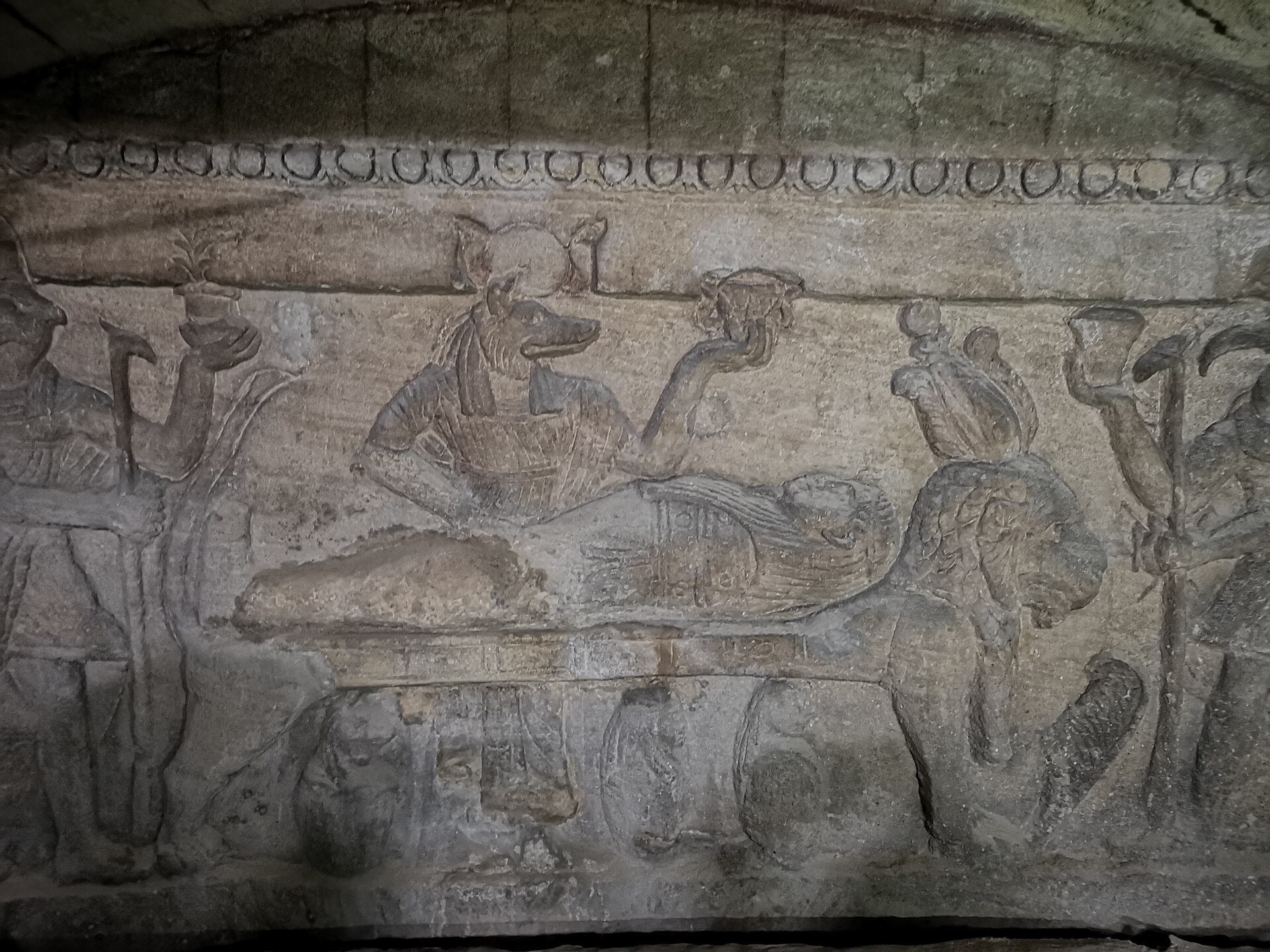
The visual language of Kom El Shoqafa defies easy categorization, and this deliberate ambiguity gives the site its archaeological significance. Consider the serpents guarding the principal tomb: they wear the double crown of Upper and Lower Egypt, the ancient symbol of pharaonic sovereignty, yet their bodies coil in poses borrowed from Greek art and the doorway they flank is decorated with Roman garlands and grapes. This is not confusion or incompetence — it is synthesis. The wealthy Alexandrians who commissioned these carvings lived in a cosmopolitan city where Egyptian priests served alongside Greek philosophers and Roman administrators. Their tomb reflects the same blending of identities they practiced in life. The most striking example of this cultural dialogue appears on the vestibule walls, where the jackal-headed god Anubis stands in full Roman military dress. He holds a round shield and spear like a legionary, yet his canine head and role as guardian of the dead are purely Egyptian. Elsewhere, Medusa's head — a Greek symbol of protective menace — appears on tomb facades meant to frighten away grave robbers, placed beside hieroglyphic-style cartouches and lotus-column capitals. Guides trained in Alexandrian history decode these juxtapositions, explaining which elements derived from pharaonic tradition, which from Hellenistic sculpture, and how Roman patrons paid for it all during the imperial period when Egypt supplied grain to feed Rome's hungry millions.
Excavation History
The catacombs welcome visitors daily from 9 AM to 5 PM, with last entry at 4:30 PM. Arriving early — between 9 and 10:30 AM — lets you explore before tour-bus groups arrive from Cairo, when the narrow passages feel less congested. General admission runs approximately 200 Egyptian pounds for foreign visitors, with student discounts available for those carrying valid international ID. Photography without flash is permitted, though tripods and video equipment require a separate permit that most casual visitors will not bother to obtain. Wear sturdy closed-toe shoes: the spiral staircase and underground floors can be damp, especially near the flooded lower level, and loose sandals invite slips on smooth stone. Bring a small flashlight or use your phone — official lighting highlights the major features, but many secondary carvings sit in deep shadow, and a directed beam reveals painted pigment traces invisible to the unaided eye. If confined spaces make you uncomfortable, visit during quieter hours when the corridors feel less compressed; some passages narrow to about 1.5 meters wide and the ceilings dip to 1.8 meters in places. Pompey's Pillar and the Serapeum complex stand just 500 meters south, making a natural pairing for a single morning's exploration before heading to the Bibliotheca Alexandrina or the Citadel of Qaitbay along the Corniche.
When to Visit
The physical experience of entering Kom El Shoqafa begins with a wide spiral staircase that coils around a central shaft. This shaft once served a grim practical purpose: lowering sarcophagi and wrapped bodies by rope to their final resting places in the chambers below. The staircase wraps around it in a gentle helix, each turn bringing you deeper underground and further from the noise of modern Alexandria. The temperature drops steadily — by the time you reach the first level, the air holds a constant chill between 18 and 20 degrees Celsius regardless of the searing heat above. Light is deliberately subdued throughout the complex, both to protect the ancient carvings and to preserve something of the atmosphere that ancient mourners would have experienced by flickering torchlight. The bedrock walls absorb sound, creating a hush that encourages whispered conversation. Passages branch in several directions with minimal modern signage; a guide who knows the layout leads you through chambers in archaeological sequence, explaining how the original family tomb expanded over generations as relatives and eventually unrelated families purchased space in the expanding network. Some corridors dead-end at rough-hewn walls where workers stopped carving; others open into chambers lined with niches for individual burials, the shelves now empty but once holding hundreds of wrapped bodies.
Admission and Costs
One of the most evocative spaces in the catacombs is the triclinium, a U-shaped banquet hall where ancient mourners gathered to share ritual meals with their dead. The room takes its name from the Roman custom of reclining on three couches arranged around a central table, and the stone benches here faithfully reproduce that arrangement. Families would descend into the catacombs on anniversaries of death, carrying food and wine to consume in the presence of their ancestors. The tradition blended Roman dining customs with Egyptian beliefs about sustaining the ka, or spirit, of the deceased through offerings. Look closely at the floor near the benches and you can see shallow channels carved into the stone — libation conduits through which wine or water was poured as an offering to the dead. The walls above the couches retain traces of painted decoration, though centuries of humidity have faded most pigment to ghostly suggestions of their original colors. Guides often pause here to recreate the scene: torches flickering in wall brackets, families reclining on the stone couches with platters of bread and roasted meat, conversation mingling with ritual prayers for the spirits resting in the chambers just beyond. The broken pottery that gave the site its name — "Mound of Shards" — accumulated over decades of such feasts, as mourners smashed their vessels after use rather than carry them back to the surface.
Tips for Visitors
A separate gallery on the first level bears the name of the Roman emperor Caracalla, though the connection is more legend than confirmed history. Ancient sources record that Caracalla visited Alexandria in 215 AD and ordered a massacre of the city's youth after they mocked him in satirical verses. The horse and ox bones discovered in this chamber led early excavators to speculate that the space served as a mass grave for victims of that slaughter, or perhaps for animals sacrificed in their memory. Modern archaeologists are more cautious, noting that animal remains appear in many Roman burial contexts without necessarily indicating violence. What is certain is that the catacombs continued to reveal surprises long after their accidental discovery in 1900. Groundwater has gradually risen over the past century, permanently flooding the third and lowest level. Divers who have explored these submerged corridors report additional chambers, carved reliefs never seen by archaeologists working on dry ground, and tantalizing hints that the complex extends further than any published plan suggests. The flooded passages remain largely undocumented, and visitors peering down from the second level see only dark greenish water obscuring whatever lies beneath. This sense of the unknown — of passages and burials still hidden — gives Kom El Shoqafa an atmosphere that more fully excavated sites lack.