
What To Buy
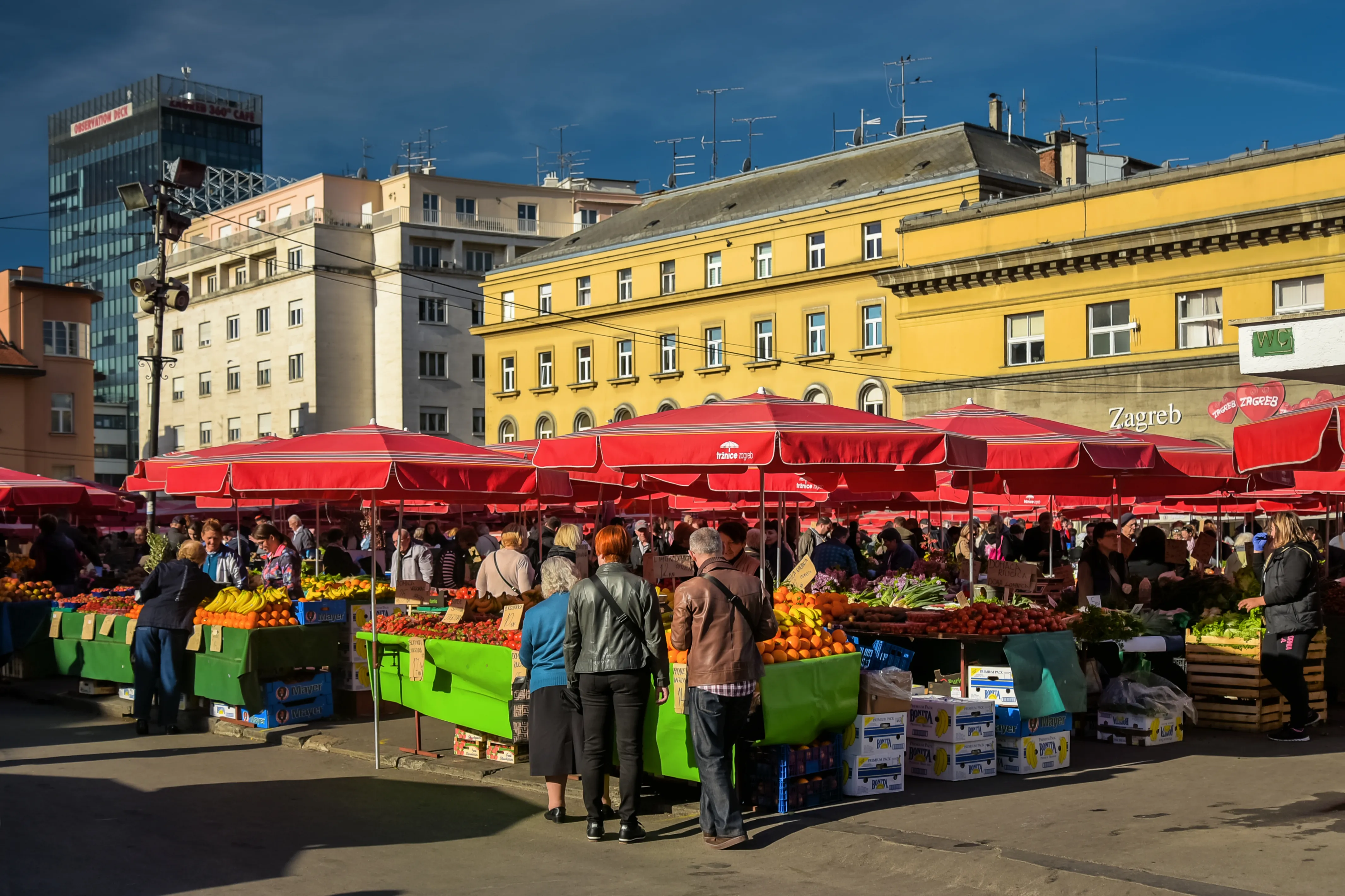
Dolac rewards seasonal, perishable-but-portable shopping. Fresh fruit and vegetables dominate the open-air tables — strawberries and cherries in late spring, peppers and tomatoes in summer, and squashes, chestnuts, and wild mushrooms in autumn. Local cheeses are a highlight: look for the firm, salty škripavac and creamy fresh cottage cheese (svježi sir). Cured meats such as kulen and pršut travel well as edible souvenirs, as do jars of Croatian honey, olive oil, and rakija (fruit brandy) from nearby producers. The flower section is famous, and even if you cannot carry blooms home, the cut-flower stalls are among the market's most colourful corners. The covered hall is the place for fish and freshly baked bread.
Food Stalls
While Dolac is primarily a produce and provisions market rather than a street-food court, you will not go hungry around its edges. The market is ringed by small bakeries and snack counters selling burek (flaky filled pastry), štrukli, and fresh bread, ideal for eating on the move. Vendors in the covered hall offer cheese, cured meat, and olives that can be sampled and assembled into an instant picnic. Just steps away, the streets toward Tkalčićeva are lined with cafés and casual eateries where you can sit down with a coffee or a plate of grilled food. The classic Dolac experience is to buy directly from the stalls — fruit, cheese, bread, a few slices of pršut — and picnic on a bench overlooking Ban Jelačić Square.
When to Visit
Dolac runs daily, generally Monday to Friday from about 7 AM to 3 PM, Saturdays from 7 AM to 3 PM, and Sundays with reduced hours, roughly 7 AM to 1 PM, when fewer stalls operate. The open-air section is at its fullest in the morning, between 7 and 11 AM; arrive then for the widest choice and the most energy. The covered hall below tends to stay open a little later than the upper terrace. Allow 30–60 minutes to wander, longer if you stop to assemble a picnic or chat with vendors. Mornings also bring the best light for photographing the red parasols from the upper terrace.
Admission and Costs
Entry to Dolac is free — it is a public market, not a ticketed attraction. Prices are set by individual vendors and are typically lower than supermarkets for seasonal produce. As rough guides: a kilo of seasonal fruit runs about €2–4 (around $2–4); a wedge of local cheese €8–15 per kilo (about $9–16); a small jar of honey €5–8 (about $5–9); a bunch of flowers from a few euros. Bring small cash in euros, as many farm stalls do not take cards, and prices on the open-air tables are generally fixed rather than haggled. A satisfying market picnic for two can be assembled for €10–15 (about $11–16).
The Case for a Guide
Dolac is easy to enjoy unguided, but a local food-focused guide unlocks layers that a casual stroll misses.
- Knowing what is in season: A guide steers you to whatever is at its peak that week, from wild asparagus in spring to chestnuts in autumn, and away from imported filler
- Meeting the right vendors: Long-standing sellers of cheese, honey, or cured meat are not obvious to newcomers; a guide knows whose škripavac cheese or kulen sausage to buy
- Tasting traditions explained: A guide can explain štrukli, sir i vrhnje (cottage cheese and cream), and other Zagreb specialities and where the ingredients come from
- Language and etiquette: A few words of Croatian and an understanding of market customs make purchases smoother and friendlier
- Linking food to the city: Tying Dolac to nearby Kaptol, the cathedral, and the Upper Town turns a shopping stop into a story about how Zagreb eats and lives
Tips for Visitors
Come hungry and early: The market is freshest and liveliest before 11 AM, especially on Saturday. Carry cash: Small euro notes and coins are essential for the open-air farm stalls. Bring a bag: Vendors may not provide one, and a reusable tote makes carrying a picnic easy. Explore both levels: Many visitors photograph the red parasols and leave, missing the covered hall of cheese, meat, and fish below. Be considerate with photos: The kumice are used to cameras, but a smile or a small purchase first is good manners. Pair it with breakfast: Buy fruit and cheese here, then eat on Ban Jelačić Square or carry it up toward the Museum of Broken Relationships in the Upper Town.
Frequently Asked Questions
Why is Dolac called the "belly of Zagreb"?
The nickname trbuh Zagreba — the belly of Zagreb — sums up the market's role as the place that has fed the city for generations. Since it opened in 1930, farmers from the Zagorje hills and the Slavonian plains have hauled their produce up to this terrace before dawn, and from Dolac the fruit, cheese, eggs, meat, and flowers fan out to the kitchens, konoba restaurants, and homes of the capital. The phrase is at once literal — this is quite simply where Zagreb's food comes from — and affectionate, a nod to how central the daily ritual of market shopping remains to local life. It has stuck so firmly that it now turns up on postcards, in guidebooks, and on the market's own signage.
How old is Dolac Market, and when did it open?
Dolac opened on 1 September 1930, which puts it not far off a century of continuous trading and makes it one of the longest-running daily markets in this corner of Europe. Before it existed, Zagreb's produce sellers spread informally across Ban Jelačić Square and the lanes around it; to tidy the growing capital, the city cleared a block of old houses on the slope up toward Kaptol and gave the traders a single purpose-built terrace, and farmers have gathered on it every morning since. That continuity is the whole point — some ninety-five years on, Dolac is still a working farmers' market rather than a heritage reconstruction, which is exactly why locals treat it as part of daily life rather than a monument to photograph and leave.
Why is Dolac covered in so many identical red umbrellas?
The rows of bright red parasols — known locally as šestine umbrellas after a traditional regional style — shade the open-air stalls of farmers selling directly from raised concrete tables. They have become the market's unmistakable visual signature, photographed from the terrace above and turned into fridge magnets across the city. Practically, they protect produce and vendors from sun and rain; symbolically, the uniform red has made Dolac one of the most recognisable images of Zagreb, second only to the cathedral spires that rise just behind it.
Who are the kumice, the women running the stalls at Dolac?
The kumice are Dolac's traditional market women — growers, many of them older, who come in from the villages of the Zagorje and Prigorje hills around the capital to sell their own fruit, vegetables, cheese, and flowers directly from the raised stone tables. They once sold in regional folk dress, and while everyday clothes are the norm today, the kumica remains the human face of the market and a living link to the rural countryside that still feeds Zagreb. A bronze statue of a kumica with her basket stands at the edge of the terrace, a small tribute to the generations of women who have supplied the city's kitchens. A few words of Croatian and a small purchase go a long way with them, and a smile before a photograph is simple good manners.
When is the best time of day to experience Dolac at its liveliest?
Come between 7 AM and 11 AM, especially on a Friday or Saturday, when farmers arrive with the freshest produce and locals do their main shopping. The atmosphere is busiest, the selection widest, and the haggling and chatter at their best. By early afternoon many open-air sellers begin packing up, and by mid-afternoon the upper market is winding down, though the covered hall below stays active a little longer. Avoid arriving late in the day if you want the full sensory experience.
What days is Dolac Market open, and what are its hours?
Dolac trades every day of the week, though the rhythm shifts as the week goes on. The open-air terrace of farm stalls is fullest Monday to Saturday from about 7 AM until early afternoon, roughly 2 to 3 PM, while Sunday is a shorter, quieter session — many growers stay home, but you will still find a reduced spread of produce and flowers until around 1 PM. The covered hall of butchers, fishmongers, and cheese sellers below the terrace tends to keep going a little later than the umbrellas above it. Croatian public holidays can thin the stalls further or close the market entirely, so treat a major feast day as uncertain. Whatever the day, aim for the 7-to-11 AM window, when the tables are freshest and the terrace is at its liveliest.
Is Dolac somewhere tourists actually buy things, or just a photo stop?
Both. Plenty of visitors come simply to photograph the red parasols and the view toward the cathedral, but Dolac is a genuine working market where you can buy a picnic's worth of food. Seasonal fruit, fresh cheese, cured meats, olives, honey, and flowers all travel well, and vendors are used to small purchases. If you are self-catering or assembling a riverside picnic, it is far cheaper and fresher than the supermarkets, and buying something is the friendliest way to engage with the sellers.
Is Dolac Market worth visiting?
For most visitors, yes — and it costs nothing to walk in. Dolac hands you Zagreb's most photographed everyday scene, the sea of red parasols with the cathedral spires rising behind, alongside a genuine working farmers' market where you can assemble a cheap picnic of cheese, seasonal fruit, and pršut. It sits a two-minute climb from Ban Jelačić Square and slots neatly between the main square and Zagreb Cathedral, so it rarely costs you a detour. Skip it only if you can reach it only mid-afternoon, once the open-air stalls have largely packed up, or on a quiet Sunday — otherwise a morning stop of 30 to 60 minutes is one of the easiest and most rewarding things to do in the centre of Zagreb.
How does Dolac fit with the other sights right next to it?
Dolac sits on a terrace directly above Ban Jelačić Square and just below Kaptol and Zagreb Cathedral, so it slots naturally into a compact morning. Most people climb up from the main square, browse the market, then continue to the cathedral or up into the Upper Town. Combining Dolac with the surrounding old-town streets and a coffee on Tkalčićeva makes an easy half-day of central Zagreb without needing any transport.
How do you get to Dolac Market?
Dolac sits on a raised terrace immediately above Ban Jelačić Square, the central hub of Zagreb's tram network, so reaching it is effortless. ZET trams 6, 11, and 12 all stop on or beside the square, and from there it is a two-minute walk up the short flight of steps or the gentle ramp onto the market terrace. If you are coming downhill from Kaptol and Zagreb Cathedral, the market is barely a minute away, which is why most visitors fold the two into a single stroll. There is no visitor parking on the terrace and the surrounding old-town lanes are pedestrianised, so arrive on foot or by tram rather than by car.