
Landmarks Along
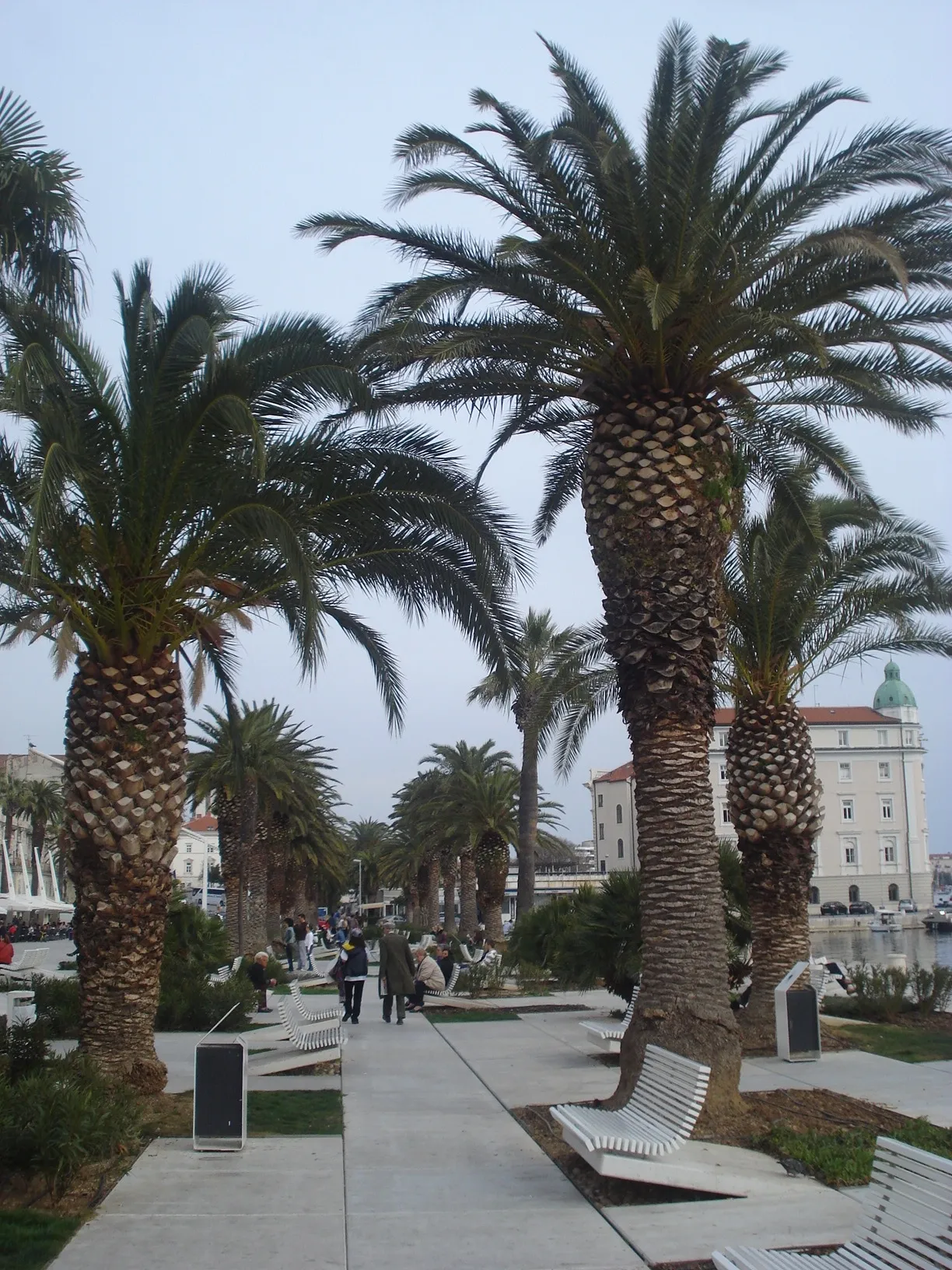
Several fixed points anchor a walk along the promenade. At the eastern end lie the ferry and catamaran terminals, the maritime gateway to the islands and the busiest pulse of the seafront. Midway, the southern gates of the old town — including the modest doorway once used as the palace's sea entrance — open directly off the Riva into the ancient streets behind. Just inland rises the bell tower of the Cathedral of St Domnius, visible above the rooftops as a constant orientation point. At the western end, the promenade flows toward the Matejuška fishermen's harbour, where wooden boats moor beneath Marjan, and continues toward the Sustipan headland. Throughout, the line of tall palms and the continuous café terraces form the Riva's own signature streetscape.
Photo Spots
The most photographed view is taken from the harbour pier looking back at the promenade, framing the row of palms against the white marble and the honey-coloured palace wall behind. For golden-hour shots, position yourself at the western end near Matejuška so the setting sun backlights the boats and the silhouetted strollers. The café terraces offer candid frames of Split's evening social life, while a climb to the nearby Cathedral of St Domnius bell tower delivers a sweeping aerial of the entire Riva curving along the water. After dark, the floodlit palms and lit café fronts reflected in the calm harbour make for atmospheric long exposures.
When to Visit
The Riva is a public promenade, open at all hours, with no gate or closing time. The single best window is the two hours around sunset, when the marble glows and the evening stroll fills the seafront. May, June, and September offer warm, comfortable evenings without the full crush of high summer; July and August are vibrant but hot and crowded, especially when cruise ships are in. Mornings are peaceful and ideal for an unhurried coffee. A casual walk end to end takes about 15 minutes; settling into the café culture as locals do can absorb an entire evening.
Admission and Costs
Walking the Riva costs nothing. The price of admission, in practice, is a drink: an espresso on a terrace runs about €2.50–4 (roughly $3–4), a beer or glass of wine €4–7 (about $4–8), and an ice cream from the kiosks €2–4 (about $2–4). A light meal at a waterfront café sits around €12–20 (about $13–22). There are no entry fees for the festivals and concerts staged on the promenade. A guided old-town walk that includes the Riva typically costs €20–30 (about $22–33) per person in a small group.
The Case for a Guide
The Riva looks simple, but a knowledgeable guide turns a pleasant stroll into a reading of the whole city's character and history.
- The 2007 redesign story: Explaining why a strip of pavement caused a citywide uproar — and what the modernist makeover replaced — reveals how passionately Split feels about its seafront
- Decoding the špica: The evening promenade has its own unwritten etiquette and social meaning; a guide explains who walks where, when, and why this ritual matters to locals
- The Napoleonic origins: Few visitors realise the palms and the embankment date to the French occupation; a guide traces the seafront's evolution from working dock to civic showpiece
- Linking sea and palace: A guide shows how the Riva's cafés sit directly against the Roman south wall, tying the modern promenade to Diocletian's Palace behind it
- Festival and ferry timing: Knowing when concerts, sports welcomes, or cruise crowds hit the Riva lets a guide steer you to the calm moments and the lively ones, whichever you want
Tips for Visitors
Come at dusk: Arriving for the evening špica is the difference between seeing the Riva and experiencing it. Nurse one drink: Order a single coffee and you have earned your terrace seat for as long as you like — no one will rush you. Look up at the palace wall: The café awnings hide the fact that you are sitting against the Roman south facade; step back into the square to see it. Mind the cruise schedule: When several ships dock, the promenade gets shoulder-to-shoulder by late morning; come early or late instead. Walk west to Matejuška: Continue past the promenade's end to the little fishermen's harbour, a favourite local sundown spot. Photograph from the harbour: The classic shot of the palm line and palace wall is taken looking back from the pier.
Frequently Asked Questions
Where exactly is the Riva and how do I find it?
The Riva runs along the southern edge of Split's old town, directly beneath the seaward wall of the historic palace. Walk through any of the southern gates of the centre and you step straight onto it. Its full name is the Obala hrvatskog narodnog preporoda (Croatian National Revival Embankment), but everyone, locals included, simply calls it the Riva.
When is the best time to stroll the Riva?
The promenade comes alive at dusk, when families, couples, and friends pour out for the evening špica — the ritual see-and-be-seen stroll. Late afternoon light on the white stone is gorgeous for photos, and summer nights stay busy past midnight. Early mornings are calm and good for a quiet coffee with the ferries gliding past.
Are there cafés and places to sit along the Riva?
The entire landward side is one continuous run of cafés and bars, most with shaded terraces of wicker chairs facing the harbour. A single coffee buys you a seat for as long as you like — that is the local custom. Public benches and the low marble ledges along the waterside offer free seating if you prefer to bring your own snack.
How does the Riva connect to the ferries and the rest of Split?
The promenade ends at the eastern harbour where the ferry and catamaran terminals depart for Hvar, Brač, Vis, and other islands, so the Riva doubles as the gateway to the Adriatic. Westward it leads toward the Matejuška fishermen's harbour and the foot of Marjan; northward, the palace gates open into the heart of Split.