
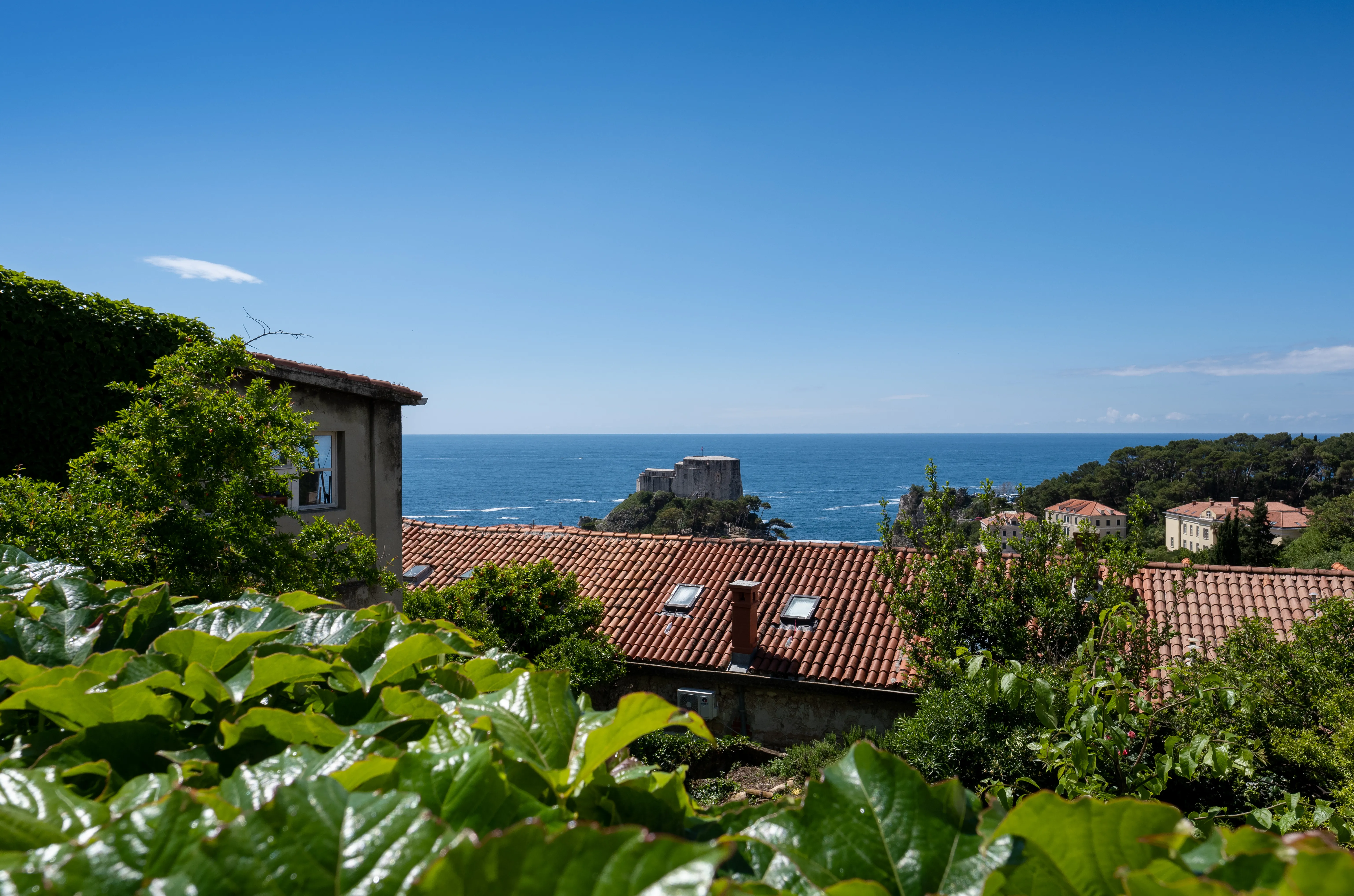
Fortification History
Fort Lovrijenac (Saint Lawrence) crowns a rock that Ragusan tradition says was fortified in haste in the early 11th century to forestall a Venetian foothold, though the structure visible today is largely the result of rebuilding after fires and the catastrophic 1667 earthquake. Its purpose never changed: to command the western sea approach and the Pile channel. The fortress is triangular, following the shape of the crag, with three terraces stacked at different heights so that cannon could fire over one another. The thickest walls — up to 12 metres — face the open sea, while the landward wall was kept thin on purpose so the city could demolish it if the fort fell. Inside the gate stretched a small garrison that rotated monthly, a Ragusan precaution against any commander growing powerful enough to seize the strongpoint and hold the Republic hostage.
Notable Rooms
Beyond the inscribed main gate with its liberty motto, the fort centres on a triangular inner courtyard ringed by stone arcades that once sheltered the garrison and stored powder and shot. Stairways climb to three open terraces at staggered heights, the uppermost giving the postcard panorama back across the Pile cove to the Old Town and the Minčeta tower on the walls. Vaulted casemates and gun positions are cut into the seaward mass, where the embrasures still frame slices of the Adriatic. During the Dubrovnik Summer Festival the largest terrace transforms into the celebrated open-air stage, its natural acoustics and sea backdrop making it one of Europe's most atmospheric theatrical settings.
When to Visit
Open daily in line with the city walls — roughly 8 AM to 6:30 PM in high summer, shortening to about 9 AM to 3 PM in winter; closing follows the daylight and the wall schedule, so check the day's hours at the Pile Gate ticket booth. Allow 30 to 45 minutes for the fort itself, plus the 10-minute walk and climb each way. The best light falls in late afternoon, when the low sun warms the stone and rakes across the Old Town opposite. During the Dubrovnik Summer Festival (mid-July to late August) the upper terraces may close to day visitors when rehearsals or performances are scheduled.
Admission and Costs
Entry is included in the Dubrovnik city walls ticket (€35 / about $38), which is the way most people visit. A standalone Lovrijenac ticket costs roughly €15 (about $16) at the base. Children under 7 enter free. Summer Festival theatre tickets are sold separately, typically €20–50 (about $22–54) depending on the production and seat. There is no charge for the staircase or the viewpoints around the Pile cove, so even non-ticket holders can photograph the fortress from below.
The Case for a Guide
The fort looks simple — one courtyard and some terraces — but its design and its political back-story are easy to miss without someone to point them out.
- The crossfire logic: A guide shows exactly how Lovrijenac and the Bokar tower were aimed to trap a fleet in the Pile channel, turning a single rock into a citywide defensive system
- The thin inner wall explained: The deliberately weak city-facing wall is the fort's most ingenious feature, designed so Dubrovnik could destroy its own fortress rather than let a captor hold it — a detail almost no one notices unaided
- Reading the inscription: The Latin motto over the gate encapsulates the Ragusan obsession with liberty, and a guide can connect it to the Republic's tribute payments and diplomacy
- Game of Thrones geography: Guides pinpoint precisely where the Blackwater battle and Red Keep scenes were shot, matching screen frames to the real terraces
- Festival context: Local guides explain how the fort became a legendary Hamlet stage and why Dubrovnik treats it as a cultural venue, not just a museum
Tips for Visitors
Combine it with the walls: Because one ticket covers both, do the city walls circuit first, then cross to Lovrijenac while the ticket is fresh. Mind the steps: The 175-step climb is steep and the courtyard floor is polished, slippery stone — wear grippy shoes and skip it in rain. Go late: Afternoon light on the Old Town across the water is far better than harsh midday glare, and the fort empties as cruise crowds leave. Bring water: There is no café or shop inside, and the terraces offer little shade. Photograph from below too: The view up at the fortress from the Pile cove is as iconic as the view down from its terraces.
Frequently Asked Questions
How do I reach Fort Lovrijenac from the Old Town?
Leave the Old Town through the Pile Gate, turn left toward the small cove of Pile harbour, and follow the path up the rock. The climb is a steep flight of roughly 175 stone steps with no lift or ramp, so it is not suitable for wheelchairs or strollers. From the Pile Gate the whole walk takes about ten minutes, and the staircase rewards you with the classic head-on view of the fortress before you even reach the door.
Does the Dubrovnik city walls ticket also cover Fort Lovrijenac?
Yes. Because the fort was administered by the same Ragusan defensive system, your combined city walls ticket (€35) includes entry to Lovrijenac, and the two are best visited on the same day. If you only want the fort, a standalone ticket is sold at the base for roughly €15. Keep your wall ticket safe — the staff at Lovrijenac will ask to see it at the entrance.
Why is Fort Lovrijenac famous among Game of Thrones fans?
The fortress doubled as the Red Keep and several King's Landing scenes, including the Battle of the Blackwater. Tour groups gather on the upper terrace where Cersei and Tyrion watched the bay, and the dramatic seaward drop made the location ideal for the show's coastal-siege sequences. Even visitors who have never seen the series recognise the silhouette from the marketing posters.
Is Fort Lovrijenac used for anything other than sightseeing today?
Every summer the fort becomes an open-air theatre. During the Dubrovnik Summer Festival (10 July to 25 August) its terraces host Hamlet and other classical productions, with the Adriatic as a backdrop and the Old Town walls glittering across the water. Performances sell out quickly, so book through the festival office well ahead if you want to see the stone stage in its theatrical role.