

Overview
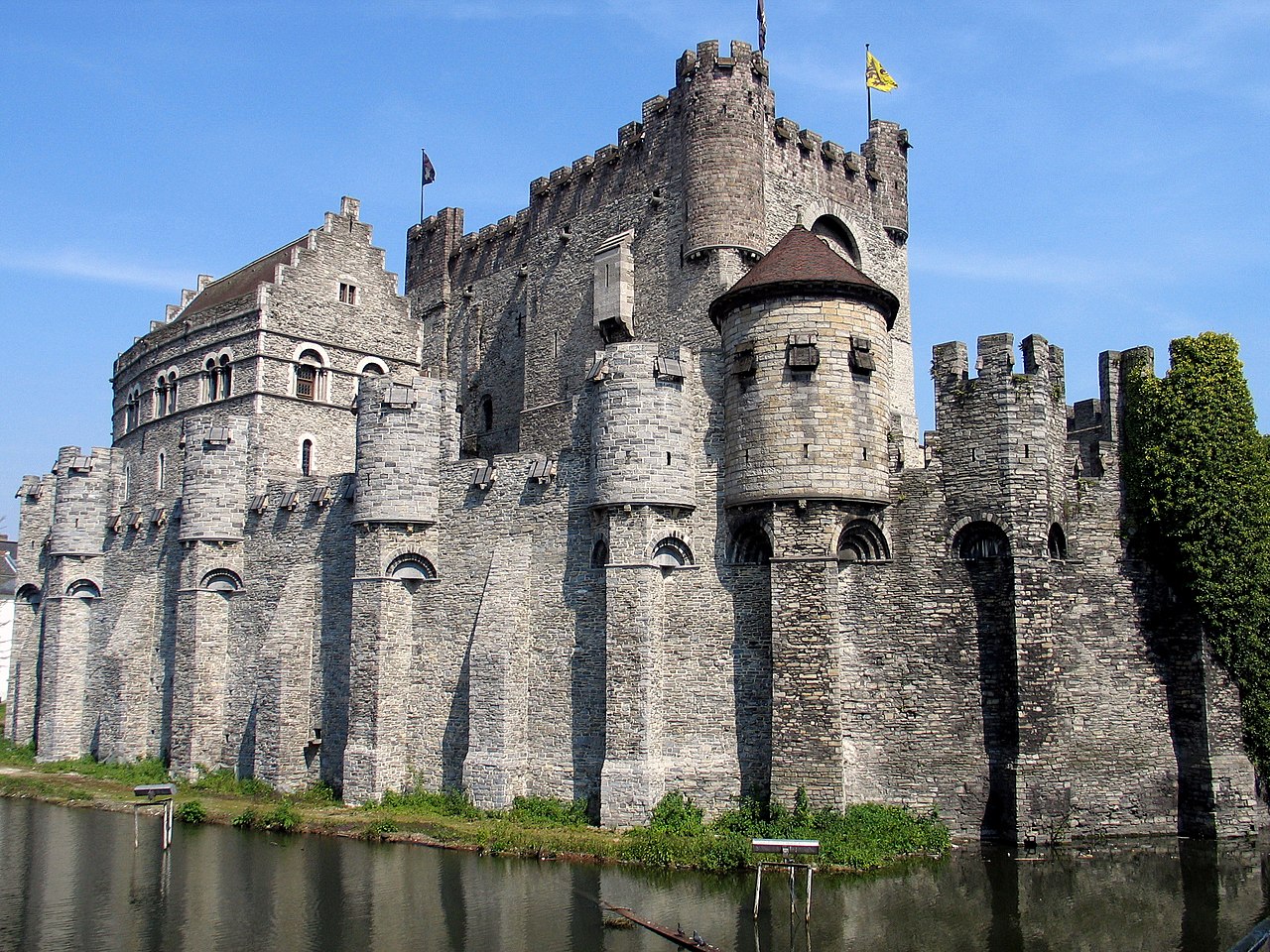
Gravensteen erupts from the historic center of Ghent like a clenched stone fist, its gray fortress walls and crenellated towers dominating the surrounding medieval streetscape in a way few European castles still manage within dense urban fabric. The name translates simply as "Castle of the Counts," referring to the Counts of Flanders who built this stronghold around 1180 on foundations dating to the 9th century. Unlike romantic Rhine castles perched on dramatic hillsides, Gravensteen sits in the flat Flemish lowlands where the Lieve canal splits from the Leie River, using water as defensive moat rather than elevation for protection. The castle you see today represents a 1893-1907 restoration that reconstructed collapsed sections and cleared away the textile factories that had occupied the interior courtyard since 1800, when the abandoned fortress was sold to private owners and converted into industrial space. This industrial interlude paradoxically preserved the medieval stonework — the factories needed the walls intact for structural support, preventing the wholesale dismantling that destroyed many European castles during the 18th-19th centuries. Approaching Gravensteen from Sint-Veerleplein square emphasizes the fortress's military character. The entrance gate funnels attackers through a narrow passage overlooked by murder holes (ceiling openings for dropping projectiles), past a massive portcullis groove that once held an iron grill, into an enclosed gatehouse where defenders could trap and slaughter invaders before they reached the inner courtyard. Medieval castle design prioritized killing zones that neutralized numerical superiority through architectural bottlenecks, and Gravensteen's entrance embodies this logic with brutal efficiency. Once through the gatehouse, you enter the central courtyard surrounded by the count's residence, great hall, chapel, stables, and keep (donjon). The residential quarters demonstrate that medieval nobility lived in functional discomfort by modern standards: the count's private chambers consist of a few modest rooms heated by fireplaces that filled spaces with smoke, narrow windows admitting minimal light, and floor plans prioritizing defense over domestic comfort. The great hall, used for receiving vassals and administering justice, occupies the largest interior space but remains austere — stone floors, minimal decoration, enormous fireplace that barely heated the volume during Flemish winters. The keep represents the castle's most formidable defensive element, a three-story cylindrical tower serving as last-resort refuge during sieges. Climbing the keep's narrow spiral staircase (worn smooth by 800 years of footsteps, uneven and treacherous in places) takes you through progressively defensible levels. The ground floor functioned as storage for provisions and weapons during siege conditions. The second floor served as guard barracks with arrow slits permitting defensive fire while minimizing exposure to attacking archers. The top floor housed the count's final retreat chamber, accessible only via the easily-defended spiral staircase. Reaching the keep's roof battlements rewards the climb with panoramic views across Ghent's medieval skyline: three distinctive towers dominate the vista — St. Bavo's Cathedral, St. Nicholas Church, and the Belfry forming the famous "three towers" alignment that defines Ghent's silhouette. From this elevated perspective, you grasp why the Counts of Flanders chose this location: visibility across the surrounding textile district allowed monitoring of the wealthy merchant class whose economic power constantly challenged aristocratic authority. Gravensteen's dungeon and torture museum occupy the basement levels, drawing crowds despite (or because of) their macabre content. The medieval dungeons consist of cramped cells with minimal ventilation where prisoners awaited trial, execution, or ransom payment. Unlike Hollywood's deep subterranean oubliettes, these cells sit just below ground level near the water table, making them perpetually damp but preventing the expense of digging deep into Flemish clay. The torture devices displayed throughout these chambers represent varying degrees of historical authenticity. Some implements — the rack, the pillory, iron shackles — have documented use in medieval Flanders for extracting confessions and punishing criminals. Others appear to be 19th-century fabrications created during the Romantic period's fascination with medieval cruelty, when inventors retroactively imagined tortures that likely never existed. The museum labels acknowledge this ambiguity imperfectly, leaving visitors uncertain which devices represent genuine historical practice versus Victorian Gothic fantasies. Regardless of authenticity debates, the torture exhibition serves an important function: it punctures nostalgic medievalism with uncomfortable reminders that castle life involved systematic violence, not just chivalric romance. The museum sections occupying the residential quarters display artifacts documenting Gravensteen's evolution from military fortress to textile factory to tourist attraction. Medieval armor and weapons demonstrate the castle's martial function: crossbows, swords, polearms, and chainmail that Flemish soldiers used defending this stronghold against French royal armies during the Hundred Years War. Later exhibits cover the castle's post-medieval decline: detailed architectural drawings from the 1850s showing textile looms installed in the great hall, photographs documenting the 1893-1907 restoration removing industrial additions, and models depicting how archaeologists determined which collapsed sections to rebuild versus leave as ruins. This museological transparency about the castle's restoration is refreshingly honest compared to sites that present heavily reconstructed structures as authentically medieval. Gravensteen never pretends to be unaltered 12th-century fabric — the interpretive materials acknowledge that what visitors experience represents a combination of medieval stonework, 19th-century industrial adaptation, and early 20th-century archaeological reconstruction based on historical evidence. Walking the battlements provides the visit's highlight, offering protected walkways along the entire circuit of exterior walls and towers. The crenellations (alternating raised merlons and lowered embrasures) allowed defenders to shoot arrows or crossbow bolts while sheltering behind stone protection, then duck back during enemy counterfire. From the ramparts, you gain visceral understanding of medieval siege warfare logistics: the moat (now dry and grassed over) created a killing zone forcing attackers to cross exposed ground under arrow fire, the arrow slits positioned every few meters along the walls provided overlapping fields of fire eliminating blind spots, and the height advantage multiplied defenders' effectiveness against numerically superior forces below. The battlements also deliver spectacular photography opportunities overlooking Ghent's historic district — the Graslei and Korenlei quays lining the river, the step-gabled guild houses in Flemish Renaissance style, and the medieval streetscape stretching toward the distant cathedral towers. Late afternoon light (particularly golden hour before sunset) creates dramatic shadows enhancing the stonework's texture and illuminating the surrounding cityscape in warm tones that justify timing your visit accordingly. Contextualizing Gravensteen within medieval Flemish power structures enriches what could otherwise be a straightforward fortress tour. The Counts of Flanders ruled one of medieval Europe's wealthiest territories — Flemish textile production in Ghent, Bruges, and Ypres generated enormous commercial prosperity, making Flanders a contested prize between French royal ambitions and local autonomy movements. Gravensteen functioned as both defensive stronghold against foreign invasion and domestic power demonstration aimed at Ghent's wealthy merchant guilds who increasingly challenged aristocratic control. The castle's placement in the city center rather than on peripheral hilltops deliberately symbolized comital authority over urban commerce. Yet this strategy ultimately failed: by the 14th century, Ghent's textile guilds had accumulated sufficient power to rebel repeatedly against comital rule, and by 1540, Holy Roman Emperor Charles V (ironically born in Ghent) brutally suppressed the city's independence and forced civic leaders to parade in humiliating penance. Gravensteen survived these power struggles but gradually lost military relevance as gunpowder artillery made medieval stone fortifications obsolete, beginning its transformation into the tourist attraction it is today. Practical visiting considerations shape how much you'll enjoy Gravensteen. The castle is entirely self-guided with multilingual information panels and a free audioguide (download the app or use provided devices) explaining each room's function and historical context. The audioguide proves essential since the bare stone rooms offer minimal inherent interpretation otherwise. The entire visit requires 90 minutes to two hours if you explore thoroughly, read all signage, and walk the complete battlements circuit. The narrow spiral staircases and uneven medieval floors present accessibility challenges — visitors with mobility limitations should inquire about alternative routes, though significant portions of the castle simply cannot accommodate wheelchairs due to 12th-century architecture predating accessibility concepts. The torture museum sections may disturb sensitive visitors or young children; parents should preview the content before deciding whether to include kids in the visit. Summer crowds (July-August) make the narrow staircases congested and the battlements packed with photographers; visiting during shoulder season (April-May, September-October) or early morning (arriving at 10 AM opening) improves the experience significantly.
Fortification History
Gravensteen's foundations date to the 9th century when a wooden motte-and-bailey fortification guarded the confluence of the Lieve canal and Leie River — a strategic position controlling water access to Ghent's growing textile trade. The Counts of Flanders rebuilt in stone around 1180, modeling the fortress on Crusader castles observed during the Second and Third Crusades. The castle served dual purposes: military defense against French royal armies seeking to control Flanders' wealthy textile cities, and domestic intimidation aimed at Ghent's increasingly powerful merchant guilds who repeatedly challenged comital authority. By the 14th century, the guilds had accumulated sufficient economic power to rebel — the 1302 Guldensporenslag (Battle of the Golden Spurs) saw Flemish craftsmen defeat French knights, and by 1540, Holy Roman Emperor Charles V (ironically born in Ghent) brutally suppressed the city's independence. Gravensteen lost military relevance as gunpowder artillery made medieval stone walls obsolete. The castle was sold to private owners in 1800 and converted into a textile factory — an industrial period that paradoxically preserved the stonework until the 1893-1907 archaeological restoration.
Notable Rooms
Great Hall: The largest interior space where the Counts of Flanders received vassals and administered justice — austere stone floors, massive fireplace, and the donjon staircase entrance. Visitors can appreciate its medieval proportions, imagining the room filled with petitioners, guards, and the flickering light of torches and hearth fires. Donjon (Keep): Three-story cylindrical tower with progressively defensible levels — ground floor provisions storage, second floor guard barracks with arrow slits, top floor the count's final retreat chamber. The roof battlements provide the castle's finest panoramic views of Ghent's "three towers" skyline. Gatehouse: The entrance killing zone with murder holes, portcullis groove, and narrow passage designed to neutralize attackers — medieval military architecture at its most brutally functional. Dungeons: Basement cells near the water table where prisoners awaited trial — perpetually damp, minimal ventilation, and disturbingly cramped. Torture museum: Controversial collection spanning racks, pillories, and iron shackles with documented medieval use alongside questionable 19th-century fabrications. Chapel: Small devotional space within the fortress walls where the count and garrison attended daily mass.
When to Visit
Open daily: 10:00 AM - 6:00 PM year-round, including weekends and most holidays. Last entry: 5:00 PM — allow 90 minutes minimum, so arrive by 3:30 PM latest for full experience. Best: Early morning (10:00-11:00 AM) for smallest crowds on battlements and in narrow staircases. Photography: Late afternoon (4:00-5:30 PM) for golden hour light enhancing stonework and illuminating Ghent's cityscape from ramparts. Avoid: Midday (12:00-2:00 PM) when tour groups create bottlenecks in the keep's spiral staircase. Seasonal: April-May and September-October offer better weather than summer heat and smaller crowds than July-August peak tourism.
Admission and Costs
Adult admission: €14 — includes castle access, torture museum, battlements, and audioguide app. Youth (19-25): €10.50 — bring valid student ID or age verification. Children (under 19): Free when accompanied by paying adult. CityCard Gent: Free admission with the 48-hour or 72-hour Ghent city pass (€39/€45) that also includes public transport and other attractions. Combined ticket: €20 for Gravensteen + St. Bavo's Cathedral (modest savings versus separate €14 + €12.50). Guided tour: €180-220 for private 2-hour tour covering castle history and medieval Ghent context (separate from admission). Audioguide: Included in admission — download the app or borrow a device at entrance.
Tips for Visitors
Download audioguide first: The free app provides essential context for otherwise bare stone rooms. Download before arrival to avoid relying on castle WiFi. Wear appropriate shoes: Medieval staircases are narrow, uneven, and worn smooth by centuries of use. Avoid slippery-soled footwear and high heels. Start with the keep: Climb the donjon first while you have energy for the spiral stairs, then work your way through the easier ground-level exhibits. Budget serious time: 90 minutes minimum needed to explore thoroughly. Rushing through in 45 minutes means missing the battlements circuit and torture museum. Torture museum context: Take the implements with historical skepticism — some are authentic medieval devices, others are likely 19th-century Gothic fantasies. Labels don't always clarify which is which. Battlements photography: The ramparts offer spectacular Ghent skyline views. Visit during late afternoon golden hour for best light on the surrounding architecture. Accessibility limitations: Narrow medieval staircases and uneven floors make much of the castle inaccessible to wheelchairs. Inquire at entrance about alternative routes to accessible sections. Children considerations: Free admission for kids is great value, but the torture museum may disturb sensitive children. Preview the content before deciding to include young ones. Combined tickets: The €20 Gravensteen + St. Bavo's package saves a few euros if visiting both sites. The CityCard Gent (€39/48-hours) includes both plus public transport. Industrial history: Don't skip the museum exhibits documenting the castle's textile factory period — they provide honest context about restoration work that many sites gloss over. Moat views: Walk around the exterior before entering to photograph the castle from Sint-Veerleplein square and the canal bridges, showing the full fortress in context. Crowd strategy: Arrive at 10 AM opening or after 4 PM to avoid midday tour group bottlenecks in the narrow staircases and keep.