

Overview
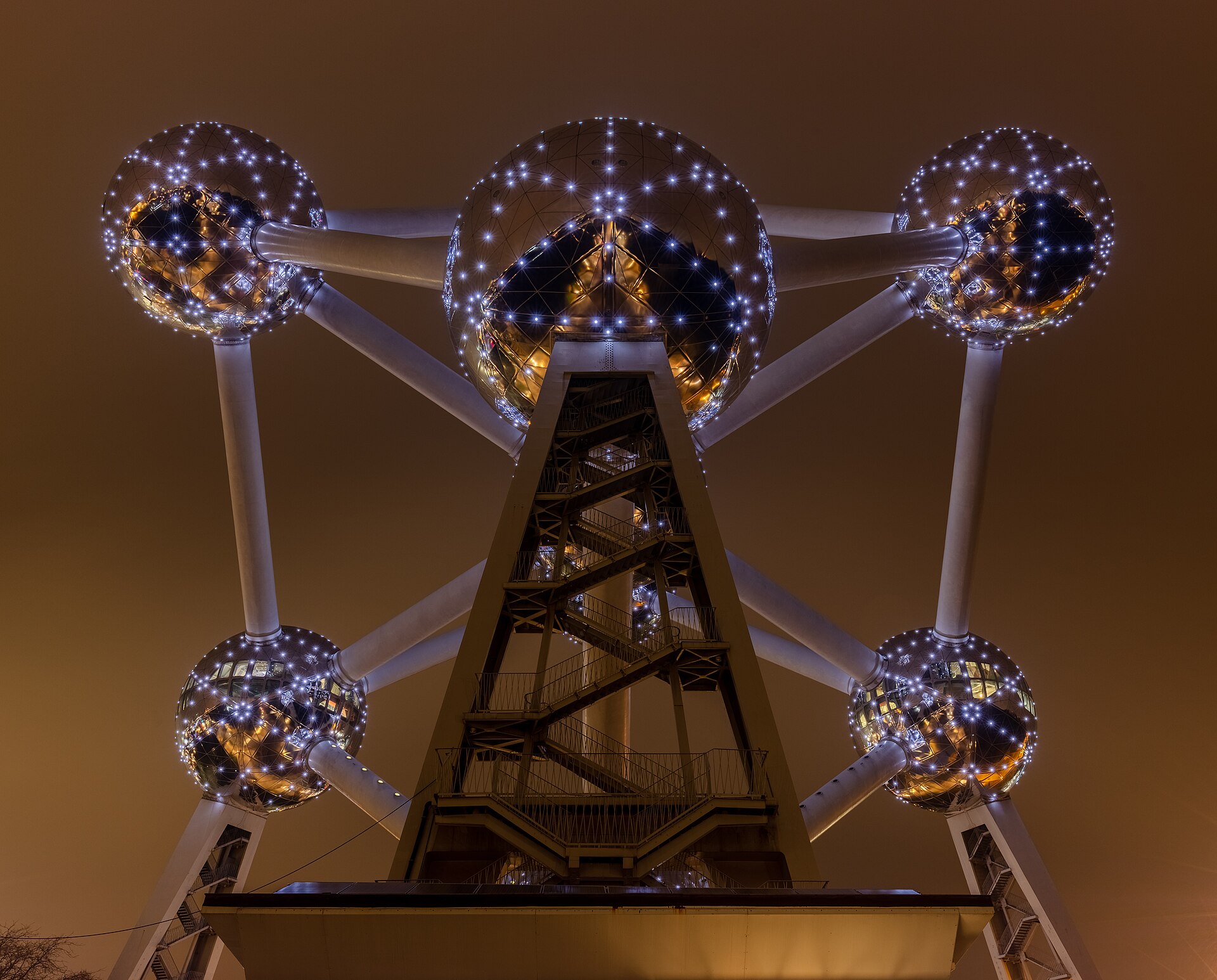
The Atomium is either glorious retrofuturism or a dated relic, depending on whom you ask, but it has undeniably become Brussels' most recognizable symbol after Grand Place and Manneken Pis. Designed by engineer André Waterkeyn for the 1958 Brussels World's Fair (Expo 58), the structure represents an iron crystal magnified 165 billion times — nine stainless steel spheres connected by tubes, forming a cubic crystal lattice standing 102 meters tall. Critics initially dismissed it as kitschy and temporary, but when authorities moved to demolish it after Expo 58, public outcry saved the structure. A 2004-2006 renovation replaced the aluminum cladding with gleaming stainless steel, transforming a corroding relic into a polished monument to atomic-age optimism. Each sphere is 18 meters in diameter; six are accessible to visitors via escalators inside the connecting tubes (the longest escalator in Europe at the time of construction). The top sphere offers panoramic views across Belgium — on clear days, you can identify Antwerp's port 40 kilometers north and the forested hills of Wallonia to the south. The interior houses rotating exhibitions on design, architecture, and mid-century modernism, plus a permanent display on Expo 58 and the Atomium's construction. Most visitors spend 60-90 minutes total: escalator ascent, brief exhibition visits, photography at the top sphere, then descent. The experience is more about the structure itself than any specific content inside — the Atomium is architecture as spectacle, a statement about 1950s faith in atomic energy, space exploration, and international cooperation that now reads as charmingly naive.
Engineering Facts
Engineer André Waterkeyn designed the Atomium to represent a unit cell of an iron crystal magnified 165 billion times, with each of the nine spheres positioned at the atoms' locations in a body-centered cubic lattice. The structure stands 102 meters tall and weighs approximately 2,400 tonnes, supported by a central pillar containing an elevator shaft and three bipod legs that distribute loads to massive concrete foundations. The original 1958 construction used aluminum cladding over a steel skeleton, but the 2004-2006 renovation by architects Conix and Bureau d'Etudes Arcadis replaced all exterior panels with 50,000 triangular stainless steel tiles that resist corrosion and reflect light with mirror-like intensity. The connecting tubes between spheres are 3 meters in diameter and contain escalators — the tube connecting the base to the top sphere houses an elevator that was, at the time, the fastest in Belgium, ascending 102 meters in 23 seconds. Six of nine spheres are accessible to visitors; the remaining three provide structural support but lack floor space suitable for public access. The entire structure was designed for a planned lifespan of 6 months as a temporary Expo 58 pavilion — its survival for over 65 years required continuous structural reinforcement as wind loads, thermal expansion, and material fatigue exceeded original engineering tolerances.
Observation Points
Top sphere panorama: At 92 meters up, the circular viewing platform provides 360-degree views. Identify landmarks with interpretive displays: the Palais Royal, Basilique de Koekelberg, and on exceptionally clear days, Antwerp's port cranes. Rotating exhibitions: Design-focused shows change every 6-12 months. Past exhibitions covered Tintin, Art Nouveau, and Belgian surrealism. Expo 58 permanent display: Photographs, videos, and artifacts from the 1958 World's Fair when 42 million visitors attended — showing the atomic-age optimism and Cold War subtext of the era. Top-sphere restaurant: A rare opportunity to dine inside an architectural icon — reserve the sunset slot if visiting in summer. Evening illumination: The Atomium glows at night with sophisticated LED lighting — best photographed from the adjacent park or Mini-Europe entrance (free to approach exterior).
When to Visit
Daily: 10 AM - 6 PM (last entry 5:30 PM). Extended summer hours: Sometimes until 7 PM July-August — check website. Closed: Rare maintenance days (check ahead). Best: Late afternoon (4-5 PM) for golden hour light; early morning (10-11 AM) for fewer crowds. Avoid: Weekend afternoons in summer when tour buses and families peak. Duration: 60-90 minutes including ascent, exhibitions, and photography.
Admission and Costs
General admission: €16 adults, €12 students/seniors, €8.50 children 6-17. Restaurant reservation: No entry fee if dining at the top-sphere restaurant (book ahead). Guided tours: €80-120 for private 1-hour tours explaining architecture and Expo 58 context. Combined ticket: Atomium + Mini-Europe (miniature park next door) €29.50 adults — worthwhile if traveling with children.
Tips for Visitors
Buy tickets online: Skip the ground-level queue by purchasing timed-entry tickets in advance — weekends sell out ahead. Photography strategy: The best exterior shots are from 50-100 meters away in the surrounding park. Inside, the escalator tubes provide dramatic perspectives but lighting is challenging. Accessibility: Despite escalators, some connecting tubes have stairs. Visitors with mobility limitations can access the top sphere via service elevator — ask staff. Restaurant booking: If dining at the top, reserve 2-3 weeks ahead for dinner slots. Lunch is easier to book last-minute. Combine with Mini-Europe: The miniature park next door recreates 350 European monuments at 1:25 scale. It's touristy but children love it, and the combined ticket makes sense if you're already at the Atomium. Getting there: Metro line 6 to Heysel station (5-minute walk). Allow 25 minutes from central Brussels. The Atomium is far from other Brussels attractions — don't underestimate travel time. Weather dependency: The views are the main draw. On overcast days, consider skipping unless interested in the exhibitions specifically.