

Overview
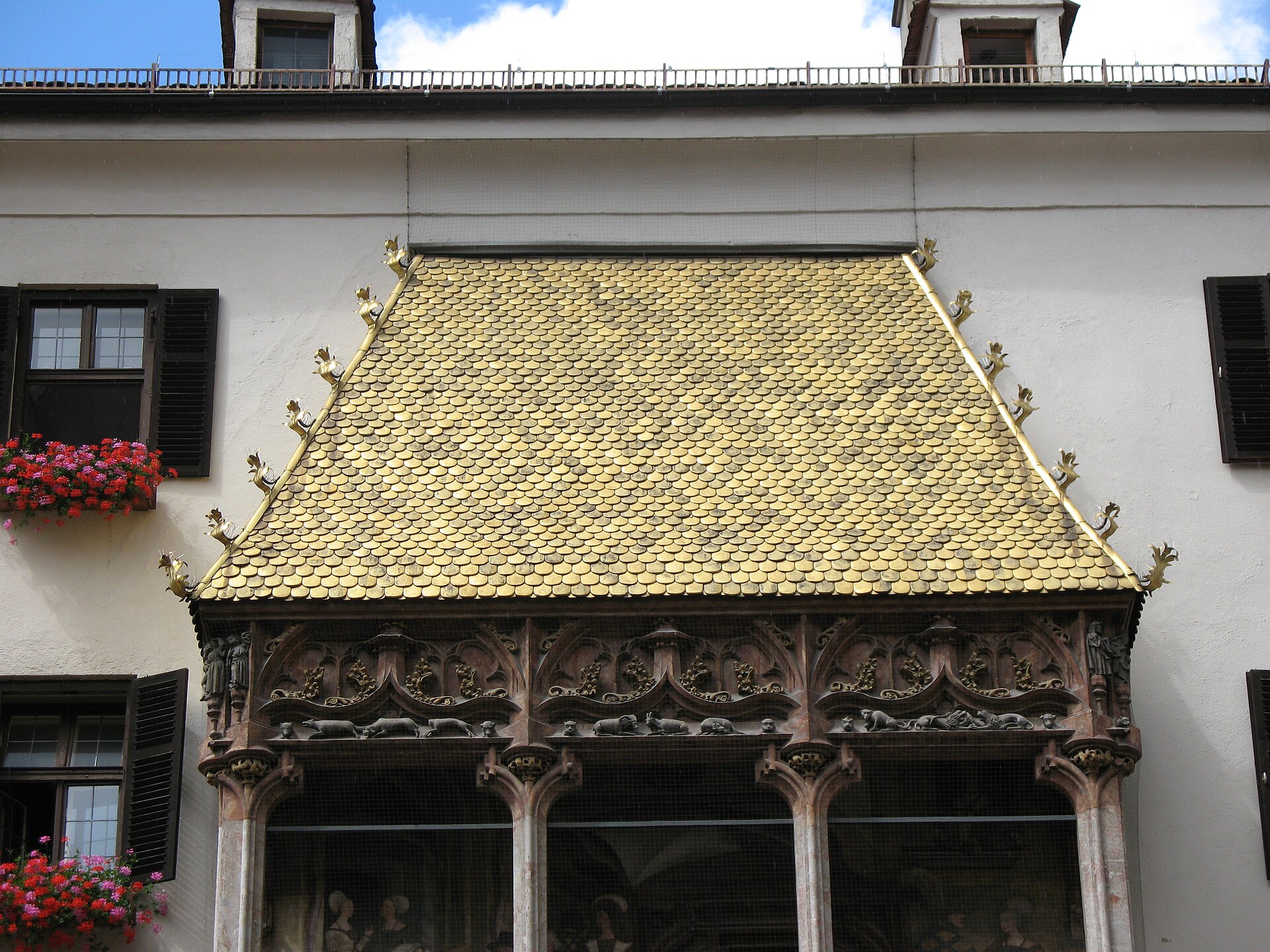
The Goldenes Dachl (Golden Roof) is a late-Gothic oriel window added to the Neuer Hof palace in 1500 by Emperor Maximilian I to mark his marriage to Bianca Maria Sforza of Milan. Its roof of 2,657 fire-gilded copper shingles blazes in the Tyrolean sunlight above Herzog-Friedrich-Strasse, making it the most recognizable landmark in Innsbruck. Maximilian used the balcony as a royal box to watch tournaments, festivals, and public spectacles in the square below. The relief panels decorating the balcony depict the emperor with both his wives, heraldic symbols of his vast domains, and dancers performing a traditional Moriskentanz. The Golden Roof stands steps from the Hofkirche, the Hofburg palace, and the start of Maria-Theresien-Strasse, making it a natural hub for exploring the old town before heading to Ambras Castle or the Nordkette Cable Car.
Architecture
Gilded shingles: 2,657 copper tiles covered in gold leaf — best appreciated in direct sunlight around midday when they blaze against the Alpine sky. Relief panels: Maximilian I with his two wives and dancers performing the Moriskentanz — each figure carries political symbolism a guide decodes. The oriel window projects from the palace facade on stone brackets carved with heraldic beasts. Mountain backdrop: The Nordkette peaks rise directly behind the old town roofline — visible from the square, creating one of the most dramatic urban-mountain juxtapositions in Europe. Stadtturm (City Tower): 51-meter watchtower adjacent to the Golden Roof with a viewing platform. Herzog-Friedrich-Strasse: The pedestrian old town street beneath the Golden Roof, lined with painted facades and arcade shops dating to the medieval period.
Historical Significance
Emperor Maximilian I (1459-1519) — called "the Last Knight" for his devotion to chivalric ideals — made Innsbruck his preferred residence and transformed it into an imperial capital. The Golden Roof, commissioned in 1500, served as his public viewing balcony during tournaments and festivals, projecting royal magnificence to the crowds below. The relief panels encode Maximilian's dynastic strategy: his marriages to Mary of Burgundy (which brought the Low Countries into Habsburg control) and Bianca Maria Sforza (which secured Italian alliances) are depicted alongside heraldic symbols claiming sovereignty from Spain to Hungary. Maximilian's tomb in the nearby Hofkirche — guarded by 28 larger-than-life bronze statues of his ancestors and allies — continues the story of a ruler who used art and architecture as instruments of political power. The Golden Roof museum connects these threads through interactive exhibits covering his marriages, military campaigns, and the empire he built through diplomacy as much as through war.
When to Visit
Museum open: Daily 10 AM-5 PM (closed Mondays in winter). Exterior viewing: 24/7, outdoor landmark in the pedestrian zone. Best time: Late morning when sunlight directly hits the gilded tiles for the most dramatic effect. Duration: The small museum takes 30-45 minutes; the exterior is a quick photo stop. Evening: Tasteful illumination after dark makes for atmospheric photographs.
Admission and Costs
Viewing exterior: Free. Golden Roof Museum: €5.40 adults, €2.70 ages 6-15. Innsbruck Card: Includes the museum along with all other major Innsbruck attractions. Guided old town walking tour: €15-25 per person (2 hours, Golden Roof is a key stop). Private guide: Part of half-day Innsbruck tours (€150-240 for up to 6 people).
Tips for Visitors
Quick stop, deep history: Most visitors photograph the exterior in minutes, but the museum and guided context reveal much more. Best photo angle: Stand across the square looking up — morning light from the east or warm afternoon light from the west. Combine with Stadtturm: The adjacent city tower offers the best overhead view of the Golden Roof itself (148 steps). Pedestrian zone: The entire old town is car-free — a pleasant environment for wandering before and after. Christmas market: The square beneath the Golden Roof hosts one of Tyrol's most atmospheric Christkindlmarkt during Advent.