
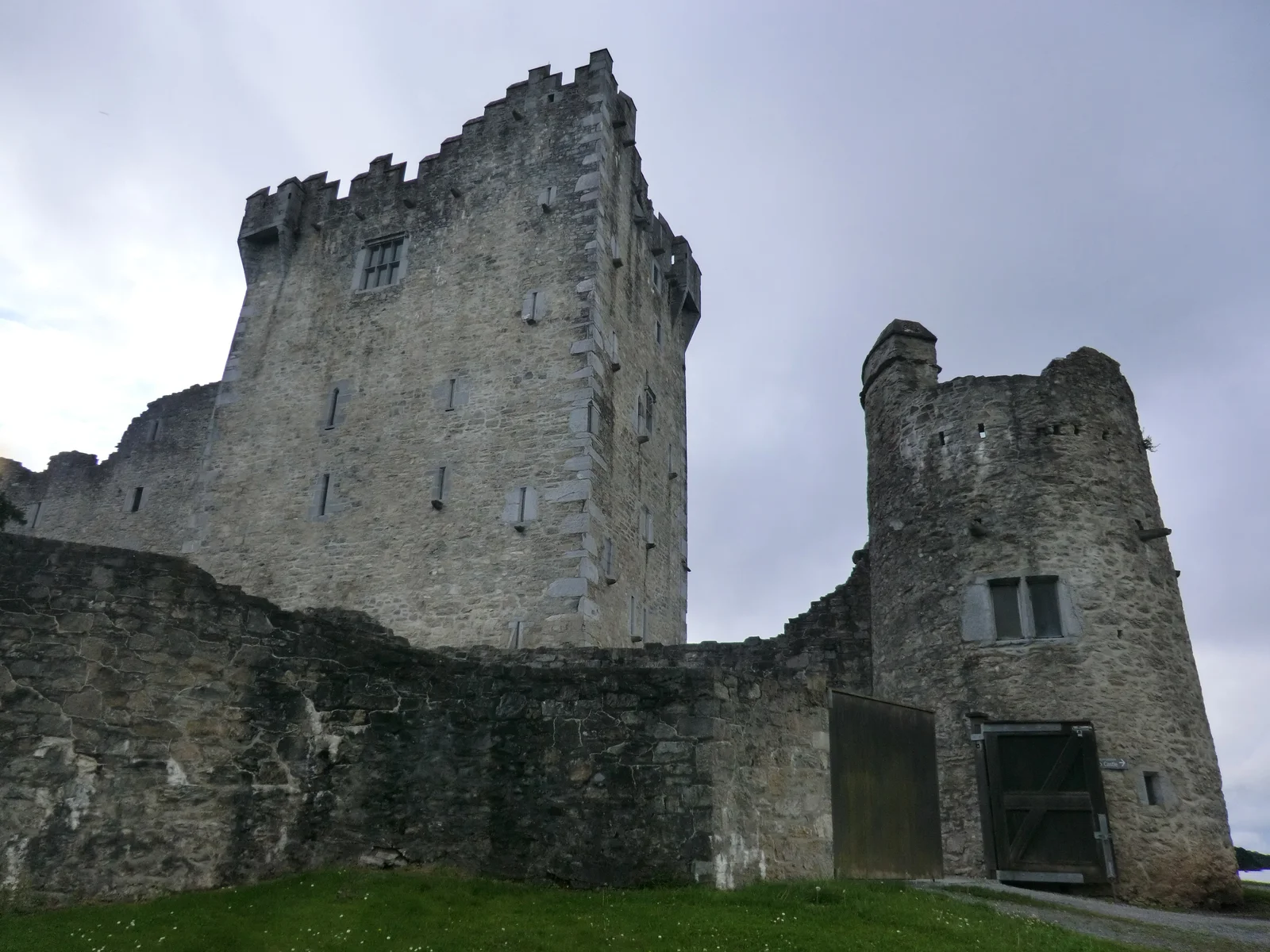
Fortification History
Ross Castle was raised in the late fifteenth century as the chief seat of the O'Donoghue Mór, and like other Irish tower houses it was designed for defence in an age of clan warfare: thick walls, a single well-guarded entrance, a murder hole above the doorway and a spiral stair built to favour a defender fighting downward. A bawn wall with round corner towers once enclosed the base of the tower, giving the garrison an outer line to hold.
Its most celebrated moment came in 1652, during the Cromwellian conquest of Ireland, when Ross was among the last strongholds in the country to hold out. A local prophecy held that the castle would only fall to an attack from the water; when the Parliamentarian commander Edmund Ludlow had boats hauled overland and floated onto Lough Leane, the demoralised defenders under Lord Muskerry surrendered. The tale, whatever its embroidery, marks the castle's place at the very end of organised Gaelic and Royalist resistance in Munster.
Notable Rooms
The guided route climbs through the tower's stacked chambers, from the vaulted lower rooms used for storage and defence up to the principal living quarters and the great hall where the household ate and the lord received guests. The rooms have been furnished with sixteenth- and seventeenth-century oak pieces, so the tour doubles as an introduction to the domestic life of a Gaelic-Irish and later Anglo-Irish household, from the canopied beds to the heavy dining furniture.
Because the tower is tall and narrow, the visit is essentially vertical, and the tight spiral stair between floors is part of the experience: it was built deliberately cramped and awkward as a defensive measure. From the upper levels the windows frame wide views over Lough Leane and Innisfallen Island toward the surrounding mountains, a reminder that a castle chosen for its command of the lake still commands its finest views today.
When to Visit
The castle is open to guided tours daily through the main season, usually from spring into the autumn, with reduced or no interior access in the depths of winter, so it pays to check current opening dates before travelling. Tours run at intervals through the day and the last is admitted well before closing. The grounds and lakeshore stay open year-round for walkers.
Set aside around 45 minutes to an hour for the tower tour itself, and add time for the walks and for any boat trip onto the lake. Late spring and summer offer the longest days and the best chance of calm water for Innisfallen, while a clear autumn morning gives crisp reflections of the tower in the lake with few crowds.
Admission and Costs
A guided tour of the tower house costs roughly €5 ($5.50) for an adult, with concessions for seniors, students and children and a family rate that makes it an inexpensive outing. Access to the grounds, the pier and the lakeside paths is free, so visitors who miss a tour slot can still enjoy the setting at no cost.
Boat trips are the main additional expense and are arranged with the licensed boatmen at the jetty rather than through the castle. A short run out to Innisfallen Island typically costs in the region of €10–€15 ($11–$17) per person, while longer lake tours and the popular one-way trip through the Gap of Dunloe cost more and are best agreed in advance during busy periods.
The Case for a Guide
A local guide adds real depth to Ross Castle by placing it in the long story of Gaelic Kerry and the wars that ended it. The Office of Public Works tour covers the building itself, but a private guide can connect the O'Donoghue lords, the Desmond rebellions and the Cromwellian conquest into a single narrative, and explain how a lake stronghold defended itself and finally fell. Guides also make it easy to fold the castle into a wider park itinerary with Muckross House, Torc Waterfall and a boat trip, handling the timings so nothing clashes.
Tips for Visitors
Arrive early in summer, both to secure a place on a guided tour — group sizes are capped by the narrow medieval stairs — and to find space in the car park, which fills by mid-morning in July and August. If you plan to take a boat, speak to the boatmen at the pier soon after arriving so you can slot the crossing around your tour time.
Wear flat, sturdy footwear for the spiral stairs and uneven floors inside the tower, and bring a layer against the breeze off the lake, which can be sharp even on a bright day. Photographers should linger for the low evening light, when the tower and the mountains behind it reflect in the still water of Lough Leane.
Frequently Asked Questions
Can you go inside Ross Castle?
The interior of the tower house can only be seen on a guided tour run by the Office of Public Works, which leads small groups up the narrow stairs through the furnished chambers. Numbers on each tour are limited by the tight medieval stairwell, so places are allocated on the day and can run out at peak times. The grounds, lakeshore and boat jetty around the castle are open to walk for free.
How much does it cost to visit Ross Castle?
A guided tour of the castle costs about €5 ($5.50) for an adult, with the usual reductions for seniors, students, children and families, and it is one of the better-value heritage tickets in the Killarney area. Walking the grounds and the lakeside paths costs nothing. Boat trips to Innisfallen Island and around Lough Leane are arranged separately with the boatmen at the jetty.
How do I get from Killarney to Ross Castle?
Ross Castle stands about 3 km from the centre of Killarney, an easy walk, cycle or short drive along a lane that runs down to Lough Leane through the national park. There is a car park near the castle, though it fills early in summer. A pleasant alternative is to hire a jaunting car in town, as many visitors do when combining the castle with Muckross House.
What is there to do at Ross Castle besides the tower?
The castle is the launch point for boats onto Lough Leane, including trips to the monastic ruins on Innisfallen Island and longer excursions up toward the Gap of Dunloe. The surrounding parkland has gentle lakeshore walks with mountain views, and the setting makes it a favourite spot for photographs at sunset. Rowing boats and open motorboats can be hired at the pier in the warmer months.