
Engineering Facts
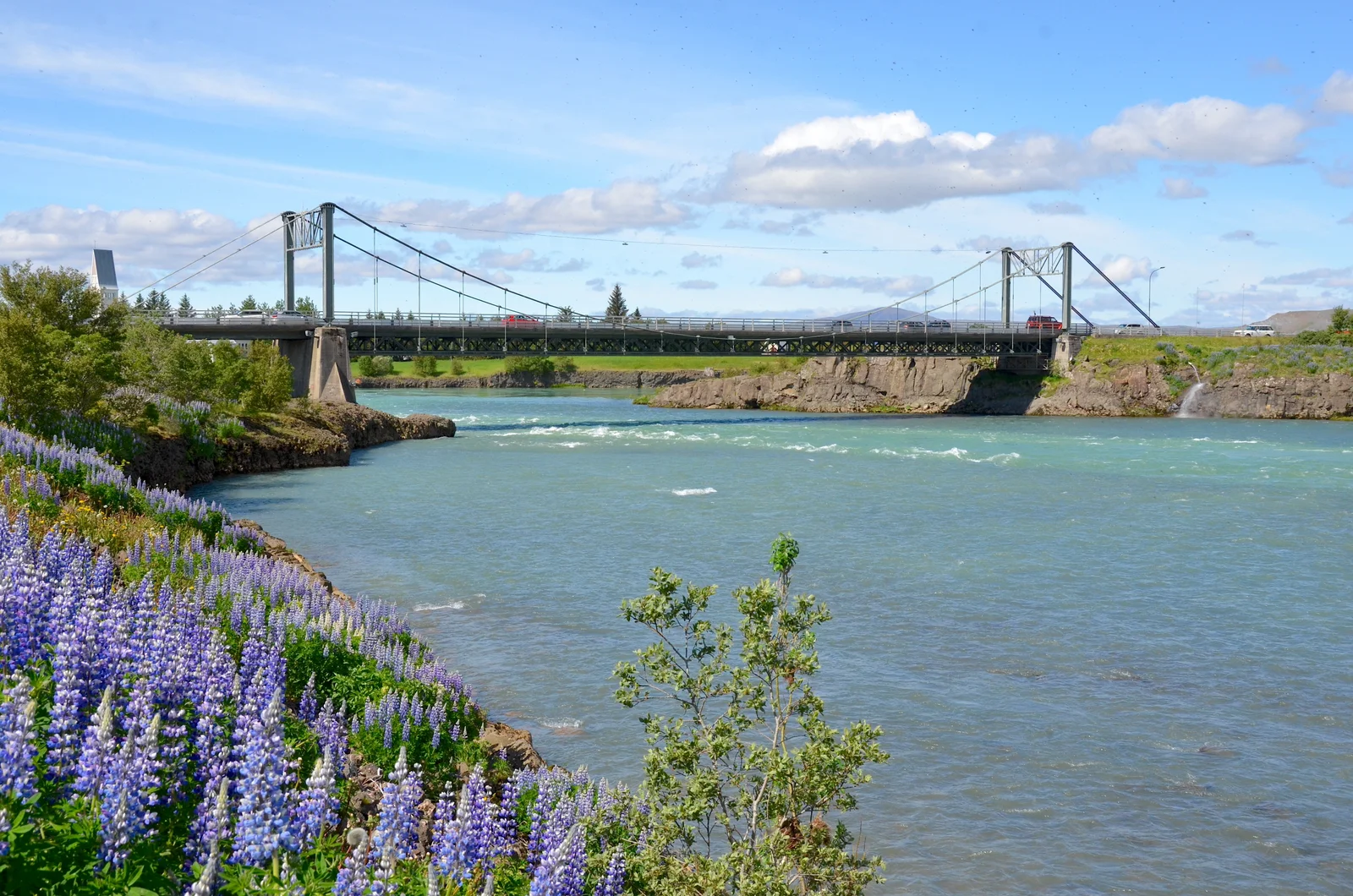
The 1891 original was a genuine milestone: the first suspension bridge erected in Iceland, a cable-hung span chosen precisely because the Ölfusá is too wide and too powerful for the simple beam crossings used on smaller rivers. Suspension design let a single long span leap the river without piers standing in the destructive current. The structure standing today was built in 1945 after the earlier bridge was lost, keeping the same suspension principle with towers and cables carrying the deck.
The Ölfusá itself shapes the engineering challenge: fed by the Sog and Hvítá rivers, it is among the highest-discharge rivers in Iceland, so any crossing here must resist enormous, fluctuating flow. That demand is also why a new, larger bridge was opened downstream in 2024 to carry the heavy modern Ring Road traffic, relieving the historic span while leaving it in place as the town's centrepiece.
Observation Points
The best free viewpoint is the bridge deck itself: stopping at the midpoint of the footway gives an uninterrupted look along the river in both directions, with the water racing beneath the cables. From here the scale of the Ölfusá and the slenderness of the span are most apparent.
The eastern riverbank, beside the old-town quarter and Tryggvaskáli, offers the classic side-on composition, framing the whole suspension structure against the water and the town. For a wider setting, the riverside paths a little upstream and downstream let you place the bridge in the landscape of central Selfoss, useful for photographers wanting the towers, the river and the historic buildings in a single frame.
When to Visit
The bridge is a public road crossing, so it is open every hour of every day, free to walk or drive across, and needs no ticket or booking. There is no wrong season to see it, though the long summer daylight from June to August gives the most time to linger by the river, and the low winter sun can light the towers and cables handsomely for photographs when the weather cooperates.
A visit on foot takes only a few minutes to cross and back, but it is worth allowing 20 to 30 minutes to walk the riverbank on either side and take in the old-town buildings clustered at the eastern end. Early morning and evening are the quietest times, away from the through-traffic that still uses the crossing during the day.
Admission and Costs
There is no charge to use or view the Ölfusá Bridge; it is an ordinary public river crossing rather than a ticketed attraction, and the riverside paths around it are free to walk at any time. Parking in central Selfoss near the bridge is generally free as well, though the streets around the restored old-town quarter can fill up in high summer.
Those who want context beyond the free view can join a guided walking tour of central Selfoss or a Golden Circle day tour that pauses in the town; group Golden Circle coach tours from Reykjavík typically run ISK 9,000–14,000 ($66–102) per person, while a private guided day for a small group costs more but allows a proper stop at the bridge and the old town rather than a passing glance.
The Case for a Guide
A guide brings the Ölfusá Bridge to life by tracing the story most visitors miss: how the 1891 crossing made a town out of a river ford, why the original span failed, and how the 1945 replacement and the 2024 downstream bridge fit into Iceland's engineering history. Local guides also connect the bridge to the wider fabric of Selfoss, walking you from the crossing into the reconstructed old-town quarter and explaining how the settlement grew. For a structure that looks unremarkable at a glance, that context is what makes the stop worthwhile.
Tips for Visitors
Use the footway rather than the road edge when crossing, and pause midway for the best vantage over the fast green water of the Ölfusá both up and downstream. The eastern bank puts you closest to the historic buildings, so cross from the town centre toward Tryggvaskáli for the most rewarding short walk.
Photographers get the cleanest compositions early or late in the day, when traffic is light and the low sun catches the towers. Combine the bridge with a riverside meal — several cafés and restaurants sit within a minute's walk — and treat it as the natural starting point for exploring the compact heart of Selfoss on foot.
Frequently Asked Questions
When was the Ölfusá Bridge built?
The first suspension bridge over the Ölfusá opened in 1891 and was the first of its kind in Iceland. The structure crossing the river in the town centre today dates from 1945, after the original was rebuilt following a collapse. In 2024 a larger new bridge opened a short way downstream to carry the growing volume of Ring Road traffic.
Can you walk across the Ölfusá Bridge?
Yes. The bridge in central Selfoss carries a footway alongside the roadway, and crossing on foot is the best way to feel the span over the wide, fast-flowing river. It is free and open at all hours, and the walk links the two halves of the town, including the restored old-town quarter around Tryggvaskáli on the eastern bank.
Why is the Ölfusá Bridge important to Selfoss?
Before the bridge, the Ölfusá was a formidable barrier that travellers crossed by ferry. Once the 1891 span joined the banks, a settlement grew up at the crossing to serve the traffic, and that settlement became Selfoss. The bridge is, in a real sense, the reason the town exists, which is why it still anchors the centre today.
Is there a new bridge over the Ölfusá?
A new, larger bridge opened downstream of the town in 2024 to move through-traffic on the busy South Iceland Ring Road more efficiently. The historic 1945 suspension bridge remains in place at the heart of Selfoss, still used and still central to the town's identity rather than replaced by the newcomer.