
Spiritual Significance
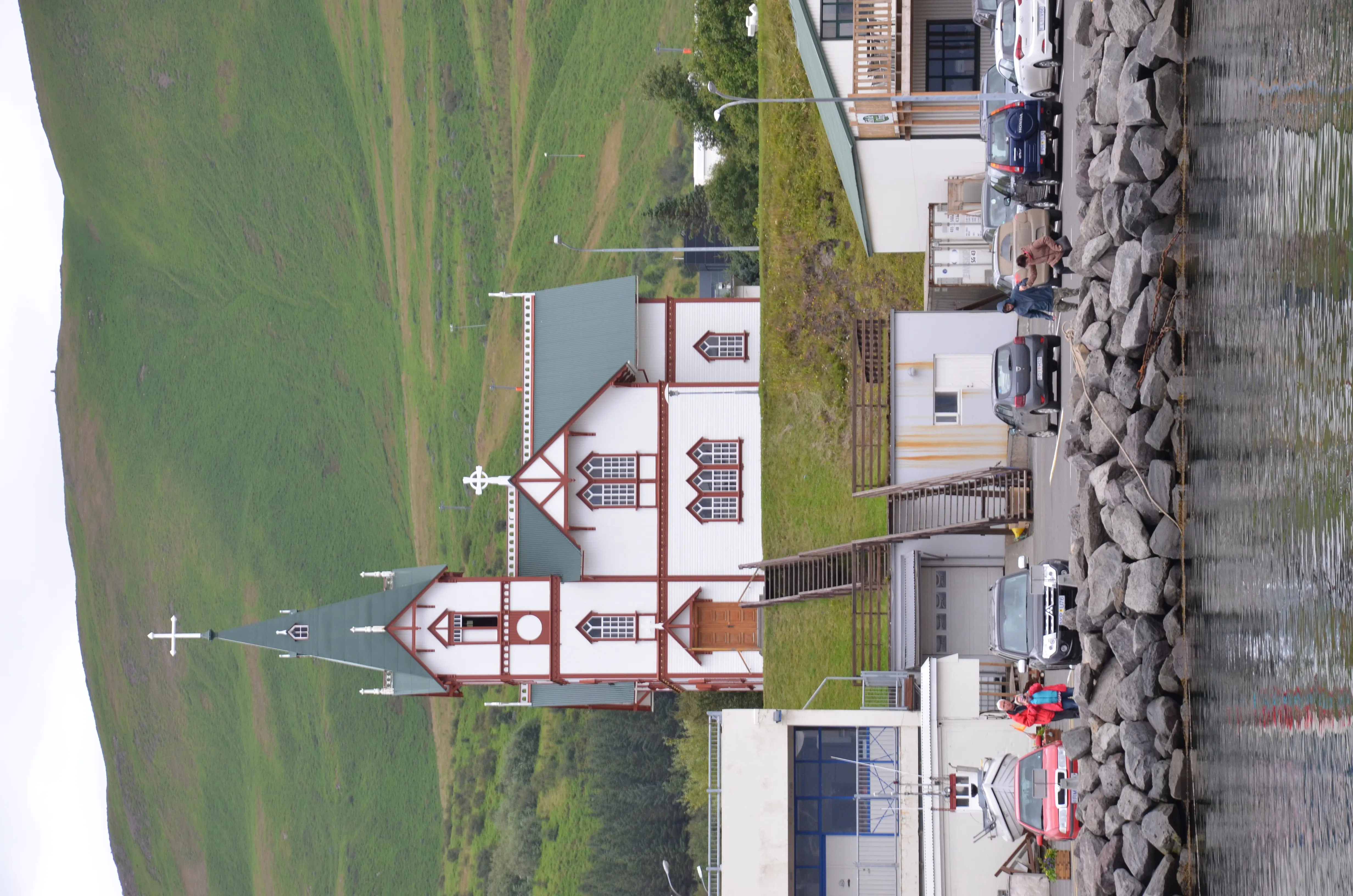
Húsavíkurkirkja is the parish church of Húsavík within the Evangelical Lutheran Church of Iceland (Þjóðkirkjan), the national church to which the large majority of Icelanders belong, and for well over a century it has marked the rhythms of local life — baptisms, confirmations, weddings, and funerals for the families of this fishing community. Its prominent hillside position is itself meaningful: the church looks out over the harbour from which generations of Húsavík crews went to sea, and many of the town's defining moments of joy and grief have been observed within its timber walls. The altarpiece's placement of the raising of Lazarus in an Icelandic setting reflects a distinctly local theology of hope — resurrection imagined not in a distant Holy Land but among the very mountains the congregation could see from their boats. Even today, when far more visitors arrive for whale watching than for worship, the church remains a quietly active centre of community faith and memory rather than a museum piece.
Visitor Etiquette
Húsavíkurkirkja is a working church, so a few simple courtesies apply. Enter quietly and remove hats inside the nave; speak in low voices, especially if anyone is praying. Photography of the interior and altarpiece is generally tolerated for personal use, but never photograph a service, wedding, or funeral, and avoid using flash near the historic painted woodwork. Dress is informal — no strict code applies — but tidy, modest clothing is appropriate, particularly if you stay for a service. Switch phones to silent, do not move furniture or candles, and leave any donation discreetly in the box provided. If a service or concert is about to begin, either take a seat respectfully or step outside; visitors are welcome but should never disrupt the parish's own use of the building.
When to Visit
The church is usually open to visitors during summer daytime hours (roughly June–August) outside of scheduled services and events; entry is free. In the shoulder and winter months it is often locked except for services, so plan around that or enjoy the exterior. A visit takes 15–25 minutes inside, and the exterior is most photogenic in late-afternoon light, when the white timber glows against the bay. To fold it neatly into a Húsavík day:
- Late morning — climb the two-minute path up from Húsavík Harbour before or after a whale-watching sailing, while the nave is most reliably unlocked.
- Early afternoon — pair it with the Whale Museum a few minutes downhill for context on the town's marine life.
- Late afternoon — return to the church steps for the best light and the widest free view over the harbour.
Sunday and holiday services are the surest way to see the interior in the off-season, but visitors should sit quietly and respect the congregation. Allow extra time simply to stand on the steps and take in the harbour panorama below.
Admission and Costs
Entry to Húsavíkurkirkja is free, though a donation toward upkeep of the historic timber structure is welcomed and can be left in the box near the entrance — a few hundred ISK (a couple of US dollars) is a fair contribution. There is no ticket office and no paid tour of the church itself. If you attend a concert held in the nave during the summer cultural season, tickets are typically in the region of ISK 2,000–4,000 (about USD 15–30), sold by the event organiser rather than the parish. Parking in the streets around the church is free.
The Case for a Guide
A guide turns Húsavíkurkirkja from a quick photo stop into a window onto how a remote Icelandic town built its identity in timber and paint.
- Reading the architecture: A guide can explain why Rögnvaldur Ólafsson's cruciform timber design mattered in 1907, and how imported Norwegian wood reflected the town's trading ambitions rather than the older turf-church tradition.
- Decoding the altarpiece: The choice to set the raising of Lazarus in an Icelandic landscape is easy to miss; a guide points out the local mountains in the painting and what that relocation of scripture meant to the parish.
- Connecting church and harbour: Standing on the steps, a guide can trace the relationship between the parish above and the whale-watching fleet at Húsavík Harbour below, tying the building into the town's transformation from fishing port to tourism hub.
- Off-season access knowledge: Local guides know when the church is open, which services welcome visitors, and how to see the interior in winter when casual visitors find the doors locked.
Tips for Visitors
- Come for the light — the white-and-red timber is at its best in late afternoon, when the low northern sun makes the spire stand out sharply against Skjálfandi Bay.
- Check opening times locally — outside high summer the nave is frequently locked except for services, so confirm before relying on getting inside.
- Pair it with the harbour — the two-minute downhill walk leads straight to the boats at Húsavík Harbour and the Whale Museum, making an efficient half-day.
- Be quiet and respectful — this is an active parish church, so keep voices low and avoid photography during any service.
- Use the steps as a viewpoint — even if the doors are shut, the elevated position offers one of the best free panoramas of the bay and town in Húsavík.
Frequently Asked Questions
Why does such a small fishing town have such an elaborate wooden church?
Húsavíkurkirkja was deliberately built to be far grander than its tiny parish strictly needed. When it was consecrated in 1907, Húsavík was a rising trading and fishing port on Skjálfandi Bay, and the community wanted a church that announced its ambitions. They commissioned Rögnvaldur Ólafsson, Iceland's first formally trained architect, and imported pre-cut Norwegian timber rather than relying on the turf-and-stone tradition of older Icelandic churches. The result is a cruciform building with a soaring octagonal spire that still dominates the harbour skyline — proof that the town saw itself as a place of consequence, not a remote outpost.
What is the story behind the painting above the altar?
The altarpiece is one of the church's most discussed features because it breaks with convention. Instead of a generic European devotional scene, the painting depicts the raising of Lazarus — but transplanted into a recognisably Icelandic landscape, with the figures set against local mountains rather than a Holy Land backdrop. The work was painted by the northern Icelandic artist Sveinn Þórarinsson. Placing a biblical resurrection in an Icelandic setting was a quietly radical choice for its time, and guides often use it to explain how the parish wanted scripture to feel rooted in their own valley and fjord.
Can you climb the spire or go inside between services?
The tall spire is not open to visitors — it houses the bells and structural framing, not a viewing platform. The nave, however, is usually open to visitors during summer daytime hours outside of services, and entry is free. The interior is worth the few minutes it takes: pale painted woodwork, the curved gallery, and the altarpiece reward a slow look. Outside of summer the church may be locked except for services and events, so it is best to check locally or simply admire the exterior, which is photogenic from the harbour below.
How does the church fit into a half-day in Húsavík?
The church sits on the slope directly above the harbour, a two-minute uphill walk from the waterfront where the boats depart. Most visitors fold it into the same outing as a whale-watching trip and a visit to the Whale Museum: the church makes a natural pause either before boarding a boat or while waiting for a departure. Its position also makes it the best orientation point in town — from its steps you can see the harbour, the bay, and on clear days the mountains across Skjálfandi.