
.JPG)
Overview
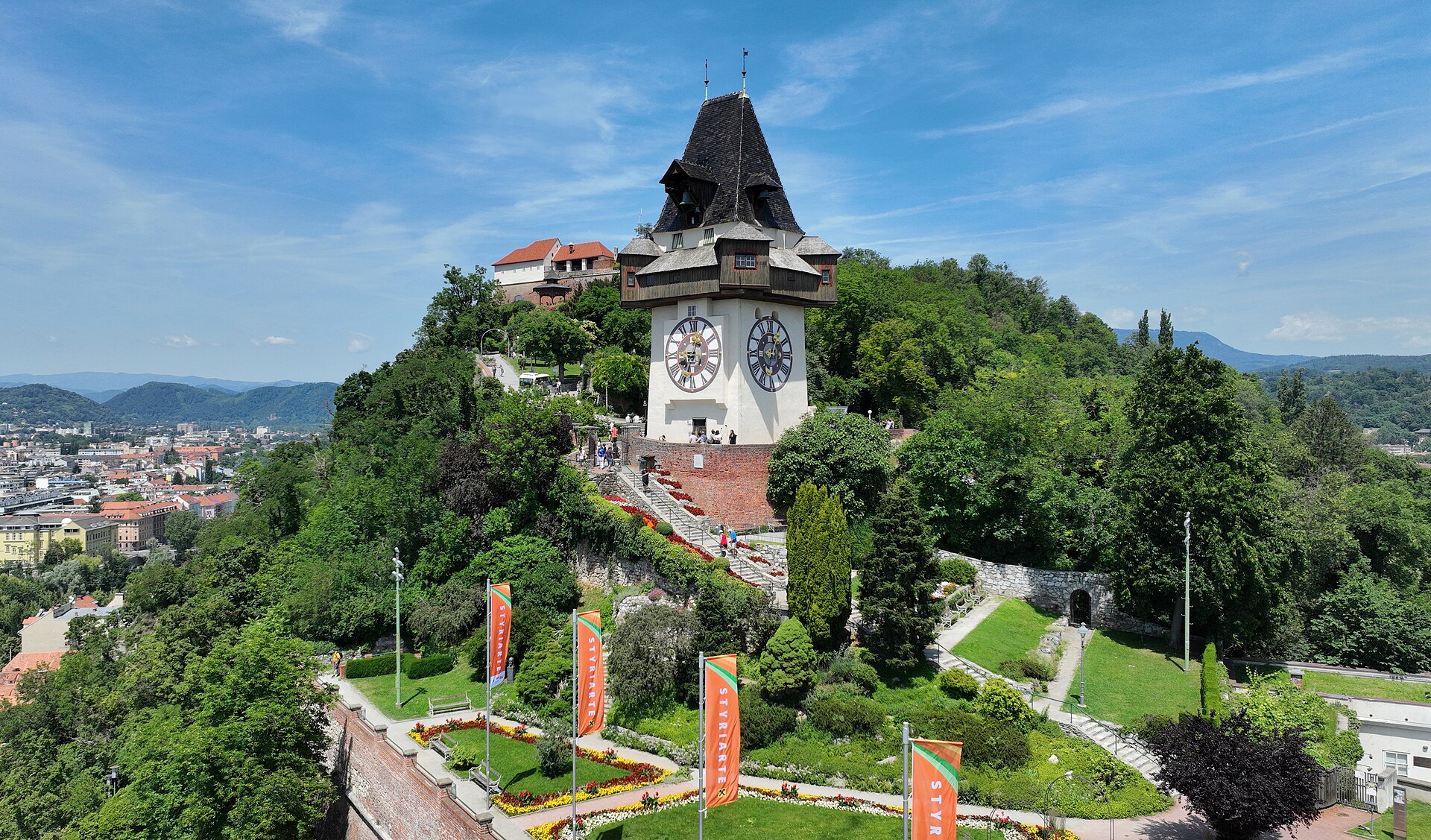
The Schlossberg (Castle Hill) is a 473-meter dolomite rock rising from the center of Graz, topped by the Uhrturm clock tower that has been the city's emblem since 1561. The hill once supported a fortress so formidable that Napoleon's armies, having conquered much of Europe, failed to take it by force during the 1809 siege — they only secured its demolition through treaty negotiations. The citizens of Graz ransomed the clock tower and the bell tower from destruction, and both stand today as the sole survivors of what was once Austria's strongest citadel. Today the Schlossberg is a landscaped public park with paths, a café, an open-air theater, and underground tunnels from World War II that now serve as exhibition spaces. The hill base is steps from Hauptplatz and the Kunsthaus Graz.
Fortification History
The fortress atop the Schlossberg was first documented in 1125 and grew over the centuries into Austria's most impregnable citadel. During the Napoleonic Wars, French forces besieged the hill in 1809 but failed to take it by assault — making it one of the few fortifications in Central Europe to resist Napoleon successfully. The fortress was only demolished after the Treaty of Schönbrunn mandated its destruction as a condition of peace. The citizens of Graz raised 2,988 florins to ransom the Uhrturm and Glockenturm from demolition — a remarkable act of civic pride that preserved the city's defining landmarks. During World War II, tunnels were carved deep into the dolomite rock as air-raid shelters, and these subterranean passages now serve as atmospheric exhibition and concert spaces.
Notable Rooms
Uhrturm (Clock Tower): 1561 tower with its famously reversed hands — the large hand shows hours, the small hand minutes — Graz's most photographed landmark. Glockenturm (Bell Tower): The other survivor of Napoleon's demolition, housing a 17th-century bell nicknamed "Liesl." Panoramic terrace: Unobstructed 360-degree views over the UNESCO old town, the Mur River, and the Styrian hills. WWII tunnels: Underground passages carved as air-raid shelters now host exhibitions and a concert venue. Kasematten amphitheater: Open-air stage in the former casemates used for summer concerts and performances. Starcke Haus: Hilltop restaurant and café with terrace views — a pleasant rest after the climb. Herberstein Garden: Quiet green space on the south side of the hill, away from the main tourist paths.
When to Visit
Schlossbergbahn (funicular): Runs daily from Kaiser-Franz-Josef-Kai, 2-minute ride. Lift (elevator): Glass elevator from Schlossbergplatz through the rock, free with Graz Card. Walking paths: Multiple routes, 15-20 minutes via steps or winding paths. 260 steps: The direct staircase carved into the rock face — the most dramatic approach. Schlossberg open: 24/7 (paths are lit at night); funicular runs approximately 8 AM-midnight.
Admission and Costs
Hill access: Free (all paths, viewpoints, and the clock tower exterior). Funicular (Schlossbergbahn): €2.20 single trip. Lift: €1.50 single trip. Graz Card: Covers funicular, lift, and all Graz museums. Underground tunnel tour: €8 adults (Schlossberg tunnels, approximately 45 minutes). Guided city tour including Schlossberg: €15-25 per person.
Tips for Visitors
Take the stairs, ride down: The 260-step staircase offers the best experience going up; take the lift or funicular for the easy descent. Sunset is spectacular: The west-facing panorama catches golden-hour light over the old town rooftops. Night visits: The hill is open and lit after dark; the clock tower is illuminated and the city views sparkle. Combine with old town: The Schlossberg base is steps from Hauptplatz and the old town's painted courtyards. Wear comfortable shoes: Paths are steep in places and cobblestoned; the rock staircase is exposed. Clock tower photo spot: The best angle is from the terrace just below, looking up with the old town rooftops as background.